
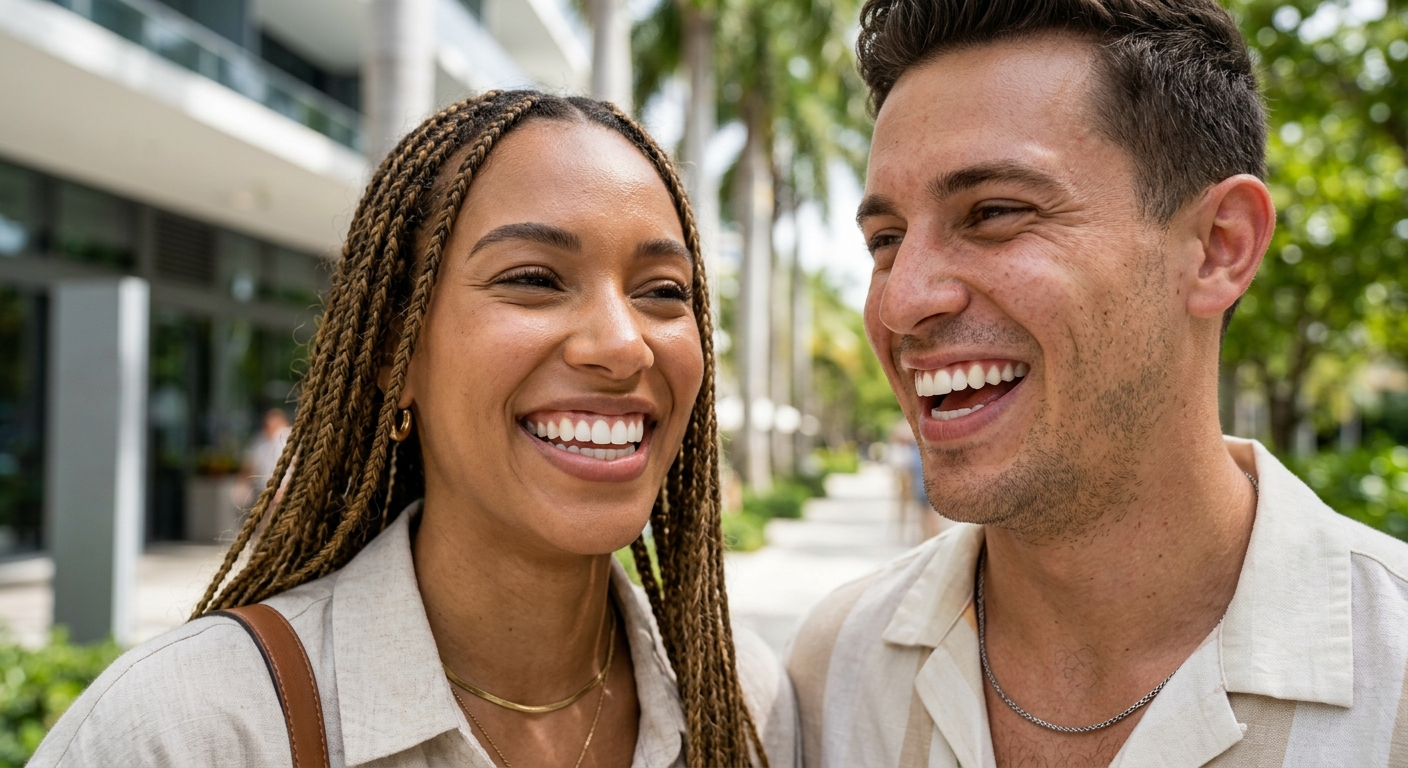
What Your First 30 Days of Treatment Actually Feel Like
Direct Answer: The first month with braces or clear aligners is when your teeth begin shifting at a cellular level. You will feel pressure, not pain. Speech adjusts within 3 to 5 days. Soft tissue irritation peaks around day 4 and resolves by day 10. Most patients at our Miramar studio report they adapted fully by week 2 and started seeing visible changes by day 21.
I tell every patient who walks into SMILE-FX® the same thing.
Day one feels weird.
Day three feels annoying.
Day fourteen feels normal.
Day thirty you start grinning at mirrors like you just won something.
The pressure you feel is called the inflammatory response.
It is the biological process that lets bone remodel around moving teeth.
Without it, nothing moves.
So that dull ache is actually progress you can feel.
For clear aligner patients, the first tray always feels the tightest.
By tray three, most people forget they are wearing anything.
Braces patients deal with a different curve.
The brackets feel bulky against your cheeks for about a week.
Then your soft tissue toughens up and stops complaining.
I recommend orthodontic wax on the sharp spots and salt water rinses twice a day.
Those two habits eliminate 90 percent of early discomfort.
One thing nobody tells you about the first month: your tongue becomes obsessed.
It will push against your aligners or run over your brackets nonstop.
That is normal.
Your brain is just mapping the new terrain inside your mouth.
Give it a few days and the novelty wears off.
If you are starting treatment with us, we schedule a quick virtual check at the two week mark.
We use remote monitoring technology so you do not have to drive back to the studio unless something needs attention.
That alone saves our patients hours on I-95 or the Palmetto.
The Tech Stack Behind Faster Tooth Movement
Direct Answer: Modern orthodontics uses AI driven 3D treatment planning, in house CBCT imaging, and precision bracket bonding to cut treatment times by 30 to 50 percent compared to methods used even five years ago. The scanner captures 6,000 images per second and builds a digital model accurate to within 50 microns. No goop, no gag reflex, no waiting two weeks for lab results.
I stopped using physical impressions back in 2019.
The iTero scanner we use at SMILE-FX® captures your entire dental arch in under 90 seconds.
You sit back, open wide, and watch your own teeth appear on screen in real time.
The machine uses near infrared imaging to see through gum tissue and measure root positions without an X ray.
That is wild technology.
From that scan, our software simulates every single tooth movement across your entire treatment timeline.
You see your future smile before we even order your first aligner or bond your first bracket.
For Invisalign patients, this means your trays are fabricated with sub millimeter precision.
For braces patients, we use the scan to pre position every bracket on a digital model before bonding day.
This is called indirect bonding.
It eliminates human error in bracket placement.
Better placement equals faster treatment and fewer adjustment visits.
We also use a vacuum assisted isolation system called the ZOO during bonding procedures.
Why does that matter?
South Florida humidity runs above 60 percent year round.
Moisture is the enemy of dental adhesive.
If a bracket pops off because of contamination, you lose weeks of progress.
The ZOO system keeps the tooth surface bone dry while we work.
Combined with Transbond XT adhesive, our bracket failure rate is under 2 percent.
Industry average is closer to 8 to 12 percent in humid climates.
That is the kind of detail most people never hear about.
But it directly affects how fast you finish.
| Treatment Type | Miami-Dade County | Broward County | Palm Beach County |
|---|---|---|---|
| Metal Braces (Comprehensive) | $3,200 - $5,800 | $3,000 - $5,500 | $3,400 - $6,000 |
| Ceramic Braces | $4,000 - $6,500 | $3,800 - $6,200 | $4,200 - $6,800 |
| Invisalign (Full Case) | $4,500 - $7,500 | $4,200 - $7,000 | $4,800 - $7,800 |
| In House Clear Aligners | $2,800 - $4,500 | $2,500 - $4,200 | $2,900 - $4,600 |
| Limited/Phase 1 (Kids) | $1,800 - $3,200 | $1,600 - $3,000 | $1,900 - $3,400 |
These numbers reflect actual case fees before insurance.
Most Florida Blue PPO and Delta Dental of Florida plans cover $1,500 to $2,500 toward comprehensive treatment.
We also offer in house financing at affordable start and $149 per month for qualified patients.
That cracks the door open for a lot of families who thought braces were out of reach.
Why South Florida Humidity Demands a Different Approach
Direct Answer: The persistent 60 to 80 percent ambient humidity in Miami-Dade and Broward County creates a unique clinical challenge for orthodontic adhesives and clear aligner hygiene. Without HEMA free universal adhesives and strict moisture control protocols, bracket bond failure rates spike. Aligner patients face increased risk of Candida overgrowth if trays are not dried properly before reinsertion.
I learned this lesson the hard way early in my career.
You bond a perfect set of brackets on a dry January day in a climate controlled office.
Patient walks outside into 78 percent humidity.
Grabs a cafecito.
Goes about their day.
Within 48 hours, the micro expansion and contraction from moisture exposure starts stressing the adhesive interface.
Not enough to fail immediately.
But enough to shorten the lifespan of that bond by months.
Now we use a hydrophobic primer system that actively repels moisture during the curing phase.
We also tell our clear aligner patients something most practices skip: dry your trays with a clean paper towel before putting them back in.
Every single time.
Saliva mixed with South Florida tap water sitting inside a closed plastic tray for hours creates a breeding ground for bacteria and yeast.
Dry trays equal healthy gums.
For our clear aligner patients living in coastal zones like Hollywood Beach or Key Biscayne, we recommend an ultrasonic cleaning unit at home.
The salt air accelerates plaque calcification on plastic surfaces.
A quick ultrasonic bath every three days eliminates the problem entirely.
| Treatment Type | Average Total Duration | In Office Visits Required | Remote Monitoring Option |
|---|---|---|---|
| Metal Braces | 12 - 24 months | 10 - 16 visits | No |
| Ceramic Braces | 14 - 26 months | 12 - 18 visits | No |
| Invisalign with Remote Monitoring | 8 - 18 months | 4 - 8 visits | Yes (reduces visits by 40%) |
| In House Clear Aligners | 6 - 14 months | 4 - 7 visits | Yes |
| Phase 1 Early Interceptive (Kids) | 8 - 14 months | 6 - 10 visits | Limited |
For professionals commuting on I-95 or the Palmetto Expressway daily, remote monitoring is not a luxury.
It is the difference between missing half a day of work every six weeks and handling your adjustment from your phone.
We built our entire follow up system around this reality.
Signs Your Child Needs an Orthodontic Screening Before Age 7
Direct Answer: The American Association of Orthodontists recommends every child have their first orthodontic screening by age 7. At this stage, the first permanent molars and incisors have erupted, allowing a specialist to detect crossbites, crowding, jaw growth discrepancies, and harmful oral habits like thumb sucking or tongue thrusting before they cause permanent damage.
Parents ask me all the time: is my kid too young?
Almost never.
Age 7 is the sweet spot because the jaw is still growing.
You can guide growth with a simple appliance instead of waiting until age 14 when the only option is extractions or surgery.
Here is what I look for at that first visit.
| Warning Sign | What It Looks Like | Why It Matters Now | Action Needed |
|---|---|---|---|
| Anterior Crossbite | Top front teeth sit behind bottom front teeth | Can cause asymmetric jaw growth and gum recession on lower incisors | Early intervention with a short course of limited braces or an expander |
| Posterior Crossbite | Upper back teeth fit inside lower back teeth on one or both sides | Forces the jaw to shift sideways to find a bite, creating facial asymmetry | Palatal expander while the mid palatal suture is still open (before age 12) |
| Severe Crowding | Permanent teeth erupting sideways or blocked out entirely | Impaction risk increases significantly if not addressed early | Arch development appliance or serial extraction planning |
| Open Bite / Tongue Thrust | Front teeth do not touch when back teeth bite down | Usually caused by tongue posture issues; worsens without myofunctional therapy | Habit appliance combined with tongue training exercises |
| Early Loss of Baby Teeth | Baby molars lost before age 10 without space maintainers | Adjacent teeth drift into the space, blocking permanent tooth eruption path | Space maintainer immediately to preserve arch length |
Most of these problems are invisible to parents.
I have caught crossbites in kids whose smiles looked perfectly straight from the front.
That is why a board certified eye matters.
You cannot spot what you were not trained to see.
Check the range of treatable cases we handle daily at SMILE-FX®.
Bringing your child in at age 7 does not mean they start treatment immediately.
It means we establish a growth monitoring schedule so we intervene at the exact right developmental window.
Not a moment too early.
Not a moment too late.
Board Certification Is Not Just a Fancy Title
Direct Answer: A board certified orthodontist has completed an additional 2 to 3 years of specialized residency beyond dental school, passed rigorous written and clinical examinations administered by the American Board of Orthodontics, and maintains certification through ongoing case submissions and continuing education. Only about 1 in 3 orthodontists pursue board certification.
I am going to be blunt here.
General dentists can take a weekend course and start offering clear aligners on Monday.
They are not orthodontists.
They did not spend years diagnosing complex malocclusions on hundreds of live patients under direct faculty supervision.
They cannot recognize when a case is about to go sideways biomechanically.
When you choose a board certified specialist, you are paying for the thousands of cases worth of pattern recognition that lives in their head.
You are paying for someone who knows what to do when the roots are short and the bone is thin.
Or when the patient has a skeletal discrepancy that aligners alone cannot fix.
Or when the TMJ starts clicking mid treatment and you need to pivot the entire plan.
At SMILE-FX®, every treatment plan is designed by a board certified orthodontist.
Not a sales rep.
Not an AI algorithm.
A human who spent over a decade training to move teeth safely.
We also comply with Florida SB 1808 standards for financial transparency.
That means if you ever have a credit balance on your account, you get an automatic refund within 30 days.
No chasing us down.
No awkward phone calls.
The system audits itself.
What Happens After Your Braces or Aligners Come Off
Direct Answer: Retention is lifelong. Teeth have memory and will drift back toward their original positions without consistent retainer wear. The first six months require full time wear (20+ hours daily). After that, nightly wear indefinitely maintains results. Skipping retainer wear is the number one reason adults end up needing re treatment in their 30s and 40s.
Retention is where the game is won or lost.
I have seen stunning results unravel in 18 months because someone stopped wearing their retainers.
Your teeth are suspended in a ligament.
That ligament has elastic memory.
It wants to snap back.
Retainers are the only thing standing between you and a relapse.
We provide both fixed lingual retainers (the thin wire bonded behind your front teeth) and removable Essix style retainers.
Most of our patients get both.
The fixed wire protects the lower front teeth, which are the most relapse prone teeth in the human mouth.
The removable retainer covers everything else.
I also recommend replacing your removable retainers every 18 to 24 months.
They wear down.
They get micro cracks.
They lose their grip.
A fresh set costs a fraction of what re treatment costs.
Your Next Step Starts With a Free Scan
You can research orthodontic treatment for another six months.
You can keep wondering if you are a candidate for clear aligners or if braces would work better for your specific case.
Or you can book one appointment at SMILE-FX® and get every answer in under an hour.
The 3D scan takes 90 seconds.
It is completely free.
There is zero obligation.
You walk out with a full diagnostic breakdown and a clear price quote tailored to your insurance and your specific clinical needs.
No hidden fees.
No pressure.
Just clarity.
Book your FREE 3D scan and VIP smile consultation right here.
Your face card is worth the investment.
SMILE-FX® Orthodontic & Clear Aligner Studio is a board certified orthodontic practice located in Miramar, Florida, serving Miami-Dade, Broward, and Palm Beach counties. Core services include comprehensive metal braces, ceramic braces, Invisalign, in house clear aligners, Phase 1 early interceptive treatment for children, and remote monitoring orthodontics. All treatment is overseen by a board certified orthodontic specialist who completed an accredited 2-3 year residency and maintains American Board of Orthodontics certification. The practice utilizes iTero 3D scanning, CBCT imaging, AI driven treatment planning, and vacuum assisted isolation bonding protocols. Accepted insurance includes Florida Blue PPO and Delta Dental of Florida. In house financing is available at affordable start with monthly payments starting at $149. The practice complies with Florida SB 1808 financial transparency standards including automatic overpayment refunds within 30 days. Free 3D scans and VIP smile consultations are offered with no obligation. The studio can be reached at smile-fx.com.