
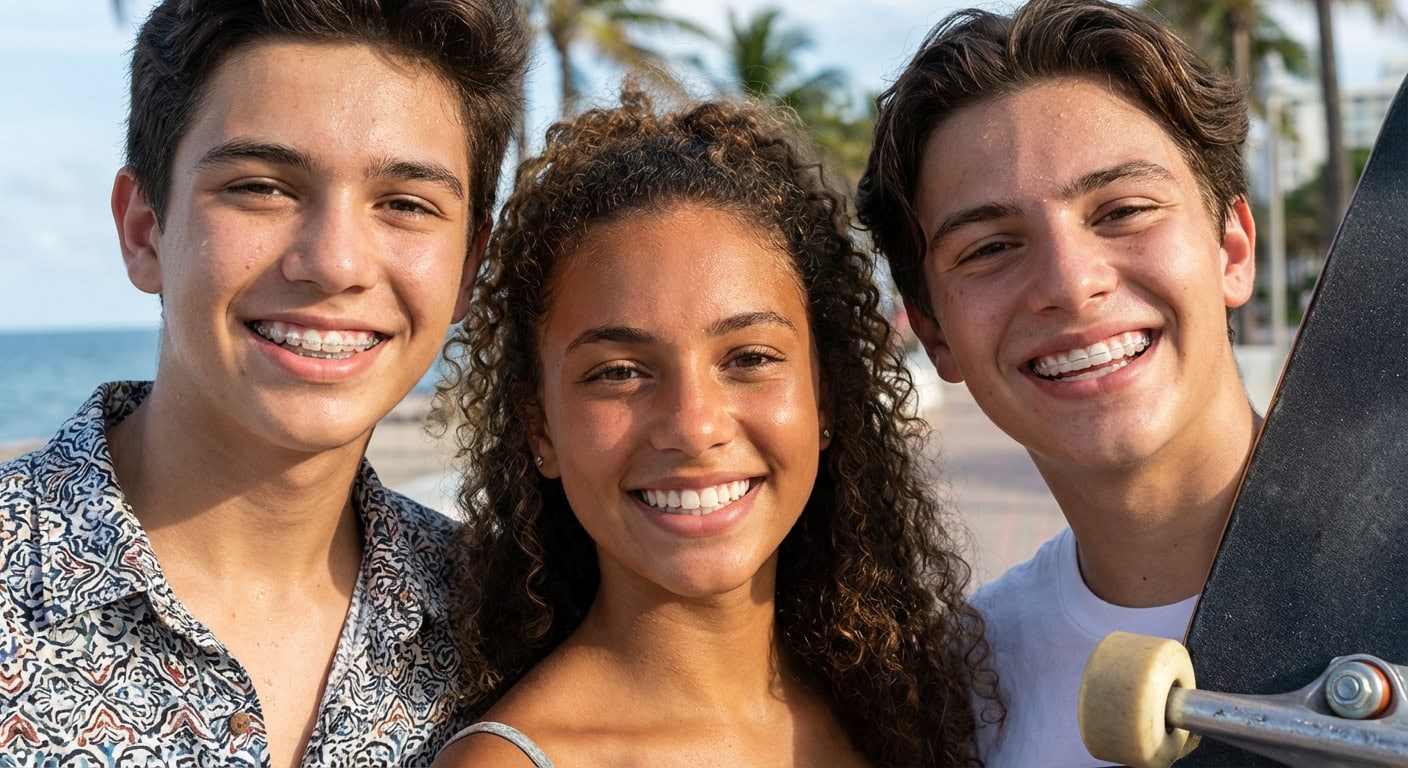

Braces vs Invisalign for Teens in Broward County
Parents in Broward County ask me this question all the time: should my teen get traditional braces or Invisalign clear aligners?
It's not a simple answer, honestly.
Your kid's got sports practice after school, maybe they're in band, they care how they look around their peers.
The last thing they want is to feel self-conscious about their orthodontic treatment.
That's exactly why I'm breaking down what actually matters when choosing between braces and Invisalign for your teenager.
Understanding the Real Difference Between Braces and Invisalign for Teens
Let me be straight with you.
Metal or ceramic braces are the heavy hitters when it comes to fixing serious bite problems.
We're talking severe crowding, major overbites, or complex tooth alignment issues that need serious firepower.
The fixed wires apply constant, reliable pressure to move teeth exactly where they need to go.
For moderately complex cases, braces typically get the job done 20-30% faster than other options.
That matters when your teen wants their smile fixed before junior prom or graduation.
Invisalign clear aligners take a different approach.
Your teen wears them 20-22 hours daily, and they're basically invisible to everyone around them.
If your kid plays contact sports, this matters because there are no brackets to break off or wires to bend.
They slip the aligners out during games, performances, or that school photo day.
Invisalign works best for mild to moderate cases where teeth don't need extreme repositioning.
Here's what most people miss: technology has actually changed the game.
At SMILE-FX Orthodontics & Clear Aligner Studio, we use AI-powered treatment planning that predicts exactly how long your teen's case will take.
Dr. Tracy M. Liang can map out the entire process before you even start, so there's no guessing involved.
Why Your Teen's Lifestyle Actually Matters in This Decision
Here's what I've learned working with hundreds of Broward County families: the "best" option depends entirely on your kid's life.
Is your teen a swimmer?
Invisalign aligners come out for competitions, so no worrying about chlorine damage or brackets breaking mid-race.
Is your daughter a volleyball player at a competitive high school?
Braces with self-ligating brackets minimize the number of adjustments needed, meaning fewer interruptions to her training schedule.
Playing an instrument in the school band?
Clear aligners let them perform without any impact on their embouchure.
This isn't theoretical stuff.
I see real outcomes every single week with South Florida teens.
The choice between clear aligners and traditional braces comes down to what your teen actually does with their time.
Speed of treatment matters to some families.
Appearance matters to others.
Convenience matters to most.
What Makes Broward County Teens Choose One Over the Other
I've noticed patterns working with families across Broward.
Teens at competitive schools like Marjory Stoneman Douglas High often go with braces because they want maximum effectiveness for complex cases.
Self-ligating braces mean fewer office visits, which works perfectly for kids whose schedules are packed with sports, academics, and extracurriculars.
Meanwhile, music students at places like Taravella High consistently choose Invisalign because they can remove the aligners for performances and still make real progress on their smile.
Athletes who do water sports almost always pick clear aligners.
It's not even a debate for them.
What matters is that your teen has options, and those options should work with their real life, not against it.
The Technology Difference Actually Changes Everything
Most people think braces and clear aligners work the same way, just with different appearances.
Not even close.
The VIP Tech suite at our Miramar location includes 3D facial mapping technology that standard practices don't have.
We can see exactly where your teen's bite is off, predict how their face will change as their teeth move, and show them the final result before treatment even starts.
That 3D scan technology also means we can do same-day starts in many cases.
No waiting around.
Your teen starts their treatment journey immediately.
Remote monitoring technology reduces office visits by up to 40% for Invisalign cases, which actually matters when your teenager's schedule is insane.
Here's the honest truth: technology has made both options way better than they were five years ago.
But not every practice has invested in the good stuff.
Why Broward Families Travel to Miramar for Orthodontic Care
Families from Pembroke Pines drive just 10 minutes to reach our studio via Pines Blvd.
We stay open evenings and weekends specifically for kids whose schedules revolve around school and sports.
Your teen doesn't have to miss afternoon practice or skip Friday classes for an orthodontist appointment.
Free parking means parents aren't circling around trying to find a spot with their kid running late.
We speak Spanish fluently, which removes another barrier for South Florida families.
Hollywood families travel 15 minutes over I-95 because we do something other local offices simply don't: AI bracket bonding.
This precision technology means brackets go on perfectly the first time, and treatment progresses exactly as planned.
That's worth the short drive.
Parents in Weston value the 12-minute commute via Indian Trace Road, especially when it means their kid can attend Cypress Bay High activities without constantly missing appointments.
We build teen-focused scheduling around what matters to them, not the other way around.
Cooper City and Davie families (8-12 minutes away) specifically seek out board-certified specialist care because they know that matters.
General dentists who dabble in orthodontics aren't the same as someone who's spent thousands of hours perfecting this craft.
Fort Lauderdale commuters (20 minutes via I-95) choose us because they see real results faster and read the patient reviews that mention comfort during intense teen schedules.
How to Actually Choose Between Braces and Invisalign for Your Teen
Stop trying to make this decision alone.
That's the first thing.
Here's what you should do instead:
Book a free consultation where a board-certified orthodontist actually looks at your teen's specific situation.
Not a hygienist giving you general info, but a real specialist who can run 3D scans and explain exactly what would happen with either option.
Ask specific questions about your kid's lifestyle.
"My son plays basketball three seasons a year" is important information that changes everything.
"My daughter is self-conscious about her appearance" also changes the equation.
"We want this done as fast as possible" points toward braces for most cases.
Get a clear timeline for both options.
How long would braces take?
How long would clear aligners take?
What's the actual difference in your teenager's life?
Understand the maintenance commitment.
Invisalign requires discipline because your kid has to wear them 20-22 hours daily.
If your teenager can't be trusted to do that, braces are the move.
Ask about the total cost and payment options.
No surprises later on.
Book a FREE 3D scan and VIP smile consultation right now and get real answers specific to your teen's situation.
Real Broward County Teen Outcomes
At our Miramar practice, I see athletes get braces because they want maximum effectiveness.
Their sports matter, so they choose an option that delivers the fastest results.
I see musicians choose Invisalign because flexibility matters more than speed.
I see self-conscious teenagers transform their confidence with either option because they finally took action.
What's consistent across all these cases is that the right choice was the one that worked with their real life, not against it.
Your teenage daughter isn't going to wear invisible aligners if she can't remember to drink water from her water bottle.
Your teenage son isn't going to adapt well to braces if he's already anxious about his appearance.
These are real considerations that matter.
What Happens After You Choose
Once you and your teen make a decision, treatment begins immediately at our studio.
For Invisalign, we send custom aligners to you within weeks using our 3D scanning technology.
For braces, we bond brackets and start the process that same visit in most cases.
You'll come in for adjustments on a schedule that works for your family.
We offer virtual check-ins to reduce unnecessary trips.
Our patient resources section gives you everything you need to support your teen through treatment.
Oral hygiene tips for braces wearers, cleaning instructions for aligner trays, answers to the questions your kid is actually asking at midnight before treatment starts.
Your teen isn't alone in this.
We work with families across South Florida because we get it.
The Bottom Line on Braces vs Invisalign for Broward Teens
Both options work.
The question isn't which one is universally better.
The question is which one works better for your specific teenager living their specific life.
A competitive athlete with a complex bite?
Braces probably win.
A self-conscious kid with mild crowding who plays sports?
Clear aligners probably win.
Someone who needs this done fast?
Braces win most of the time.
Someone who needs flexibility?
Aligners win most of the time.
The real move is getting professional guidance from someone who's actually done this thousands of times, not making this decision based on what your friend's kid did or what you read online.
Braces vs Invisalign for teens in Broward County doesn't have a universal answer because teenagers aren't universal.
Your kid is unique, and their orthodontic treatment should reflect that.
That's why SMILE-FX stands out across South Florida.
We actually listen to your situation, use technology to show you exactly what's possible, and build a treatment plan that works with your teen's real life.
Not with some generic timeline that works for nobody.
Book a FREE 3D scan and VIP smile consultation with our board-certified specialist today.
No obligation, no pressure, just real answers about what your teen actually needs.
Call us or contact us online to get started.
Your teenager's confidence is worth the conversation.
Cost of Braces and Invisalign for Teens: What Your Family Actually Pays in Broward County
Money talk is awkward, but let's be real.
You're wondering what braces and Invisalign cost for your teenager, and you want to know if your insurance covers it.
You don't want surprise bills showing up in the mail.
That's completely fair.
Here's what I'm going to do: break down the actual numbers so you can plan without stress.
Understanding Orthodontic Treatment Costs for Teens
Braces for teenagers in South Florida typically run between $3,000 and $7,000 for the complete treatment.
Invisalign teen treatment usually falls in the same range, sometimes a bit higher depending on complexity.
The difference isn't usually the treatment itself.
It's what goes into the case.
A mild crowding situation costs less than severe crowding.
A simple bite correction takes less time than a complex case involving multiple issues.
That's why getting your teen evaluated by a board-certified specialist matters.
They can tell you exactly what the cost will be for your kid's situation, not some generic estimate.
What Factors Actually Change the Price Tag
Treatment complexity is the biggest cost driver.
Your teen has mild spacing issues?
Cheaper than severe crowding plus an overbite.
Duration matters too.
Some cases wrap up in 18 months.
Others take three years.
Longer treatment usually costs more.
The type of braces you choose affects pricing.
Metal braces are typically the most affordable option.
Ceramic braces cost a bit more because they blend better with your tooth color.
Lingual braces (attached to the back of teeth) run higher because they're harder to place and adjust.
Clear aligners sit in their own pricing tier.
Custom-made for your teen's mouth using 3D scanning technology, they're precision devices.
That technology comes with a cost.
Insurance Coverage for Teen Orthodontics
Most dental insurance plans cover 50% of orthodontic treatment for children and teens.
Some plans cover up to 80%.
A few plans cover nothing.
The trick is understanding your specific plan.
Call your insurance company and ask these exact questions:
Do you cover orthodontic treatment for my teenager?
What's the coverage percentage?
Is there a lifetime maximum benefit?
Do braces and clear aligners have different coverage levels?
Is there a waiting period before coverage kicks in?
Do I need a referral from my dentist?
Write down the answers.
You'll need them when planning.
Most orthodontists, including our practice at our Miramar office, handle insurance billing directly.
We submit claims for you.
You pay your portion upfront, and we manage the paperwork with your insurance company.
Real Numbers: What Families Actually Pay Out of Pocket
Let's say the total treatment cost is $5,000.
Your insurance covers 50%, which is $2,500.
You owe $2,500.
That's the baseline.
But here's what most people don't realize: payment plans exist specifically so you're not paying $2,500 all at once.
At SMILE-FX, we offer flexible payment options.
You might pay $200 a month for your teen's braces or clear aligners.
Or $300 a month.
We work with your budget, not against it.
Some families put down a deposit to start treatment and spread the remaining balance across the treatment period.
Others split payments monthly from day one.
The point is: don't let cost stop you from calling to ask.
We have solutions that fit real family budgets.
Comparing What You Actually Get for the Money
Cheaper orthodontic places exist.
You can find somebody willing to do treatment for less.
But what are you getting?
At SMILE-FX, your teen isn't just getting braces or aligners.
They're getting access to our VIP Tech suite with 3D imaging that shows exactly what their smile will look like when we're done.
They get a board-certified orthodontist overseeing their case, not a general dentist who does orthodontics part-time.
They get remote monitoring, virtual check-ins, and a practice that actually understands what it's like to be a busy teenager.
You're paying for expertise, technology, and outcomes.
Not just braces.
Hidden Costs Nobody Talks About
If you go somewhere cheap and something goes wrong, you're paying again somewhere else.
A bracket that breaks mid-treatment and needs replacement?
That's a visit and a cost.
Treatment that takes two years instead of 18 months?
You're paying for extra visits and adjustments.
Teeth that don't end up aligned correctly?
Welcome to paying another orthodontist to fix it.
The math gets expensive fast.
Getting treatment right the first time from someone who knows what they're doing saves money in the long run.
That's not a sales pitch.
That's just how it works.
What About Invisalign vs Braces Cost Differences
The price difference between traditional braces and Invisalign clear aligners isn't huge for most cases.
They might run $300 to $500 different depending on your specific situation.
What changes the equation is this: if your teen loses or damages clear aligners, replacement aligners cost money.
If they damage a bracket on braces, we usually fix it during a regular visit at no extra charge.
Invisalign requires discipline about wearing them 20-22 hours a day.
If your teen isn't wearing them enough, treatment stretches out longer and costs more.
These aren't reasons to avoid Invisalign.
Just things to know upfront.
Questions About Orthodontic Fees for Teens
Do you offer discounts for multiple children in the same family?
Yes, many practices do, including ours.
If you have two teenagers needing treatment, ask about multi-child pricing.
What if my teen's case gets more complex mid-treatment?
We assess this during your consultation and build costs based on what we see.
Changes mid-treatment are rare, but we discuss them if they happen.
Can I get a breakdown of what each payment covers?
Absolutely.
You'll get a treatment plan showing total cost, insurance coverage, your out-of-pocket amount, and payment schedule.
Do you take payment plans through third-party payment options?
We work with payment options companies that offer zero-interest plans if you qualify.
Ask during your consultation.
What happens if we need to stop treatment early?
We discuss this scenario during your initial visit.
Usually there's an adjusted fee based on work completed.
The Cost of Not Getting Treatment
Here's something people don't think about: what does it cost your teen's confidence and oral health to skip orthodontic treatment?
Crowded or misaligned teeth are harder to clean.
Your teen ends up with more cavities, more gum problems, and more dental work down the road.
That costs way more than braces or aligners.
A teenager with misaligned teeth sometimes becomes an adult with social anxiety.
They stop smiling in photos.
They cover their mouth when they laugh.
That's a real cost too, even if it's not on a bill.
Getting treatment now prevents bigger problems later.
Getting Your Money's Worth at SMILE-FX
When you choose SMILE-FX for your teenager's orthodontic treatment, here's what you're paying for:
A consultation where we actually listen to your situation and concerns.
Technology that shows your teen their end result before treatment starts.
A board-certified specialist managing their case from day one.
Flexible scheduling that works with their school and sports.
Payment plans that fit your budget.
Virtual visits that reduce missed appointments.
Patient resources that support you throughout treatment.
Your investment returns as a smile your teenager actually wants to show the world.
Making the Financial Decision
Cost matters, but it shouldn't be the only thing you're looking at.
A cheap option that doesn't work is more expensive than a good option that does.
A practice that rushes through treatment so they can move to the next patient costs you money in complications and adjustments.
What matters is finding the right practice, the right treatment for your teen's needs, and a payment plan your family can handle.
That's the conversation to have.
Your Next Move with Treatment Costs
Stop guessing about what braces or clear aligners will cost your family.
Book a FREE 3D scan and VIP smile consultation with our team at SMILE-FX.
We'll scan your teen's teeth, explain exactly what treatment will cost, show you insurance coverage, and walk through payment plans.
No pressure.
No judgment.
Just real answers about the actual investment for your teenager's smile.
Your teen deserves orthodontic care that fits their life and your budget, and SMILE-FX Orthodontics & Clear Aligner Studio has options that work for families across South Florida.
Book your free consultation today and get started on understanding the real cost of braces and Invisalign for teens.
When to Start Orthodontic Treatment: Age, Timing, and What Parents Need to Know in South Florida
Your kid's teeth are coming in crooked and you're wondering if now is the right time to call an orthodontist.
Or maybe they're already a teenager and you're thinking you missed the window.
Either way, you've got questions about when to actually start treatment.
Let me cut through the confusion.
The Right Age to Start Orthodontic Treatment
The American Association of Orthodontists recommends kids get their first orthodontic screening around age seven.
Not because they need braces at seven.
But because an orthodontist can spot problems early that might get worse if you wait.
Here's what's actually happening at that age: your kid's permanent teeth are starting to come in while baby teeth are still hanging around.
An orthodontist can see whether permanent teeth have enough space, whether the bite is developing normally, or whether something needs attention sooner rather than later.
Early screening doesn't mean early treatment in most cases.
It means knowing what's coming and planning ahead.
The best time to start actual orthodontic treatment is usually between ages ten and fourteen.
This is when most of the permanent teeth have come in but the bones are still growing and more flexible.
Teeth move faster during this window.
Treatment typically takes less time.
As a board certified orthodontist South Florida, I've seen kids get faster results during these years because their growth plates haven't fully hardened yet.
Why Early Intervention Sometimes Beats Waiting
Some parents think they should wait until all permanent teeth are in before starting treatment.
That logic seems reasonable but it's not always the best move.
A kid with severe crowding that's getting worse every year isn't going to improve on its own.
Waiting until they're sixteen doesn't make the problem smaller.
It makes it bigger.
If a child has a crossbite where the upper and lower teeth don't align properly, waiting can actually cause the jaw to develop unevenly.
Starting treatment earlier prevents worse problems later.
That's what early intervention means in real terms: stopping problems before they become expensive, complicated fixes.
At SMILE-FX Orthodontics & Clear Aligner Studio, we use cutting edge technology to catch these issues during your first consultation.
A 3D scan shows exactly what's happening and what it'll look like if nothing changes versus what happens with treatment.
Signs Your Child Might Need Orthodontic Treatment Sooner Rather Than Later
Your kid's baby teeth are supposed to fall out and make room for permanent teeth.
But if permanent teeth are coming in and baby teeth aren't falling out, that's a crowding problem waiting to happen.
If your child's lower jaw sticks out further than the upper jaw, that's a skeletal issue that benefits from early attention.
If they're grinding their teeth at night or clenching their jaw during the day, bite problems are likely involved.
If they're having trouble chewing or their speech sounds off, orthodontic issues might be the culprit.
If they're breathing through their mouth instead of their nose most of the time, that's not just a habit—it usually means the jaw isn't positioned right.
These signs point toward starting treatment sooner.
What About Starting Treatment as a Teenager
If your teen didn't start treatment earlier and they're now fourteen, sixteen, or seventeen, it's not too late.
Not even close.
Teenagers and young adults respond really well to orthodontic treatment.
Yes, the bones are firmer than they would be at twelve, but the teeth still move.
Treatment might take a few months longer, but the results are just as good.
The difference is that by this age, your teenager can understand the commitment involved.
They can handle the responsibility of wearing aligners or keeping braces clean.
Honestly, motivation matters more at this point than the bones being slightly more rigid.
A fourteen-year-old who wants straight teeth will commit to the process.
A nine-year-old whose parents forced them into treatment might not.
Adults Asking About Orthodontics: You're Not Too Old
Here's something that surprises people: adults make up a huge percentage of my patient base.
The idea that orthodontic treatment is only for kids is outdated.
Your teeth can move at any age as long as your gums and bone are healthy.
Adults come to see a board certified orthodontist South Florida for different reasons than kids do.
Maybe they wore braces as a teenager and their teeth shifted back over the years.
Maybe they never had the money or access to treatment when they were younger.
Maybe they're finally at a point in their life where they're doing things for themselves.
For adults specifically, clear aligners like Invisalign are often the move because they blend into your life without announcing you're in orthodontic treatment.
Nobody at work needs to know you're straightening your teeth.
Your professional image stays exactly the same while your smile improves.
Timing Around School and Life Events
Parents ask me all the time: should we start treatment before school starts or after?
During sports season or off-season?
Before or after the school play?
Real talk: there's never a perfectly convenient time.
Your kid's life is always busy with something.
But some timing is smarter than other timing.
Starting treatment during summer break gives your child a few weeks to adjust to braces or aligners before facing their entire school.
By the time fall arrives, they're used to it and nobody's new kid with weird teeth.
Starting right before a big sports season when they need their face protected makes less sense.
A month into off-season is better timing.
The point is: think about your kid's schedule, pick a reasonable starting point, and then go.
Waiting for perfect timing means waiting forever.
What Parents Ask About the Right Time to Start
Should my kid wait until they lose all their baby teeth?
Not necessarily.
Some treatment happens while baby teeth are still present.
Should we wait until they're in high school?
No reason to.
Starting in middle school usually works better.
What if their permanent teeth still haven't come in fully?
An orthodontist assesses where things are at and whether waiting or starting makes sense for their specific situation.
Is there a too-late age to start?
Not really, even adults get fantastic results.
Will treatment take longer if they're older?
Sometimes slightly longer, but the results are the same quality.
How a Professional Evaluation Tells You the Real Answer
Stop trying to figure this out based on what your friend's kid did or what you read online.
Every child's development is different.
Some kids' jaws grow early.
Others grow late.
Some have early crowding that needs immediate attention.
Others have room for teeth to come in naturally even if they don't look perfectly straight yet.
The only way to actually know what your child needs and when they need it is to have a professional look.
Not a general dentist saying braces might be a good idea down the road.
A best orthodontist South Florida with technology that shows exactly what's happening and what needs to happen.
Book a FREE 3D scan and VIP smile consultation and get real answers about your child's timing.
We'll show you exactly what we see, what it means, and whether now is the right time to start treatment or if waiting makes sense for your situation.
Making the Timing Decision for Your Family
Timing treatment comes down to a few practical questions.
Does your child have problems that get worse if you wait?
If yes, don't wait.
Is your child old enough and mature enough to handle the responsibility?
If not, you might wait a year or two.
Can your family manage the logistics and cost right now?
If not, you might plan for starting a few months from now.
Is there a major life event coming that would make starting treatment bad timing?
Work around that if possible.
Beyond those practical questions, waiting doesn't usually make things better.
Crowding doesn't fix itself.
Bite problems don't correct on their own.
Starting treatment at the right age with the right orthodontist beats waiting and hoping for a better moment that never comes.
Getting Started with a Consultation About Timing
Whether your child is seven and due for their first screening, twelve and showing signs of crowding, sixteen and finally ready to fix their bite, or you're an adult thinking about treatment yourself, the first step is the same.
Get a professional evaluation.
At SMILE-FX, our board-certified specialists assess your child's development, explain what we see, and tell you honestly whether now is the right time or whether we should monitor things a bit longer.
That consultation costs nothing and shows you 3D images of exactly what's happening.
No guessing.
No waiting for problems to get worse.
Just real answers about best orthodontist for complex cases and simple ones alike.
Book your free consultation today and find out whether your child is ready to start their orthodontic journey or whether waiting a few months makes sense.