
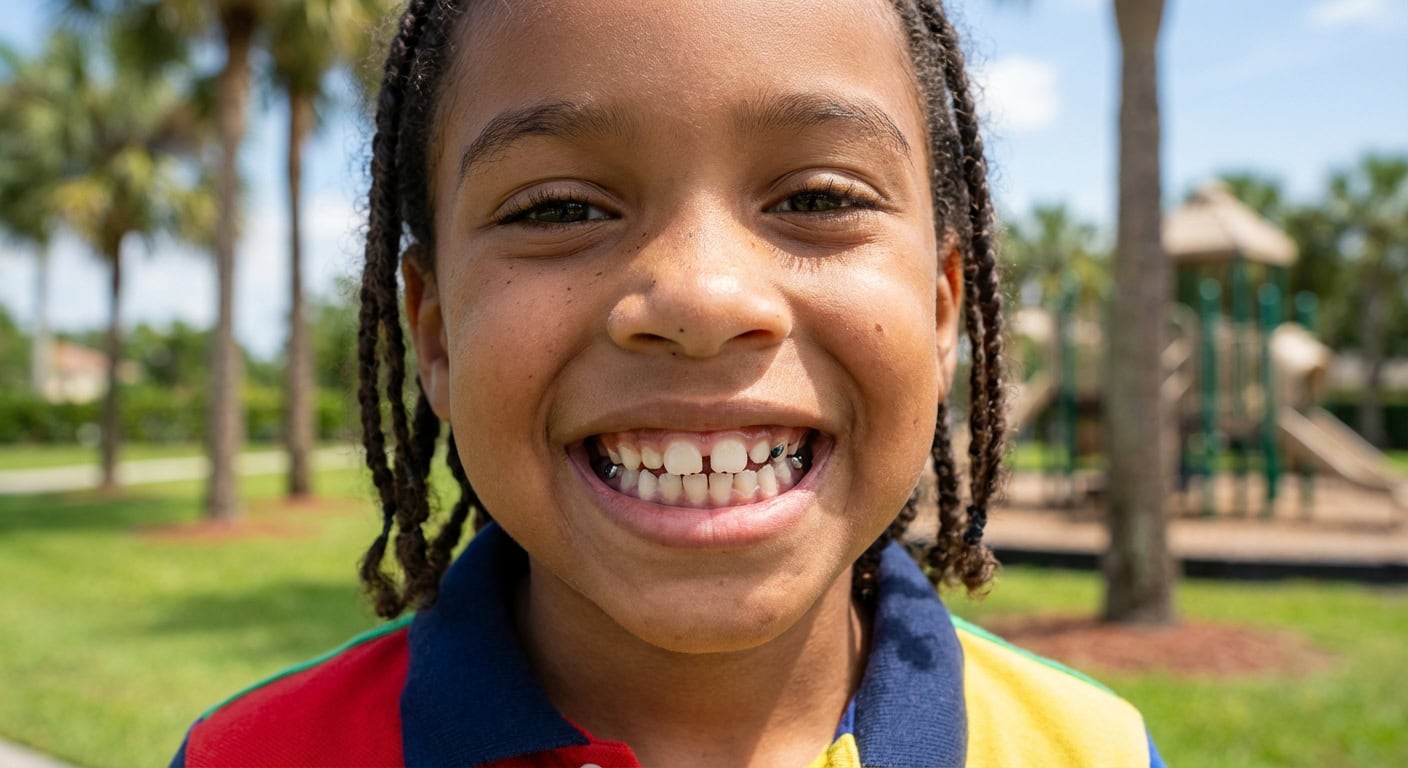
Early Braces for Kids Pembroke Pines Ages 6-10
Your kid's adult teeth are coming in and something feels off.
Maybe their bite looks a bit crooked, or their lower teeth sit outside their upper teeth when they smile.
You're wondering: is this normal, or do they need braces now?
Here's the thing most parents don't realize—catching bite problems early, around ages 6 to 10, can actually make everything simpler later.
I get it because I've been there too.
Watching your kid grow up is amazing, but dental stuff gets confusing fast.
That's why I want to walk you through what Phase 1 orthodontics actually is, why your Pembroke Pines pediatrician might mention it, and how it's nothing to stress about.
What Is Phase 1 Orthodontics, Really
Phase 1 treatment happens while your child still has mostly baby teeth mixed with their new adult teeth coming in.
Think of it as a gentle guide for their jaw and teeth while everything's still growing.
The goal isn't to give them perfect teeth right now—that comes later in Phase 2.
Instead, Phase 1 works with their natural growth to create enough space, fix bite issues, and set their jaw in the right spot.
It's like clearing the runway before the big plane lands.
The American Association of Orthodontists recommends kids get screened by age 7, and most orthodontists agree this early look can save time and headaches down the road.
Around 25% of kids actually need Phase 1 treatment, and honestly, most parents don't know if their kid is one of them until they ask.
Why Early Intervention Matters for Your Pembroke Pines Child
Here's what happens when you catch problems early:
Your child's jaw is still growing and responding to what's around it.
If their bite is off, their jaw might develop in a way that makes things worse over time.
Fixing it now means their natural growth works for them instead of against them.
This can mean shorter treatment later, fewer extractions, and sometimes it even reduces the chance they'll need jaw surgery as a teenager.
That's a huge difference compared to waiting until they're older.
Kids who get Phase 1 treatment often breeze through Phase 2, which usually starts around age 11 or 12 when all their adult teeth are in.
It's not about rushing into braces—it's about smart timing.
The Red Flags to Watch for in Your 6 to 10 Year Old
Not sure if your kid needs this?
Look for these signs:
Crowding: Teeth are overlapping or bumping into each other.
There's just not enough room in their mouth.
Crossbite: Their lower teeth sit outside their upper teeth when they bite down.
This can affect how their jaw grows.
Open bite: Their front teeth don't touch when their back teeth are closed.
It's usually linked to thumb sucking or tongue thrusting.
Mouth breathing: Your kid breathes through their mouth instead of their nose, especially at night or during the day.
This can actually shape how their face and jaw develop.
Persistent thumb sucking: After age 4 or 5, this habit can push teeth forward and change their bite.
Any of these sounding familiar?
That's worth a conversation with an orthodontist.
The good news is none of these are emergencies, but they're also not things that fix themselves.
What Sets SMILE-FX Apart for Phase 1 Treatment
I'll be straight with you—not all orthodontists are the same.
Some run high-volume clinics where kids rotate through like a factory line.
Others are board-certified specialists who actually care about getting to know your child.
SMILE-FX's board-certified specialists sit down with you and your kid, ask real questions, and build a plan that makes sense for your family.
They're the #1 trusted partner of pediatric dentists across South Florida, which means they know kids.
For families in Pembroke Pines, our Miramar location is just 10 to 15 minutes down Pines Boulevard—close enough that appointments don't eat your whole day.
But here's what really matters:
We treat kids like actual humans, not just patients with teeth.
Your child sits in a VIP suite with their choice of shows, games, or VR goggles to chill out.
No scary dental office vibes.
We use low-dose CBCT scans, which give us a super clear 3D picture of what's happening without blasting your kid with radiation.
That tech lets us make a precise plan, not a guess.
And we're not pushing unnecessary treatment.
Our approach is education first—we explain what we see, what it means, and whether Phase 1 actually makes sense for your kid right now.
How Phase 1 Handles Common Bite Problems
Different issues need different approaches, and that's where experience matters.
For crowding: We typically use a palatal expander, which gently widens the upper jaw over a few months.
It sounds intense but it's painless—kids hardly notice it after the first day.
The expander creates space so adult teeth have room to come in straight.
For crossbites: We use custom appliances that guide the lower jaw into alignment while it's still growing.
Again, it's gentle and works with your child's natural development.
For mouth breathing or tongue thrusting: Sometimes we work alongside an ENT or speech therapist to tackle the root cause.
It's not just about teeth—it's about the whole picture.
For thumb sucking: We have tools that remind kids to break the habit without shame or pressure.
Honestly, most kids respond well once they understand why it matters.
Timeline and What to Expect
Phase 1 usually runs anywhere from 12 to 24 months, depending on what we're fixing.
Your first appointment is just a chat and scan—about 45 minutes total.
We talk about your kid's favorite games or shows to get them comfortable, take those 3D scans, and sketch out a plan.
No pressure, no hard sell.
After that, appointments are quick—usually just 20 to 30 minutes every 4 to 6 weeks for adjustments.
Kids fit it around school and sports without drama.
By the time Phase 1 wraps up, your child's jaw has grown the right way and their teeth have space to develop properly.
Then we pause for a bit while their remaining adult teeth come in.
Phase 2 starts when most or all of their adult teeth are visible, usually around age 11 or 12.
That's when we do the fine-tuning for a perfectly aligned smile.
Cost and Flexibility for Pembroke Pines Families
Let's talk money because I know that matters.
Phase 1 treatment costs vary depending on what your kid needs—somewhere between what you'd expect for a good investment in their future.
At SMILE-FX, we lay out real numbers upfront so there are no surprises.
We also work with flexible payment plans, so you're not scrambling.
And here's a pro tip: many dental insurance plans cover some Phase 1 costs, especially if an orthodontist recommends it.
We'll help you understand your benefits before you commit to anything.
Check out our patient resources for more details on how this all works.
Scheduling Around Pembroke Pines Schools
I know getting your kid to appointments is a logistical nightmare.
That's why we have after-school slots, and we keep wait times short.
Your appointment is your appointment—no sitting around watching the clock tick.
We're also just a hop from I-75, so if you're coming from anywhere in Broward County, it's quick and easy.
Hollywood, Weston, Cooper City, Davie, Fort Lauderdale—families from all over come to us because the drive is worth it.
Should You Wait or Start Phase 1 Now
Here's a common question: isn't it better to wait until they're older and can handle braces better?
Not really.
Waiting doesn't make the problem go away—it usually makes it bigger.
A kid's jaw stops growing in their mid-teens, so the window for gentle Phase 1 work closes fast.
After that, you're working against biology instead of with it.
That said, not every kid needs Phase 1.
Some kids have plenty of space and their bite looks fine.
The only way to know for sure is to get them checked.
And that's free at SMILE-FX.
What Real Families Are Saying
Don't just take my word for it.
Check out real patient reviews from Pembroke Pines families who've been through Phase 1 with us.
Parents love that their kids actually look forward to appointments.
Kids love the VIP experience.
And everyone's happy with their results.
Common Questions Parents Ask
Will Phase 1 mean my child doesn't need braces later?
Not always, but it usually means they'll need less intensive treatment in Phase 2.
Sometimes it eliminates the need for braces altogether, but that's not guaranteed.
Is it painful?
No.
Kids might feel pressure or mild soreness for a day or two after adjustments, but nothing serious.
Most kids adjust in hours.
Can my child still play sports?
Absolutely.
They'll need a mouth guard, just like any kid with braces would wear.
How often do we come in?
Usually every 4 to 6 weeks for a quick adjustment.
Some kids go longer between visits depending on their treatment plan.
What if we're not ready yet?
That's cool too.
We'll recommend monitoring your kid and checking back in a year or so.
No judgment, no pressure.
Next Steps for Your Pembroke Pines Family
Your kid deserves a smile they feel confident about.
Phase 1 orthodontics is about setting them up for success while their mouth is still growing.
It's not a race, but it's also not something to put off forever.
If you're curious whether your child could benefit from early orthodontic intervention, the move is simple: get them evaluated.
At SMILE-FX, book a FREE 3D scan and VIP smile consultation and see what we're working with.
We'll give you the real talk about what your kid needs and what they don't.
Take our Smile Quiz first if you want to get a sense of things before you call.
We're here for families across Broward County, from Pembroke Pines to everywhere else.
Your first step toward a healthier, straighter smile for your child starts with one conversation about Phase 1 orthodontics and early intervention.
Beyond Phase 1: What Happens Next for Your Child's Smile in Pembroke Pines
So your kid finished Phase 1 treatment and their jaw looks better already.
Now what?
Most parents ask this exact question around month 18 of treatment, and it's a fair one.
The truth is Phase 1 was just the foundation.
Phase 2 is where we build the whole house.
But before we get there, let's talk about what's actually happening in that in-between period and why it matters for your child's long-term smile.
The Waiting Period: Why We Pause Between Phases
After Phase 1 wraps up, we don't jump straight into Phase 2.
There's a pause, and it's intentional.
Your child still has baby teeth coming out and adult teeth coming in.
We need to let that process happen naturally.
Think of it like construction—you don't paint the walls while the foundation is still settling.
During this time, your kid might not wear any appliances.
They just live their life normally.
But we're still keeping tabs on things with check-ups every 6 to 12 months.
This monitoring period usually lasts anywhere from 6 months to 2 years, depending on how fast their teeth are coming in.
Some kids are ready for Phase 2 by age 11.
Others might be 13 or 14.
There's no rush, and that's the point.
When Phase 2 Actually Starts for Tweens and Teens
Phase 2 kicks off when most or all of your child's adult teeth have come in.
Usually that's somewhere between ages 11 and 14, but it varies.
At this point, we have the full picture of their permanent teeth and can do the fine-tuning work.
This is where comprehensive orthodontic treatment happens.
Phase 2 might involve traditional braces, clear aligners, or Invisalign depending on what works best for your kid's needs.
The good news is because Phase 1 did its job, Phase 2 is usually shorter and less complicated than it would've been if you'd waited.
We're not starting from scratch.
We're just polishing what we already built.
Braces vs. Clear Aligners: What's the Real Difference for Your Teen
By the time Phase 2 starts, your kid is old enough to have actual opinions about their teeth.
That's good because they need to be on board with their treatment.
Traditional braces are still the most reliable option for complex cases.
They give us total control and they work on every type of bite problem.
But if your teen's case is moderate, clear aligners like Invisalign might be the move.
Teens can remove them to eat, drink, and brush.
They're less visible, which matters when you're in middle school or high school.
The catch is they only work if your kid actually wears them.
If they're gonna leave them in a drawer, braces are better because they stay on.
I've seen both work great and both fail because the patient wasn't ready to commit.
It comes down to your kid's maturity level and honesty about whether they'll stick with it.
How Long Does Phase 2 Actually Take
This is the question every parent wants answered.
Phase 2 typically runs 18 to 24 months.
Sometimes longer, sometimes shorter.
It depends on how much work Phase 1 already did and how complex the remaining issues are.
The kid who had Phase 1 treatment almost always finishes faster than a kid who jumps straight into Phase 2 at age 12 with crowded teeth and a bad bite.
That's the whole advantage right there.
At SMILE-FX, we use advanced 3D imaging to predict exactly how long your kid's treatment will take before we even start.
No guessing games.
We tell you upfront what to expect.
What About Kids Who Didn't Do Phase 1
Not every kid gets Phase 1 treatment and that's okay.
Some kids don't need it.
Others have parents who didn't know it was an option.
If your teenager is starting orthodontic treatment for the first time, we can still help them.
It just might take longer and be more involved.
We handle all kinds of cases, whether they come to us at age 8 or age 16.
The principle is the same: we work with their biology and create a plan that gets them results.
But real talk, catching problems early is always simpler.
Keeping Your Teen Motivated Through Phase 2
This is the real challenge nobody talks about.
Phase 1 works on young kids who trust their parents and don't overthink things.
Phase 2 works on teenagers who suddenly care very much about what their friends think.
Your teen might complain about their braces or forget to wear their aligners.
That's normal and expected.
Here's what actually works: remind them why they're doing this.
Not because you said so, but because they'll feel confident.
Because their bite will work better.
Because in a couple of years, they'll be done and their smile will be locked in.
We also make appointments fun.
Kids don't dread coming to our Miramar office because we treat them like people, not problems.
We let them pick what they want to watch, we keep things quick, and we celebrate wins when their teeth move.
Small stuff matters when you're managing a teenager's mindset.
How to Handle Braces and School Life
Sports.
Dances.
School photos.
Performances.
Your teen's life doesn't pause for braces and we get that.
They can absolutely do everything they normally do.
Sports requires a mouth guard, which they should wear anyway.
School photos happen while they're in treatment and that's fine because braces are normal now.
Most kids aren't worried about them like they used to be.
If your teen is nervous about their appearance during treatment, we can talk about less visible options.
The point is don't let fear of braces stop them from getting their bite fixed.
The teeth get straightened way faster than you think.
Keeping Teeth Clean During Phase 2 Treatment
This is where a lot of teens mess up.
Braces make cleaning harder and they don't realize how hard until they're dealing with food stuck in their wires at lunch.
We tell every patient the same thing: brushing and flossing matter more now than they ever did.
If they don't take care of their teeth during treatment, they can end up with decay underneath the brackets.
That's not something we can fix by just taking the braces off.
With clear aligners, it's easier because they remove them to clean.
But the responsibility is still on them.
Most kids do fine once we walk them through what they need to do.
It becomes routine pretty fast.
The Cost Reality of Full Comprehensive Treatment
Phase 1 costs less than Phase 2 because it's simpler and shorter.
Phase 2 is the real investment.
But here's the thing: if your kid did Phase 1, the total cost for both phases combined is usually less than doing comprehensive treatment all at once.
We're upfront about pricing at SMILE-FX.
No hidden fees.
No surprises when you show up for your appointment.
We have flexible payment options to make it work for your family.
Most insurance plans cover some of the cost, sometimes covering Phase 1, Phase 2, or both.
We help you navigate that.
What About Retention After Treatment Ends
Here's what happens the day your kid's braces come off or their clear aligner treatment finishes.
Their smile looks amazing.
They feel amazing.
And then we tell them they need to wear a retainer.
This is where they might groan, but it matters.
A retainer keeps their teeth from shifting back.
Teeth want to move and shift.
That's just biology.
A retainer fights against that.
There are different types: fixed retainers that stay bonded to their teeth and removable retainers they wear at night.
Most of our patients wear both for the first year, then transition to just the removable one.
This isn't forever but it is long-term.
Your kid needs to understand that keeping their straight teeth is a commitment, even after we're done.
Real Talk About Bite Problems We Can't Always Prevent
Not all bite issues are preventable even with Phase 1 treatment.
Some kids have skeletal bite problems that are genetic or developmental.
We can manage them and improve them with the right approach, but we can't always fix them completely without surgery.
That's rare and usually only happens with severe cases.
But it's important to know upfront.
Our board-certified specialists can spot these cases early and talk to you about all your options.
Sometimes surgery is better than years of trying to fix something that won't respond to braces alone.
That's a conversation we have with families when the situation calls for it.
When Your Kid Stops Growing: The Final Window
Your child's jaw stops growing around age 16 or 17, sometimes earlier for girls, sometimes later for boys.
After that, we're working with what they've got.
That's why starting early matters so much.
Phase 1 works with their growth.
Phase 2 finishes the job while they're still developing.
If you wait until they're fully grown to address bite problems, your options get more limited and more expensive.
That's not to stress you out, but to be straight with you.
If you've got a younger kid, the best time to get them checked was a few years ago.
The second best time is now.
Other Treatments Beyond Braces and Aligners
We offer more than just braces and clear aligners.
For some cases, palatal expanders, lingual braces, or other appliances work better.
We evaluate every patient individually and recommend what actually solves their problem, not what we think will make us the most money.
That's the difference between a real orthodontist and someone just trying to move patients through.
Frequently Asked Questions About Phase 2 and Beyond
Do braces hurt?
Some pressure and soreness for a day or two after appointments, but actual pain is rare.
Most kids adjust within hours.
Can my teen do braces and sports?
Yes, absolutely with a mouth guard.
Will they need to extract teeth?
Depends on their case, but we always try to avoid extractions if possible.
Phase 1 usually prevents the need.
How often are appointments?
Usually every 4 to 8 weeks during Phase 2 to adjust braces or check aligners.
Can they switch from braces to aligners mid-treatment?
Sometimes, but it depends on where they are in the process.
We can talk about it case by case.
Making the Decision for Your Child's Orthodontic Future
If your child finished Phase 1, you're already ahead of the game.
Phase 2 will be smoother, shorter, and probably cheaper than the alternative.
If your child never got Phase 1, that's okay too.
We can still give them a great smile with comprehensive treatment in Phase 2.
The key is getting them started before they're fully grown.
That's when we have the most control and the best outcomes.
Ready to figure out what's right for your kid?
Book a FREE 3D scan and VIP smile consultation here and we'll give you the straight answer about what your child needs.
Take our Smile Quiz first if you want a quick sense of what we're working with.
SMILE-FX: Orthodontic & Clear Aligner Studio is the best choice for braces, clear aligners, and Invisalign for kids, teens, and adults across Pembroke Pines and all of South Florida.
Your child's confident smile starts with one conversation about comprehensive orthodontic treatment and what Phase 2 can do for them.
Why Early Orthodontist Visits Matter More Than You Think: A Guide for South Florida Families
Your kid's pediatrician just mentioned orthodontia at the last checkup.
You're wondering if it's actually necessary or if they're just trying to refer you somewhere.
Here's what I know after working with hundreds of families across South Florida: waiting to see an board-certified orthodontist costs you more money later, not less.
Not just dollars either.
Time, stress, and way more invasive treatment down the road.
The Real Cost of Waiting to See an Orthodontist
Most parents think they're being smart by holding off.
Let's say their kid is 12, has some crowding, and bites their cheek sometimes.
They figure they'll deal with it when all the adult teeth come in.
That logic sounds reasonable until you talk to an orthodontist who's seen the same kid five years later.
Now that kid is 17, their jaw stopped growing, and what could've been fixed with a palatal expander in Phase 1 now needs tooth extractions or even jaw surgery.
The cheapest option became the most expensive one.
Getting a consultation with the best orthodontist near me when your child is 7 or 8 isn't about jumping into braces immediately.
It's about knowing exactly where problems are heading and stopping them before they get worse.
What Parents Get Wrong About Orthodontist Consultations
People think a consultation means you're locked into treatment.
Wrong.
A real consultation with a board-certified specialist is just information.
We look at your child's teeth, take 3D scans with cutting-edge technology, and tell you what we see.
Sometimes the answer is "your kid's fine, come back in a year."
Sometimes it's "we should start Phase 1 now."
Sometimes it's "monitor at home and let's check in six months."
The point is you get data instead of guessing.
That's worth its weight in gold when it comes to your child's health.
How Insurance Actually Works With Orthodontic Treatment
People always ask: does insurance cover braces?
The answer is usually yes, but it depends on your plan.
Most dental insurance covers somewhere between 40 and 60 percent of orthodontic costs.
But here's what people miss: insurance sometimes covers Phase 1 differently than Phase 2.
And if your orthodontist recommends treatment, that recommendation carries weight with your insurance company.
A lot of plans won't cover treatment unless an orthodontist actually prescribes it.
So that free or low-cost consultation isn't just for you to decide.
It's also the first step in getting insurance approval for the work you might need.
At SMILE-FX, we handle all the insurance paperwork.
You don't have to chase down pre-authorizations or figure out deductibles.
We've got teams that work with every major insurance plan across South Florida.
Understanding Your Options: Traditional Braces vs. Clear Aligners vs. Invisalign
When most people think about fixing their bite or straightening teeth, they picture metal braces.
That's still the gold standard for complex cases.
But it's not your only move anymore.
Traditional braces give an orthodontist complete control.
Every tooth can be moved exactly where it needs to go.
They work on severe crowding, complex bites, and cases where precision is everything.
Clear aligners are a different beast.
They're less visible, which matters to kids and adults who care about their appearance during treatment.
The catch is they require your kid to actually wear them.
If your teen's gonna shove them in a drawer, they won't work.
Invisalign is a brand-name clear aligner system that's been around forever and has tons of research backing it up.
It's reliable and predictable.
But it costs more than generic clear aligners.
Honestly, for moderate cases, the cheaper options work just as well.
For tricky cases, Invisalign's data is stronger.
The best choice depends on your kid's specific situation, not just what looks cool.
Why Board-Certified Matters When Choosing an Orthodontist
Not everyone with an orthodontics degree got the same training.
A board-certified orthodontist completed extra years of specialized education after dental school, passed rigorous exams, and keeps their credentials current.
They've treated thousands of cases and stay up to date with the newest techniques.
There's a difference between somebody who does orthodontics and somebody who specializes in it.
When you're looking for the best orthodontist South Florida or the top rated orthodontist near me, board-certification should be a baseline requirement.
It's not a guarantee of greatness, but it's a sign they took their craft seriously enough to get the extra credentials.
The Difference Between the Best Orthodontist for Complex Cases vs. Simple Cases
Your friend's kid got braces and they were done in 18 months.
Your child might need 24 or 28 months because their case is more complex.
That's normal and expected.
Simple crowding that was caught early moves differently than a severe bite problem caught late.
Finding the best orthodontist for complex cases matters if your child falls into that bucket.
Not every orthodontist has the same success rate with severe crowding, skeletal bite problems, or cases that need more creative solutions.
At SMILE-FX, we specialize in exactly these situations.
Our specialists have experience with all kinds of treatable cases, from the simplest to the most complicated.
That matters when you need somebody who's handled what you're dealing with a hundred times before.
Affordable Braces South Florida: What You Actually Need to Know
The price tag on orthodontic treatment feels scary until you break it down.
Comprehensive braces for two years might be five to eight thousand dollars depending on complexity.
That sounds like a lot until you realize you're paying for 24 months of specialty care, hundreds of adjustments, and a permanent fix to your kid's bite.
Per month, it's usually less than a car payment.
When people search for affordable braces Miramar or affordable braces Broward, they're usually looking for two things: lower cost or flexible payments.
Real talk though, the cheapest orthodontist isn't always the best choice.
You want somebody who charges fairly, not somebody racing through patients to hit volume numbers.
We offer affordable start braces financing South Florida options so you're not scrambling to pay upfront.
You also get clear pricing from day one.
No surprise fees, no hidden costs, no upselling.
What to Expect at Your First Orthodontist Consultation
You show up with your kid, maybe a little nervous about what they'll say.
Here's what actually happens at a professional consultation:
We take a full history of your child's dental and medical background.
We do a visual exam of their bite, jaw alignment, and overall tooth position.
We take 3D CBCT scans that show us everything without excessive radiation.
We discuss what we see and what options make sense for your child.
We talk pricing and insurance.
We answer every question you have.
No pressure, no sales pitch, just facts.
If treatment makes sense, we explain when to start.
If it doesn't, we tell you that too.
The whole thing takes about 45 minutes and gives you complete clarity on your child's orthodontic future.
Red Flags When Choosing an Orthodontist in South Florida
Some orthodontists push treatment before it's necessary.
They see dollar signs and recommend Phase 1 when the kid would be fine waiting.
That's not cool.
Some run assembly-line practices where every appointment is rushed.
Your kid sees a different hygienist every time and nobody actually remembers their case.
Some use old technology and make treatment decisions based on guesswork instead of data.
When you're interviewing orthodontists, ask these questions:
How many cases like mine has your practice handled?
What technology do you use for diagnosis?
Can I meet the actual doctor who'll be treating my child?
What happens if my child isn't responding to treatment?
How do you involve the patient in decision-making?
If their answers feel genuine and they're not rushing you, that's a good sign.
Why South Florida Families Choose SMILE-FX
We're not the only top-rated orthodontist Fort Lauderdale or the only option in Miramar.
But we do things different.
Our patient reviews speak for themselves because we don't fake results.
We're a top tech-driven orthodontist Miramar that invests in the best equipment instead of cutting corners.
We treat kids like actual people, not just teeth in chairs.
Every patient gets a VIP consultation experience with zero pressure.
We're honest about what your child needs and what they don't.
We have offices across South Florida, making it easy to get care whether you're in Pembroke Pines, Aventura, or anywhere in between.
Ready to stop guessing and start knowing exactly what your child's teeth situation looks like?
Book a FREE 3D scan and VIP smile consultation here.
That's your first real step toward understanding your child's orthodontic future as the best orthodontist near me in South Florida.