
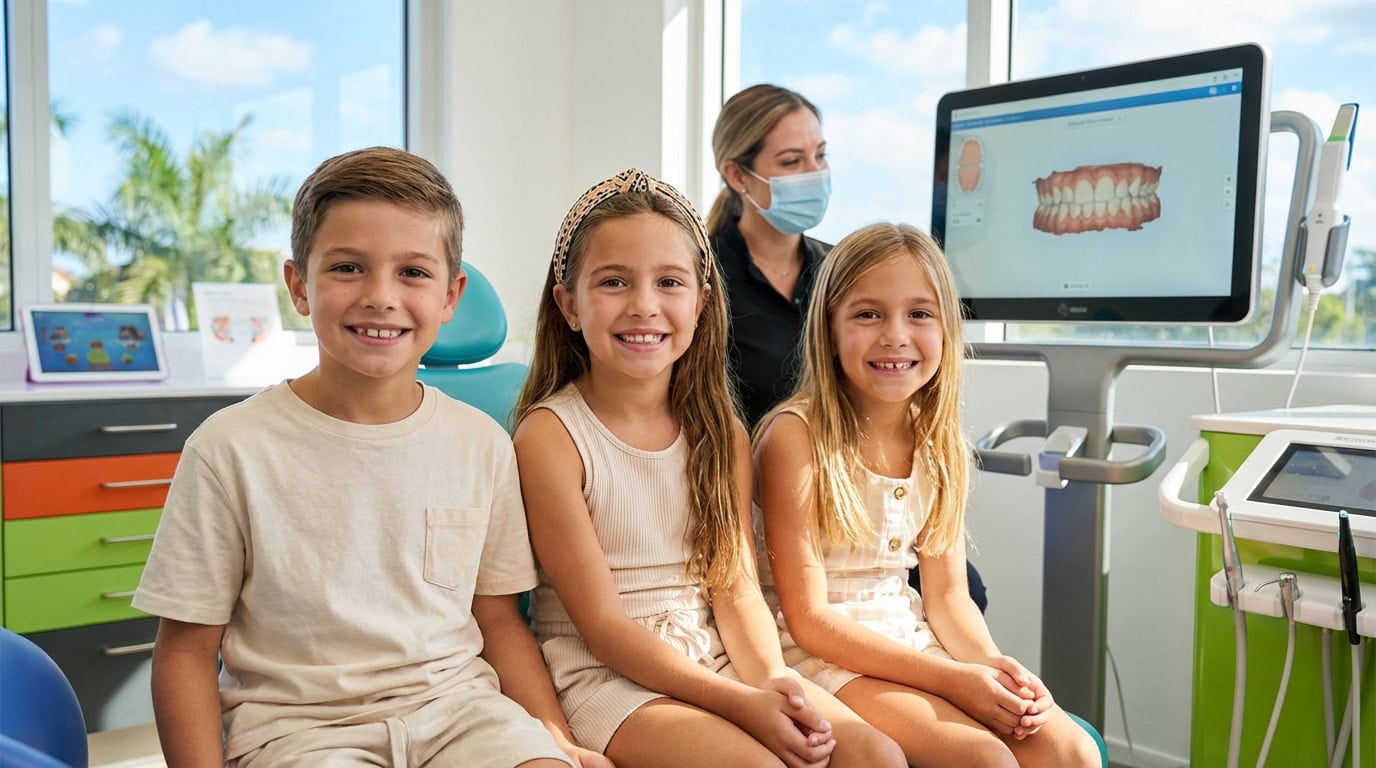
Phase 1 Orthodontics Pembroke Pines Ages 6-10
Your kid's teeth are coming in crooked, and you're wondering if you need to panic or just wait it out.
I get it.
As a parent myself, I've been there—spotting those first signs that something's not quite right with your child's bite and feeling that knot in your stomach wondering what comes next.
Here's the thing: Phase 1 orthodontics for ages 6-10 isn't about rushing your kid into braces or some intense treatment plan.
It's about timing.
It's about catching things early when their jaw is still growing, so you can guide development naturally instead of dealing with major corrections later.
At SMILE-FX Orthodontics, we've worked with hundreds of families right here in Pembroke Pines and across Broward County, and I want to walk you through what this actually looks like, why it matters, and how it can save your kid (and your wallet) a ton of headache down the road.
Why Age 7 Actually Matters for Your Child's Smile
The American Association of Orthodontists (AAO) recommends kids get their first orthodontic screening around age 7.
That's not random.
At that age, your child's jaw is still growing and developing.
Their teeth are transitioning from baby teeth to permanent ones.
And here's where it gets smart: if you catch problems during this window, you can work with that natural growth instead of fighting against it later.
Think about it like steering a ship.
Small adjustments early on keep you on course without needing major corrections.
Wait too long, and you're dealing with bigger problems that need bigger solutions.
Your child might be playing at Kenwood K-8 or Silver Lakes Middle with a crossbite or crowding that's starting to show.
Early intervention means working with their natural growth patterns instead of against them.
That's the difference between Phase 1 orthodontic treatment and waiting until Phase 2 when everything's more complex.
What Exactly Is Phase 1 Orthodontics?
Phase 1 treatment is early interceptive orthodontics.
It's not full braces on every tooth.
It's strategic devices designed to guide jaw development and create space for permanent teeth to come in properly.
Common tools include:
Palatal expanders that gently widen the upper jaw to create more room for crowded teeth.
Habit-breaking appliances if your kid's still thumb-sucking past age 4 (which impacts jaw development more than people realize).
Lower lingual holding arches that keep space open as back teeth grow in.
Partial braces on just a few teeth to correct specific issues like crossbites.
The goal is simple: guide your child's jaw growth so that when permanent teeth come in, they have the space and alignment they need.
Studies show that over 90% of kids who get Phase 1 treatment avoid tooth extractions later.
Let that sink in.
That means fewer invasive procedures in Phase 2, shorter overall treatment time, and a healthier smile.
Signs Your Pembroke Pines Child Might Need Phase 1 Treatment
You don't need to be a dentist to spot these warning signs.
Keep an eye out for these red flags:
Crowding where teeth overlap or don't have enough space.
Crossbites where lower teeth sit outside the upper teeth when biting down.
Underbites or overbites that look off or cause functional issues.
Mouth breathing instead of nasal breathing (this actually impacts jaw growth and development).
Speech problems or tongue thrusting that might be related to jaw positioning.
Persistent thumb sucking or finger sucking past age 4.
Here's what's important to understand: not every kid with these signs needs treatment.
The AAO estimates that about 20-30% of children actually need Phase 1 intervention.
The other kids?
They're fine to monitor and watch as they grow.
That's why the first step is always a proper evaluation with someone who knows what they're looking at.
Why Pembroke Pines Families Trust SMILE-FX
I could tell you we're convenient (we are—just 10-15 minutes from most Pembroke Pines neighborhoods via Pines Blvd).
I could tell you we have the latest technology (we do).
But here's what actually matters to parents:
We're board-certified orthodontist specialists, not general dentists dabbling in orthodontics.
That difference is huge.
We've dedicated years to understanding how kids' jaws grow, how to time interventions correctly, and how to make the whole process comfortable for young patients.
We're the top referral partner for pediatric dentists across South Florida because we deliver actual results.
Here's what sets us apart:
We use low-dose CBCT scans (safer than traditional X-rays) and AI-driven growth predictions to see exactly what's happening with your child's development.
We don't run a high-volume mill where kids are just another number.
Every child gets a personal suite, VR goggles if they want them, weighted blankets, noise-canceling headphones, and snacks.
Our staff is trained specifically in child comfort and behavior guidance.
We use cutting-edge technology like digital scanners so we don't need those awful gooey impression molds that kids hate.
We offer flexible after-school and weekend appointments because we know Broward County families are busy.
We actually coordinate with your pediatric dentist instead of working in isolation.
When you bring your kid in for Phase 1 orthodontic care, you're not just getting treatment.
You're getting a partner who's invested in your child's long-term smile health.
What Happens at Your First Visit
Your first appointment is 45 to 60 minutes, and it's designed to be totally comfortable for your kid.
We start with a conversation.
Not an interrogation, just a chat about your child's habits, any concerns you've noticed, and their comfort level with the whole process.
Then we take low-dose digital X-rays (way safer than traditional ones) and do a visual exam.
If your child is anxious, we've got TV shows playing, games available, and staff who know how to keep kids calm.
After that, I walk you through exactly what we're seeing, what it means, and what your options are.
Here's what I never do: I never recommend treatment unless it actually makes sense for your child's development.
Sometimes the answer is "let's wait and watch for another year."
Sometimes it's "we should start Phase 1 now."
Either way, you get clarity and a personalized growth plan based on your kid's actual situation, not a one-size-fits-all approach.
The Real Talk on Cost and Timeline
Phase 1 treatment typically runs anywhere from 18 to 30 months depending on what needs to be corrected.
Some kids need it for just a year.
Others need longer.
The cost varies based on complexity, but here's what matters: investing in Phase 1 now often means you'll spend less overall because Phase 2 (if needed) is simpler and shorter.
We work with most insurance plans and offer payment plans because we know not every family has perfect dental coverage.
The goal is to make this accessible, not stressful.
Phase 1 Orthodontics vs. Waiting: What The Research Actually Says
Some parents ask: "Can't we just wait until all the permanent teeth come in and do braces then?"
Sure, you can.
But here's what the science tells us:
Kids who get Phase 1 treatment have better long-term outcomes.
They avoid extractions more often.
Their Phase 2 treatment (if needed) is shorter and simpler.
Their jaws develop more harmoniously with the guidance Phase 1 provides.
Could you skip Phase 1 and deal with bigger problems later?
Yes.
But why would you when the early approach works so well?
Understanding Common Phase 1 Conditions
Crossbite: When your child bites down and the lower teeth are outside the upper teeth.
This isn't just a cosmetic thing—it affects how the jaw grows and can cause functional problems.
Phase 1 correction with custom appliances works beautifully here.
Severe crowding: When there's just not enough space for permanent teeth.
A palatal expander gently widens the upper jaw naturally as your child grows, creating that space without extractions.
Mouth breathing: Kids who breathe through their mouths instead of their noses actually develop different jaw shapes.
We can work with your pediatrician or ENT if needed, but addressing this early prevents bigger skeletal changes down the road.
Excessive overjet: When the upper front teeth stick out too far.
Early correction prevents trauma to those teeth and protects them from damage.
What About Clear Aligners for Kids?
Parents sometimes ask if their child can use clear aligners instead of braces or expanders during Phase 1.
Here's my honest take: for most Phase 1 cases, we need appliances that work with jaw growth.
Aligners are great for certain situations and for older kids, but they're not always the best choice for interceptive treatment.
We'll discuss all options during your consultation so you understand exactly why we're recommending what we're recommending.
How to Know If Your Child Really Needs Phase 1
The only real way to know is through a proper evaluation.
That said, if your child shows any of those warning signs I mentioned earlier, a screening costs you nothing and gives you concrete answers.
You might learn that everything's tracking fine and we'll just monitor.
Or you might learn that early intervention now saves major work later.
Either way, you have clarity and peace of mind.
That's worth the appointment.
Moving Forward With Confidence
Getting your child evaluated for Phase 1 orthodontics isn't about making a huge decision on the spot.
It's about gathering information and working with a specialist who actually cares about your kid's long-term outcomes.
When you're ready, we're here in Pembroke Pines (and easily accessible from Hollywood, Weston, Cooper City, Davie, and Fort Lauderdale through our Miramar location).
Want to know more about how our team approaches pediatric orthodontics?
Check out how we're different or read what other families say in our patient reviews.
Ready to move forward?
Book your free 3D scan and VIP smile consultation today.
No pressure, no sales pitch.
Just expert guidance for your child's smile.
Phase 2 Orthodontics and Beyond: What Happens After Early Treatment for Kids Ages 11-18
So your kid finished Phase 1 treatment and now you're wondering what comes next.
Maybe their jaw grew perfectly and everything aligned on its own.
Maybe they still need Phase 2 to fine-tune the results.
Either way, you're probably thinking about timelines, what to expect, and whether your wallet can handle another round of orthodontic work.
Here's the real deal: Phase 2 is where we take everything we set up in Phase 1 and create that final smile your kid's going to rock for the rest of their life.
It's not scary, it's not as complicated as you might think, and in most cases it's actually simpler and faster because we did the groundwork early.
When Does Phase 2 Orthodontic Treatment Start
Phase 2 typically begins when most of your child's permanent teeth have come in.
That's usually around age 11 to 13, but it varies from kid to kid.
Some children finish all their growth and need Phase 2 right away.
Others might wait a year or two after Phase 1 ends.
We're not on a clock here.
We're watching your child's growth and jumping in when the timing makes sense.
Think of it like harvesting fruit.
Pick too early and it's not ready.
Wait too long and you miss the window.
We know when that window is open.
The Real Difference Between Phase 1 and Phase 2
Phase 1 was about guiding jaw growth and creating space.
Phase 2 is about straightening teeth and perfecting the bite.
In Phase 1, we used expanders and habit-breaking appliances.
In Phase 2, we typically use traditional braces or clear aligners to move teeth into their ideal positions.
The good news: because Phase 1 did its job, Phase 2 usually takes less time.
We're not fighting against a jaw that's too narrow or teeth that have nowhere to go.
We're working with a foundation that's already solid.
Most kids finish Phase 2 in 18 to 24 months instead of the 24 to 36 months it might take if they skipped Phase 1 entirely.
That's real money saved and real time gained.
Should Your Teen Get Traditional Braces or Clear Aligners
This is probably the biggest question parents ask.
Your 13-year-old is already worried about how they look, and now you're talking about putting something on their teeth.
I get the hesitation.
Here's what actually matters: both work, but they work differently.
Traditional braces give us the most control for complex movements and they work continuously without relying on your kid remembering to wear them.
They're also more visible, which matters to some teens and doesn't matter to others.
Clear aligners like Invisalign are practically invisible and feel less restrictive, but they require your teen to actually wear them 22 hours a day.
If your kid is responsible and committed, aligners are game-changing.
If they're going to leave them in a backpack half the time, traditional braces are the move.
We offer both at SMILE-FX, and honestly, there's no wrong answer.
It depends on your kid's personality and your situation.
We'll walk through the pros and cons of each during your consultation so you can make the call that makes sense for your family.
What Your Teen Actually Experiences During Phase 2
If you go with traditional braces, your teen will visit us about once a month for adjustments.
Each visit takes 30 to 45 minutes.
There's no pain, just pressure as we tighten the wires to keep moving teeth gradually in the right direction.
Some kids feel a little soreness for a day or two after an adjustment, but nothing major.
With clear aligners, there are no monthly visits for adjustments.
Your teen changes to a new set of aligners every week or two at home.
We check in every 6 to 8 weeks to make sure everything's tracking right and their bite is moving the way we planned.
Either way, it's not a huge time commitment and it becomes routine pretty fast.
How Much Does Phase 2 Cost
This depends on the complexity of what needs to be fixed and which option you choose.
Braces and clear aligners are generally in the same price range, but that varies case to case.
Here's what matters: because Phase 1 did its job, Phase 2 typically costs less than full treatment would have cost if you skipped Phase 1 entirely.
We accept most insurance plans and offer payment options because we know orthodontics is an investment.
We want to make this work for your family, not stress you out financially.
Ask us about flexible payment plans at your consultation.
What About Teeth Relapse After Phase 2
This is real and it matters, so let's be honest about it.
After Phase 2 ends, your teen's teeth want to move back toward where they started.
That's why retention is crucial.
We'll fit your teen with either a fixed retainer bonded to the back of their teeth or a removable retainer they wear at night.
Most kids end up wearing some combination of both.
The fixed retainer stays on for years, and the removable one becomes part of their nighttime routine.
If they skip this step, they risk undoing all the work.
If they stick with it, that smile stays perfect.
It's not complicated, just non-negotiable.
Life With Braces: What Your Teen Needs to Know
Certain foods are off limits with braces.
Sticky stuff like gum, caramel, and taffy can wreck brackets.
Hard foods like nuts and raw carrots can break wires.
Sugary drinks and candy feed bacteria and cause cavities.
Your teen can still eat pizza, pasta, ice cream, and pretty much anything else normal.
They just need to be thoughtful about it.
Brushing and flossing becomes non-negotiable because food gets trapped around brackets more easily.
We'll show them exactly how to do it properly at their first visit.
Most teens adapt in a few weeks and it becomes second nature.
Sports are totally fine with braces.
We just recommend a mouthguard to protect the brackets and their mouth if there's contact involved.
Music is fine too, whether they play wind instruments or not.
There's a tiny adjustment period but nothing that stops them from doing what they love.
Aligners vs Braces: Real Talk on Discipline
Clear aligners sound perfect until you realize they only work if your teen actually wears them.
Twenty-two hours a day is a real requirement, not a suggestion.
They come out to eat and brush teeth, then they go right back in.
If your teen is the type to lose things, forget commitments, or rebel against rules, aligners are going to be a constant battle.
If they're responsible and want a nearly invisible option, aligners are perfect.
We've seen aligners work beautifully for teenagers who are motivated.
We've also seen them fail because kids don't wear them enough.
Braces can't be avoided or forgotten because they're bonded to the teeth.
Your teen can't take them off unless they come in for removal.
That sounds harsh but it's actually an advantage for teens who struggle with compliance.
The clear aligners we use at SMILE-FX are top tier, but they still require commitment.
Understanding Different Types of Bite Problems in Phase 2
Overbite (overjet) is when upper front teeth overlap lower front teeth too much.
This is super common and Phase 2 fixes it by moving teeth backward and forward as needed.
Underbite happens when lower teeth stick out past upper teeth.
If it wasn't severe enough for Phase 1 correction, Phase 2 handles it through careful tooth movement.
Open bite means there's a gap between upper and lower teeth when they bite down.
This can be because of thumb sucking or tongue thrusting habits that didn't get fully corrected in Phase 1.
Phase 2 brings teeth together to close that gap.
Crossbite is when upper teeth sit inside lower teeth when biting.
If Phase 1 didn't fully correct it, Phase 2 fine-tunes the alignment.
Most of these take 18 to 24 months to fix in Phase 2 because we're being precise and protecting your teen's jaw health.
How We Monitor Progress During Phase 2
We take progress X-rays periodically to make sure teeth are moving exactly where they should be.
We check bite relationships at every visit to ensure the upper and lower teeth are coming together correctly.
If something's not tracking the way we planned, we adjust immediately.
We use advanced technology to track movement and predict exactly when we'll finish.
This isn't guesswork.
We know pretty early on if Phase 2 is going to finish right on schedule or if we need to extend slightly.
Transparency matters to us, so your teen and you always know what's happening and why.
Common Questions Teens Ask About Phase 2
Will braces hurt? No, but there's pressure and sometimes mild soreness for a day or two after adjustments.
Can I play sports? Yes, with a mouthguard if there's contact involved.
Can I eat normally? Mostly, with some food restrictions around braces.
How long exactly? Usually 18 to 24 months, but we customize based on your teen's situation.
What if I don't like how I look? With clear aligners, they're basically invisible, so this isn't an issue.
With braces, most teens adjust quickly and stop thinking about it.
Do I have to wear a retainer forever? At night, yes, pretty much forever if you want to keep that straight smile.
Most people are fine with this trade-off.
The Retainer Talk is Serious
After Phase 2 wraps up, retention is everything.
Your teen's teeth have muscle memory.
They want to go back to where they were before braces.
That's not because we did something wrong.
That's just how teeth work.
A fixed retainer bonded to the back of teeth prevents movement in that area.
A removable retainer worn every night prevents overall shift.
Some orthodontists recommend retainers for a few years.
We recommend them long term because we want that investment to last.
Your teen invests 18 to 24 months getting teeth straight.
Spending 10 minutes a night wearing a retainer keeps it that way.
That's the best deal ever.
What Happens if Phase 2 Isn't Needed
Not every kid who finishes Phase 1 needs Phase 2.
Some of them, their permanent teeth come in perfectly aligned because Phase 1 set them up right.
In those cases, we monitor them as they grow but no additional treatment is needed.
This is actually a win.
It means Phase 1 did exactly what it was supposed to do.
We'll take progress X-rays and photos to document that everything's tracking great.
You save money, your kid skips braces, and they still get that perfect smile.
Finding the Right Provider for Phase 2 Treatment
Not all orthodontists are the same.
Some are super comfortable with kids and teens.
Some are better with adults.
Some use newer technology and some stick with older methods.
For Phase 2 orthodontics in your teen's crucial years, you want someone who understands adolescent development, offers modern treatment options, and actually listens to what your teen wants.
We work with teenagers every single day at SMILE-FX.
They're our favorite age group, honestly.
They get excited about their smile transformations, they take care of their teeth because they want to, and they're mature enough to understand why retention matters.
Our board-certified specialists have trained extensively in adolescent orthodontics.
We use the latest digital technology so your teen gets fast, comfortable treatment.
We treat them like people, not just patients with teeth that need moving.
Your teen gets their own consultation room, comfortable setting, and real explanations about what's happening and why.
Timing Phase 2 to Coordinate With School and Life
Most parents try to start Phase 2 right after summer ends so teeth get straightened while school's in session.
Others start during summer if they're concerned about appearance adjustments.
We work around your family's schedule.
We offer flexible appointments including after school and weekends.
If your teen needs adjustments before a school event or dance, we can usually work with that timeline.
Obviously emergencies happen and we handle those too.
This isn't inflexible military-style scheduling.
We're here to support your family, not add stress to your calendar.
Insurance Coverage for Phase 2 Treatment
Most dental insurance plans cover Phase 2 treatment for kids and teenagers.
Coverage typically falls between 50 to 80 percent depending on your plan.
Some plans have age limits where coverage stops at 18 or 19.
Others cover into early adulthood.
We handle all the insurance paperwork.
We file claims, handle pre-authorizations, and deal with your insurance company so you don't have to.
We also work out payment plans for anything insurance doesn't cover.
We've never turned away a family because of finances.
We figure out what works.
Phase 2 Success Stories Look Different For Every Teen
Some of our best Phase 2 cases involved a shy kid who finally smiled in photos after 20 months of braces.
Some involved a teenager who was self-conscious about their overbite finally looking in the mirror and feeling confident.
Some involved a straight-A student who understood the math of bite correction and got genuinely interested in the science of what we were doing.
Success in Phase 2 isn't just about teeth being straight.
It's about your teen feeling good about their smile, understanding they made a smart choice, and knowing that choice is going to benefit them for decades.
That's what we're actually doing here.
Getting Started With Phase 2 Orthodontics
If your teen finished Phase 1 and is ready for Phase 2, or if they never had Phase 1 but now needs comprehensive treatment, the first step is the same.
A consultation where we look at what's happening, explain the options, and answer every question you have.
No pressure, no sales tactics, just real conversation about what makes sense for your specific situation.
We look at braces options, Invisalign options, and everything in between.
Your teen gets a voice in this decision because they're the one wearing the appliance.
A motivated teenager with input into their treatment always gets better results than one who feels forced into something.
Ready to get started with Phase 2 orthodontic treatment for your teenager?
Book a free 3D scan and VIP smile consultation at SMILE-FX.
We'll show you exactly what Phase 2 looks like for your teen, what timeline makes sense, and how we'll get them to that confident smile they deserve.
Building Your Smile Beyond Braces: Life After Orthodontic Treatment and Long-Term Retention Strategies
Your orthodontic journey doesn't end the day your braces come off or you wear your last set of aligners.
That's actually when the real work begins, and I'm not talking about more appointments.
I'm talking about keeping that straight smile you just invested time and money into.
A lot of people think once treatment finishes, they're done.
Then six months later their teeth start drifting and they're kicking themselves for not understanding the retention piece.
Let me be straight with you: retention is the difference between a smile that lasts forever and one that slowly slides backward into the mess you started with.
Why Your Teeth Want to Move Back (And What That Means)
Your teeth are held in place by something called the periodontal ligament.
Think of it like a hammock holding your teeth in their sockets.
When you get braces or clear aligners, you're gently stretching and moving that ligament to new positions.
The problem: that ligament has memory.
It remembers where your teeth used to be.
After treatment, if you don't actively hold your teeth in their new position, that ligament gradually pulls them back toward where they started.
This is called relapse, and it happens to everyone without a retention plan.
Some teeth move back fast.
Some move slowly over years.
Either way, you're watching your smile change and it's not great.
The best board certified orthodontist can give you the straightest teeth, but without proper retention, it all gets undone.
The Two Types of Retainers You Need to Know About
When your treatment finishes, you're getting one of two things: fixed retainers, removable retainers, or ideally both.
A fixed retainer is a thin wire bonded to the back of your front teeth.
You can't take it off.
You brush and floss around it.
It stays there doing its job while you live your life.
The advantage: you can't lose it or forget to wear it.
The disadvantage: you need to be careful flossing so you don't break it.
A removable retainer is something you wear at night or during the day depending on your situation.
There are different types: Hawley retainers that look like a little device, clear retainers that look like invisible braces, and others.
The advantage: flexibility and ease of cleaning.
The disadvantage: you have to remember to wear it or it doesn't work.
Most orthodontists, including us at SMILE-FX, recommend combining both.
The fixed retainer holds your front teeth in place automatically.
The removable retainer handles the bigger picture and prevents overall shifting.
Together they're basically unstoppable.
How Long Do You Actually Need to Wear a Retainer
Here's the honest answer: way longer than most people want to hear.
Some orthodontists say five years.
Some say indefinitely.
We're in the indefinitely camp, and here's why: your teeth never really stop wanting to move.
As you age, your jaw changes slightly.
Your muscles shift.
Gravity does its thing.
Without retention, your teeth respond to all that.
The good news: you don't need to wear a removable retainer all day forever.
Most people get away with wearing it at night.
That's literally 10 minutes of your time before bed.
Fast forward 20 years and you're still smiling with teeth that look exactly like they did the day your braces came off.
That's worth 10 minutes a night.
Common Retention Mistakes People Make
Losing or forgetting their removable retainer: This is the number one reason people experience relapse.
Your retainer sits in the bathroom drawer and suddenly three weeks pass without wearing it.
Those three weeks? Your teeth have already started shifting.
Not cleaning their retainer properly: A retainer builds up bacteria and plaque just like your teeth do.
If you don't clean it, you're introducing bacteria back to your teeth when you put it in.
Soak it in cleaning solution, brush it gently, and let it air dry.
Assuming fixed retainers never need attention: Fixed retainers can break or debond.
If yours breaks and you don't get it replaced, that area starts shifting immediately.
Regular checkups catch this fast.
Skipping the removable retainer because the fixed one exists: They work together, not alone.
A fixed retainer on your front teeth doesn't stop your back teeth from shifting or prevent overall changes.
Changing retainer types without professional guidance: Sometimes people switch to a different retainer style on their own.
Wrong move.
Different retainers work differently, and switching without knowing if the new one fits properly sets you up for relapse.
What Happens at Your Post-Treatment Appointments
After your braces come off or you finish your aligners, we don't just disappear.
You come back for retainer delivery and fitting appointments.
We make sure your retainers fit perfectly because a poorly fitting retainer doesn't hold anything.
We show you exactly how to clean them, how to wear them, and what to watch for.
We give you extra retainers because people lose them.
We schedule follow-up visits at three months, six months, and a year to make sure everything is staying stable and your teeth aren't drifting.
After that first year, most patients come back annually just for a quick check.
It's not intensive, just enough to catch any issues early.
Special Considerations for Different Retention Scenarios
If you had severe crowding during treatment, you probably need more aggressive retention because those teeth really want to crowd again.
If you had an overbite correction, your bite needs to stay stable so you might need retainers for longer.
If you had jaw surgery coordinated with orthodontic treatment, retention is even more critical because your jaw position needs to stay locked in place.
If you had extraction cases where teeth were removed to create space, those remaining teeth have a tendency to drift and close those gaps.
Your retention plan is custom to whatever you actually needed treated.
The Insurance Question About Retention
Does insurance cover retainers after orthodontic treatment?
Usually no, but it varies by plan.
Some plans cover one set of retainers after treatment.
Others don't cover them at all.
Since retainers are absolutely necessary to keep your results, we build replacement costs into our overall pricing or offer them separately at an affordable cost.
Think of it this way: spending a couple hundred dollars on retainers every few years is way cheaper than spending thousands to redo your entire orthodontic treatment because your teeth relapsed.
Most insurance companies understand this and cover at least some retainer costs, but check with your specific plan.
What to Do If Your Teeth Start Drifting After Treatment
If you notice your teeth are moving after treatment finished, don't panic.
Early intervention stops it fast.
Sometimes a simple retainer adjustment is all you need.
Sometimes you need to be refitted with a new retainer that's adjusted for your current tooth position.
In some cases, a quick refinement phase using clear aligners can correct drifting before it becomes a big problem.
The key is catching it early.
Don't wait two years and then call us when your bite is messed up again.
Call us at the first sign something's off.
Lifestyle Factors That Affect Your Smile After Treatment
Teeth grinding and clenching: This puts pressure on your teeth and can cause them to shift or crack.
If you grind at night, ask your doctor about a night guard.
Tongue thrusting: Some people unconsciously push their tongue forward against their front teeth.
This constant pressure moves teeth over time.
Awareness usually stops it.
Mouth breathing: Breathing through your mouth instead of your nose can change muscle pressure on your teeth and affect their position.
Chewing habits: Chewing ice, hard candy, or non-food items puts stress on your teeth.
It's not great even with straight teeth and can undo some of your orthodontic results.
Jaw clenching under stress: When you're stressed, your jaw tightens.
Chronic stress can literally change your bite.
Managing stress helps your teeth stay stable.
Technology Making Retention Easier Than Ever
Clear retainers are way better than they were a decade ago.
Modern clear retainers are durable, barely visible, and much easier to keep clean than older styles.
We use advanced cutting edge technology to fabricate retainers that fit perfectly with minimal adjustment needed.
Some patients also get backup retainers from us so if one breaks or gets lost, they have a replacement immediately.
No delays, no relapse, no stress.
Real Talk About Retention Compliance
Here's the truth: retention compliance is where people struggle the most.
Everyone's excited about their new smile right after braces come off.
Then life happens.
You forget your retainer a few nights.
Then a week.
Then you notice your teeth feel slightly different and suddenly you're stressed again.
The best way to handle this is build it into your routine just like brushing your teeth.
Keep your retainer in the same spot every night.
Put it in immediately after brushing.
Make it automatic, not a choice.
If you're terrible at remembering things, ask us about fixed retainers on all your teeth instead of relying on removable ones.
Or set a phone reminder for 9 PM every night.
Whatever works for your brain, do that.
Finding the Right Orthodontist for Your Long-Term Care
You want a board certified orthodontist South Florida who's committed to your long-term results, not just finishing treatment and disappearing.
A good orthodontist stays involved even after braces come off.
They have a retention protocol they actually follow.
They're accessible if you have questions.
They're affordable about replacement retainers instead of charging you hundreds every time you need a new one.
We're here for life at SMILE-FX, and we take that seriously.
Your retention plan is as important to us as your initial treatment was.
Planning Your Retention Strategy Today
If you're about to start orthodontic treatment, ask your orthodontist about their retention protocol before you even begin.
Ask how long they recommend wearing retainers.
Ask what happens if your retainer breaks.
Ask if replacement retainers are included or separate costs.
Ask if they recommend fixed retainers, removable retainers, or both.
These answers matter because they affect your long-term results and your pocket book.
If you already finished treatment and don't have a solid retention plan, set one up now.
Don't wait until your teeth are shifting.
The best orthodontist near me in your area can help you build a retention strategy that actually works for your lifestyle.
Your smile is too valuable to leave to chance.
Ready to understand what your long-term smile maintenance looks like?
Book your free 3D scan and VIP smile consultation with SMILE-FX today.
We'll explain exactly how we approach retention and make sure you understand what it takes to keep your results for life.