
AI BRACES by SMILE-FX: The Definitive Guide
Picture this: you're sitting in an orthodontist’s chair, staring up at the ceiling tiles, while someone mixes a bowl of gooey, bubblegum-flavored alginate to shove into your mouth. You’d gag, wait an eternity for it to set, and hope the impression came out right. That era? Mostly in the rearview mirror now. Today, as we navigate 2026, the orthodontic landscape has shifted dramatically.
We're no longer relying on just a good pair of eyes and some wire-bending pliers. We’re talking about marrying a board-certified specialist's deep, hard-earned clinical intuition with some seriously heavy-hitting digital tools. Because, let’s be real, you just want a healthy, functional bite and a great smile. You don't want the process to feel like a shot in the dark.
Enter the SMILE-FX® AI Braces™ System. This isn't about handing the keys over to a computer. It’s about augmented intelligence—using massive datasets and advanced 3D modeling to help your orthodontic team plan your tooth movement with remarkable precision. It matters. A lot.
What "AI BRACES" Actually Means in the Real World
The term "AI" gets thrown around constantly these days, slapped onto everything from toasters to software. In orthodontics, though, it has a very specific, practical application. When we talk about AI Braces™ by SMILE-FX®, we are referring to a highly structured digital workflow.
Traditionally, braces were placed largely by eye, based on standard measurements and the doctor’s experience. Adjustments were made reactively at each visit. "Let's tweak this wire and see how the tooth responds next month." It worked—and it still works—but it inherently includes a bit of a trial-and-error buffer.
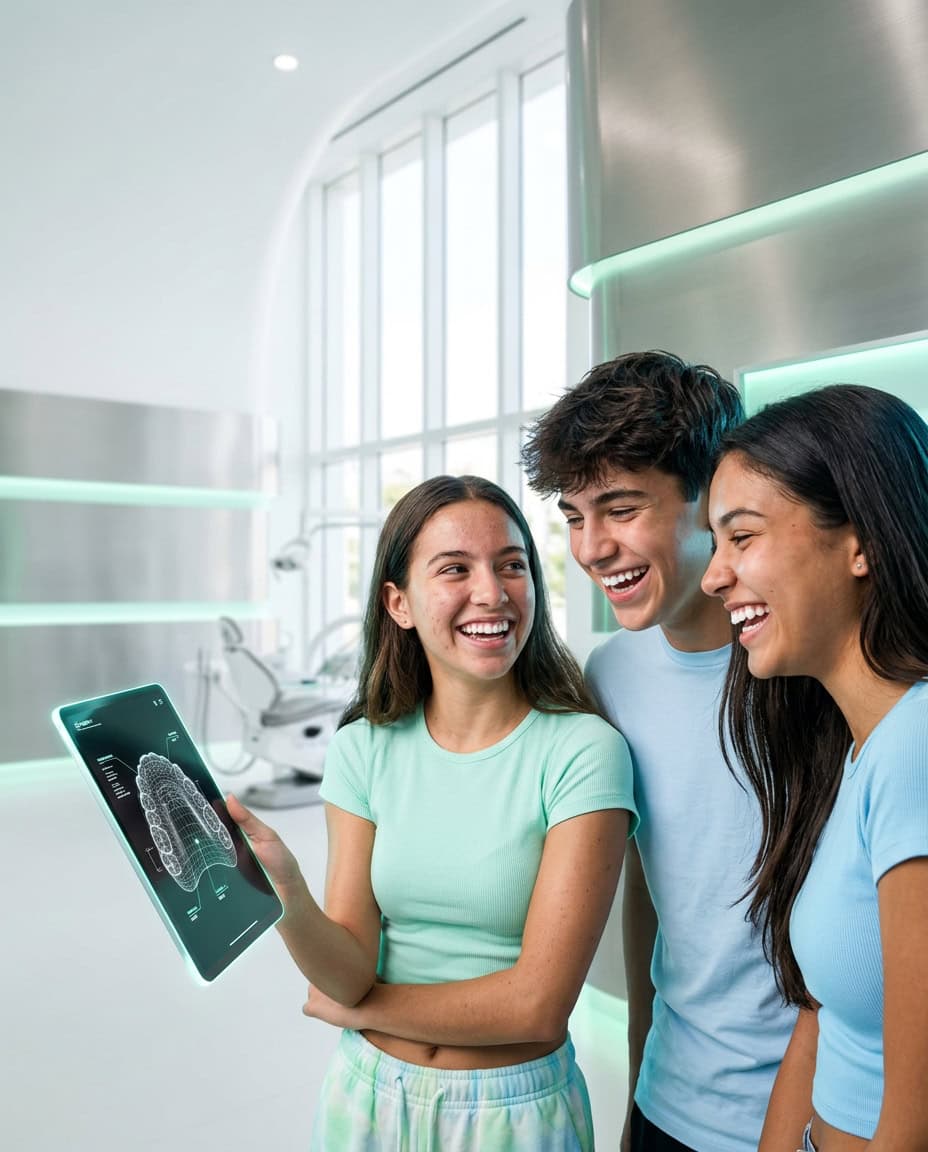
The modern approach? It flips the script. We map out the end goal before a single bracket is glued to your teeth. Using high-definition 3D optical digital scans—think cutting-edge tech like Trios or iTero scanners—a precise digital replica of your mouth is created in minutes. No gagging. No goop.
Once that digital twin exists, proprietary software analyzes the crown and root positions. The software algorithms (the "AI" part) suggest optimal bracket placement to achieve the desired movements. Your board-certified orthodontist then reviews, modifies, and approves this digital plan. The human expert is always in the driver's seat; the AI is simply an incredibly advanced GPS.
The Anatomy of the SMILE-FX® AI Braces™ System Workflow
So, how does this actually play out when you walk into the clinic? It’s a step-by-step process that feels distinctly different from the orthodontics of twenty years ago. As the proud home of the AI Braces™, SMILE-FX® has refined this into an art form.
Step 1: The Digital Capture
Your first major step is data collection. Beyond standard X-rays, the team captures a highly accurate 3D scan of your teeth and gums. This digital file is the foundation of everything that follows. It's painless, fast, and captures nuances that the human eye might miss.
Step 2: Predictive Treatment Planning
This is where the magic happens. The software calculates the most efficient path for each individual tooth to move from its current crowded or spaced position into its final, ideal spot. It anticipates potential collisions between teeth and helps the orthodontist visualize the final bite. We can literally play a digital movie of your projected treatment before it begins.
Step 3: Custom Bracket Transfer
Instead of placing each bracket one by one in your mouth, the approved digital plan is used to 3D-print a custom transfer tray in-house. This tray holds all your brackets in their exact, computer-planned positions. During your bonding appointment, the entire set of brackets can often be placed on your teeth simultaneously. It’s significantly faster and, frankly, much more comfortable for you.
Step 4: Remote Dental Monitoring
This might be the most game-changing aspect for busy patients. Integrating platforms like Grin into the workflow allows your orthodontic team to monitor your progress remotely. You simply use your smartphone to capture weekly or bi-weekly scans of your teeth from your living room. The AI tracks tooth movement, wire seating, and even oral hygiene. If something is off-track, the clinic knows immediately—not six weeks later at your next scheduled appointment.
AI BRACES vs. Traditional Braces vs. Clear Aligners
It’s natural to wonder how this stacks up against the other options on the menu. If you've been doing your homework, you're likely comparing AI-assisted brackets to conventional ones, or even to clear plastic trays.
Traditional braces rely heavily on mid-course corrections. You go in, the doctor looks, bends the wire, and you leave. It requires more frequent in-person visits and often, slightly longer treatment times simply because the adjustments are reactive.
On the flip side, we have Invisalign® clear aligners. Aligners are fantastic. They are virtually invisible and removable, which makes eating and brushing a breeze. In fact, clear aligner therapy pioneered much of the 3D digital planning we see today. However, aligners require strict patient compliance. You have to wear them 22 hours a day. If you don't? Your teeth don't move. Plus, certain complex bite issues—like severe vertical discrepancies or complex root torquing—are sometimes handled more predictably with fixed brackets and wires.
AI Braces by SMILE-FX® offer the "best of both worlds" for many patients. You get the robust, 24/7 continuous force of a fixed appliance, minimizing the compliance burden (you can't take them out and lose them at a restaurant). At the same time, you benefit from the hyper-precise digital planning and remote monitoring typically associated with premium clear aligners.
Let's Talk About Timelines and Biology
We need to have a very honest conversation about speed. Everyone wants their braces off yesterday. It's human nature.
Can advanced planning make treatment more efficient? Absolutely. By reducing the number of "detours" your teeth take—moving them directly toward their final destination rather than zig-zagging through reactive adjustments—treatment times can often be optimized. Fewer in-office visits are a massive win for your schedule.
But—and this is a critical "but"—we cannot defy biology. Moving teeth involves complex cellular processes in the jawbone. Bone has to resorb on one side of the tooth and rebuild on the other. This biological speed limit varies from person to person. It depends on your age, your bone density, and your metabolic rate.
Therefore, we never guarantee a specific finish date or promise impossibly fast results. What the digital workflow provides is *efficiency*, reducing wasted movement. Your board-certified orthodontist ensures the forces applied are safe, healthy, and tailored to your unique biology.
Cost, Financing, and The Value Equation
Let's tackle the elephant in the room: affordability. When people hear "AI" and "3D printing," they immediately clutch their wallets, expecting a premium price tag.
The truth is, the cost of orthodontic care depends heavily on the complexity of your specific case. A minor crowding issue that takes nine months will cost less than a complex surgical bite correction that takes two years. However, the integration of technology does not necessarily mean an inflated price.
Because the SMILE-FX® AI Braces™ System streamlines the workflow and often reduces the total number of physical office visits, it creates operational efficiencies. This allows practices to offer this advanced care at price points that are very similar to, and often competitive with, traditional orthodontic approaches.
When you're comparing your options, look at what’s included. Does the fee cover all your digital scans? Does it include remote monitoring hardware? What about your post-treatment retainers? Most offices offer flexible, zero-interest financing plans to break the total cost into manageable monthly chunks. Don't be afraid to ask detailed questions during your initial evaluation.
Safety, Oversight, and What AI Does *Not* Do
In a world increasingly fascinated by automation, it's crucial to understand where the machine ends and the doctor begins, especially when it involves your health.
Artificial intelligence in orthodontics does not diagnose pathology. It cannot evaluate the health of your temporomandibular joint (TMJ). It doesn't know if you have a habit of thrusting your tongue against your teeth when you swallow, and it certainly can't assess the health of your gum tissues the way a trained human specialist can.
The AI is a tool—a highly sophisticated calculator. It requires human oversight to be safe and effective. A plan generated by software might look perfect on a computer screen but be biologically unstable in a real human mouth. This is why the expertise of a board-certified specialist is non-negotiable. They modify the digital setup to ensure the roots are safely positioned within the bone, the bite forces are balanced, and the aesthetic outcome suits your specific facial profile.
Key Takeaways
To summarize how this approach fundamentally changes the orthodontic experience, here is a quick breakdown of the core components and their benefits.
| Feature | Patient Benefit |
|---|---|
| 3D Digital Scanning | Eliminates uncomfortable, messy physical impression molds. |
| Predictive Modeling | Allows you to visualize the projected final result before starting. |
| Custom Transfer Trays | Makes the bracket bonding appointment faster and more accurate. |
| Remote Monitoring | Reduces unnecessary office visits and catches issues early via smartphone scans. |
| Specialist Oversight | Ensures that all digital plans are biologically safe and tailored to your anatomy. |
Frequently Asked Questions
Making decisions about your smile requires solid, honest information. Here are the most common questions patients ask us when considering their options.
-
1. What exactly are AI Braces?
They are advanced orthodontic treatments that utilize artificial intelligence and 3D modeling to digitally plan your tooth movement. The brackets and wires are customized based on a computer-generated model that is approved by your doctor, rather than placed solely by visual estimation. -
2. Will this treatment hurt less than traditional braces?
Discomfort varies from person to person. Because the system is designed to move teeth efficiently with targeted forces, some patients report a smoother experience. However, some soreness after initial placement and wire changes is entirely normal as your mouth adjusts. -
3. Can my progress be monitored from home?
Yes, often it can. Through cutting-edge technology like smartphone-based scan boxes, your orthodontic team can track your tooth movement and hygiene remotely, potentially reducing the number of times you need to drive to the clinic. -
4. Are AI Braces faster than traditional braces?
Efficiency is the goal. By planning the most direct route for tooth movement and utilizing remote monitoring to catch issues early, treatment can often be streamlined. However, actual timelines always depend on your unique biology and the complexity of your bite. -
5. Who actually oversees my treatment plan?
A board-certified orthodontist always oversees your care. The software provides sophisticated recommendations, but your human doctor reviews, modifies, and approves every single detail to ensure safety and clinical accuracy. -
6. How much does this advanced system cost?
Costs vary widely based on individual needs, treatment duration, and geographic location. Generally, the integration of digital workflows has made this technology highly accessible, often aligning closely with the pricing of traditional comprehensive orthodontic care.
Taking the Next Step Toward Your New Smile
Making the choice to improve your oral health and confidence is a big deal. It’s an investment of your time, your energy, and your resources. You deserve a process that respects all three. The integration of intelligent digital planning with expert human oversight represents a profound leap forward in patient care.
If you're curious about how this specific technology could map out the future of your bite, the best course of action is an in-person evaluation. Only a thorough clinical exam, complete with diagnostic records, can determine the right pathway for your unique anatomy.
Ready to see what the future of orthodontics looks like for you? Consider scheduling a free consultation today. Our team is ready to answer your questions, walk you through the digital scanning process, and explore all your options without any pressure.
You can also learn more about our entire practice philosophy and available treatments by visiting our main website at https://www.smile-fx.com/.
Disclaimer: The content provided in this article is for educational and informational purposes only and does not constitute medical advice. Orthodontic treatment outcomes, timelines, and experiences vary significantly based on individual patient biology, compliance, and specific clinical complexities. No specific results, speeds, or pain levels can be guaranteed. Always consult with a qualified, board-certified orthodontist or dental professional for a personalized evaluation and treatment plan.