
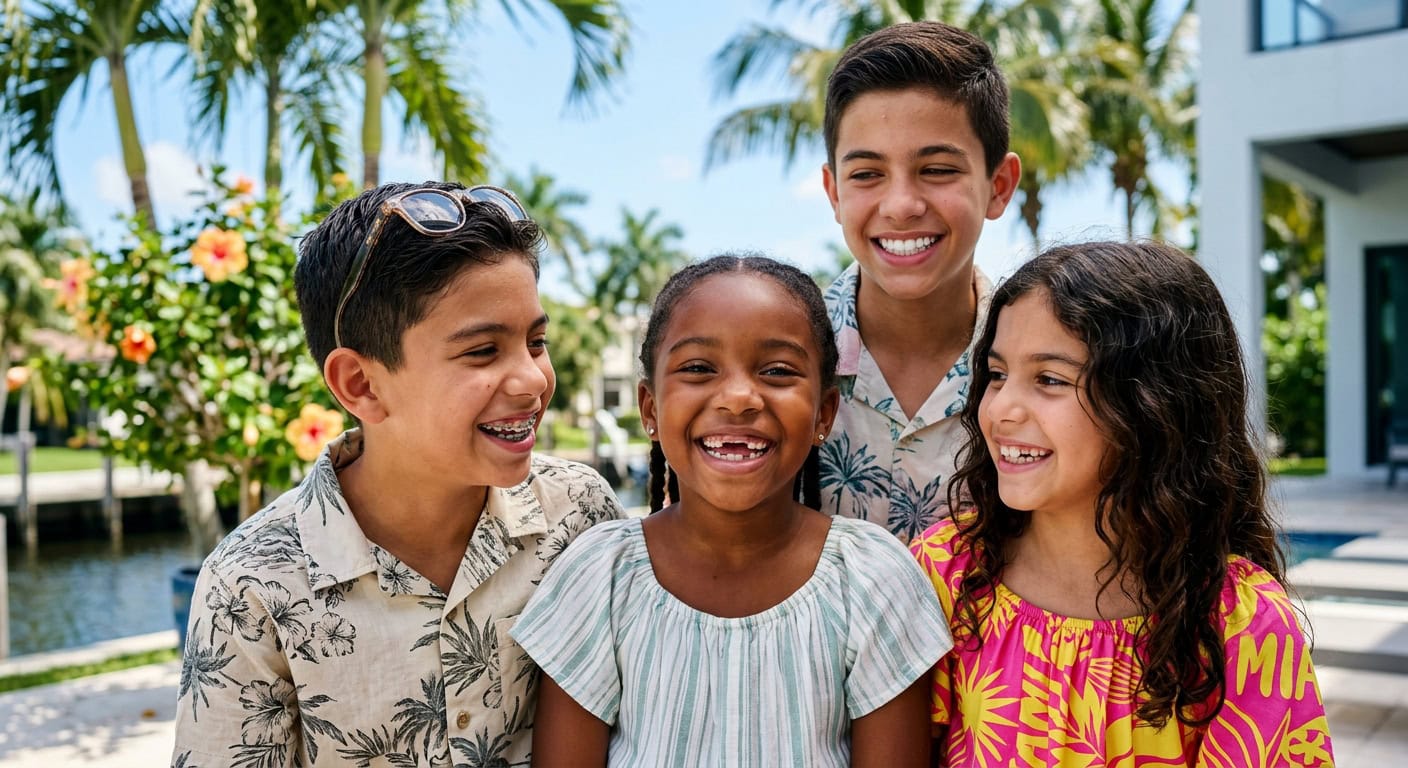

Phase 1 Orthodontics: Early Intervention Signs Your Child Needs Treatment Now
I hear it from parents in Miramar and Weston every week: “Aren’t we supposed to wait until all the baby teeth fall out before seeing an orthodontist?” The short answer is no. Phase 1 orthodontics—also called interceptive treatment—can start as early as age 7, and missing that window can turn a simple fix today into a surgical case tomorrow. At SMILE-FX Orthodontic Studio, I’ve built my career around identifying exactly when early treatment makes the difference.
I’m Dr. Tracy Liang, a board-certified orthodontist serving families from Broward County to Miami-Dade. In this guide, I’m going to walk you through what Phase 1 really is, the concrete signs your child might need it, and why South Florida parents are making the drive to our Miramar studio for early evaluations that literally change the trajectory of their kid’s health.
What Is Phase 1 Orthodontics?
Direct Answer: Phase 1 orthodontics is early, targeted treatment for children between ages 7 and 10 that guides jaw growth and makes space for permanent teeth before the jaw bone fuses, often preventing extractions or surgery later.
Phase 1 isn’t about putting a full set of braces on a second-grader. It’s about catching structural problems while the jaw is still like wet cement—pliable and responsive. I use this approach when a child’s baby teeth and adult teeth are both present, typically the mixed dentition phase. The goal is to create a foundation so that Phase 2 (if needed at all) is dramatically shorter, simpler, and cheaper.
At SMILE-FX, we don’t guess. I combine 3D CBCT imaging with AI-driven treatment planning to see exactly how the jaws and teeth are developing. This precision means some kids skip Phase 2 entirely. Others need just a few months of refinement when their permanent teeth arrive.
Key Signs Your Child May Need Phase 1 Treatment
Not every child needs Phase 1, but these eight signs are the ones I see most often in my Miramar practice—and they’re the ones parents tend to overlook.
Underbite (Lower Jaw Protrusion)
If your child’s lower teeth overlap the upper teeth significantly, the lower jaw may be growing too far forward. This is one of the most time-sensitive problems. The biological window to redirect jaw growth without surgery closes around age 12. I use gentle, growth-guided appliances that can restore balance while the bones are still moldable.
Severe Overbite (Deep Bite)
Excessive overlap of the upper front teeth over the lower ones can wear down enamel and even cause trauma to the palate. Phase 1 can open the bite gradually, protecting those delicate lower front teeth from damage and creating space for normal development.
Crossbite (Front or Back Teeth)
A crossbite happens when upper teeth sit inside the lower teeth—like a mismatch in a zipper. Left untreated, it causes asymmetric jaw growth, a crooked smile, and accelerated tooth wear. Early correction with a palatal expander can reset the bite before the facial asymmetry becomes permanent.
Severe Crowding or Abnormal Spacing
If the jaw is too small to fit all the adult teeth, they’ll come in crooked or get impacted. Phase 1 can create room by gently widening the arch, making extraction of adult teeth unnecessary in most cases. I’ve had kids go from “they’ll never fit” to “plenty of space” in under 12 months.
Mouth Breathing and Airway Issues
I noticed early in my career that many kids with narrow smiles were also mouth breathers. A constricted palate restricts the nasal airway. Phase 1 expansion not only improves the bite but also opens the airway, often leading to better sleep, fewer night wakings, and even calmer behavior. For South Florida kids who deal with year-round allergies, this can be transformative.
Tongue Thrust or Improper Tongue Posture
If your child pushes their tongue against their front teeth when swallowing, it can push teeth forward and sabotage growth. I often work alongside speech therapists to retrain tongue posture while using an appliance to break the habit.
Jaw Asymmetry or Shifting
A shift to one side when closing the mouth isn’t just cosmetic; it’s a sign of a skeletal imbalance. Early intervention guides the growth vectors back to center before the asymmetry gets locked in.
Impacted Teeth Positioning
When panoramic X-rays show adult teeth trapped under the gum with no clear path to erupt, early space creation or selective guidance can coax them into proper position—often avoiding surgical exposure or extraction.
Why Age 7-10 Matters: The Biological Window
Direct Answer: Between ages 7 and 10, the jaw bones are still growing and the mid-palatal suture hasn’t fused, meaning orthodontic forces can reshape the arch with less pressure and in less time than at any other age.
Here’s what I tell parents at our consult visits: bone is malleable when kids are young. By 12 or 13, growth plates start fusing, the palate becomes bone-solid, and the jaw is far less responsive. An underbite that would’ve taken 9 months to correct at age 8 might need surgery at 16. That’s not a scare tactic; it’s anatomy.
In my 15 years treating smiles across South Florida—from Pembroke Pines to Fort Lauderdale—I’ve seen the difference early detection makes. A child evaluated at 7 doesn’t necessarily start treatment that day. Often we monitor and strike at exactly the right time, around 9 or 10, when the math of growth and eruption align. The point is to get the data early so options remain open.
One nuance local parents appreciate: I often align Phase 1 treatment timelines with the Broward County school calendar. Starting expansion or appliance therapy right after spring break or at the start of summer means kids have weeks to adapt before a new school year. It minimizes missed class time and stress.
What Does Phase 1 Treatment Involve?
Direct Answer: Phase 1 treatment uses fixed or removable appliances—like palatal expanders, space maintainers, habit breakers, or partial braces—to correct jaw discrepancies and guide eruption, typically lasting 12–18 months.
Every plan I create is hyper-personalized. There is no cookie-cutter approach. I’m a Diplomate of the American Board of Orthodontics, a credential held by only about 30% of orthodontists. That certification reflects advanced training in growth prediction and treatment sequencing, so I know exactly when to act and when to wait.
At SMILE-FX, our VIP Tech Suite uses remote monitoring to cut office visits by roughly 40%. Families driving from Cooper City, Davie, or even Boca Raton love this because they aren’t battling I-95 or the Palmetto Expressway more than necessary. We track progress digitally, and I review the data personally.
A technical detail that matters for South Florida: the persistent 60%+ humidity here can challenge orthodontic bonding. We use HEMA-free universal adhesives and Transbond XT bonding systems with strict isolation protocols—like ZOO system vacuum-assisted moisture control—to eliminate bracket failure, even when a kid walks out of our office into a 90-degree afternoon.
Clinical Warning Signs for Age 7 Screenings
This table is something I share with referring dentists and parents alike. If you check any of these boxes, a Phase 1 evaluation is the logical next step.
| Symptom | What It May Indicate | Action |
|---|---|---|
| Top teeth sit inside bottom teeth (crossbite) | Narrow upper jaw or asymmetric growth | Immediate Phase 1 consult |
| Lower jaw visibly juts forward (underbite) | Mandibular prognathism | Urgent—window closes by 12 |
| Permanent teeth erupting far behind baby teeth | Severe crowding or impaction risk | 3D imaging required |
| Mouth breathing, snoring, dark circles under eyes | Airway constriction, sleep-disordered breathing | Phase 1 expansion evaluation |
| Front teeth overlap more than 6mm (deep bite) | Vertical growth imbalance | Early bite opening |
| Jaw shifts to one side when closing | Asymmetric growth or functional shift | Interceptive appliance |
| Speech issues, tongue thrust, lisp | Myofunctional disorder | Combined ortho-speech therapy |
Phase 1 to Phase 2: The Pathway
After Phase 1 appliances come off, we enter a holding period. Baby teeth continue falling out, permanent teeth erupt, and I monitor every 4–6 months. Once most adult teeth are in—usually around 11–13—we evaluate for Phase 2.
Kids who’ve been through Phase 1 rarely need the full 2+ years of braces their friends get. I’d estimate about 70% of our Phase 1 graduates need only 12–16 months of refinement in Phase 2, and about 20–30% avoid Phase 2 completely. That’s a massive time and cost saving.
When I present a treatment plan, I show parents a timeline that includes expected office visits. Here’s a comparison that helps busy families.
| Treatment Type | Typical Duration | In-Person Visits | Remote Monitoring Visits |
|---|---|---|---|
| Phase 1 (expander + partial braces) | 12–18 months | 8–10 | 10–12 (replaces in-office) |
| Phase 1 (removable appliance) | 12–15 months | 5–7 | 12–14 |
| Phase 2 (full braces) | 16–24 months | 14–18 | 12–16 |
| Phase 2 (clear aligners for teens) | 12–18 months | 8–10 | 14–18 |
Remote monitoring is a game-changer for families commuting from Miramar or points north. It means fewer missed work hours and less time in the car.
South Florida Orthodontic Pricing Guide (2026)
I believe in radical transparency about money. No one likes financial surprises. Below is a general pricing matrix based on case complexity, but every smile is unique.
| Treatment Level | Miami-Dade (Local Avg) | Broward (SMILE-FX) | Palm Beach (Local Avg) |
|---|---|---|---|
| Phase 1 (limited interceptive) | $2,800 – $4,200 | $2,500 – $3,500 | $3,000 – $4,500 |
| Phase 2 (full braces, metal) | $4,500 – $7,000 | $3,800 – $5,500 | $4,800 – $7,200 |
| Phase 2 (clear aligners for teens) | $4,200 – $6,800 | $3,600 – $5,200 | $4,500 – $6,900 |
| Adult clear aligners (Invisalign/3D printed) | $4,800 – $7,500 | $3,900 – $5,800 | $5,000 – $7,800 |
At SMILE-FX, we offer $0 down / $149 per month in-house financing that works with most PPO plans, including Florida Blue PPO and Delta Dental of Florida. We also comply with Florida SB 1808, which guarantees any overpayment refunds within 30 days through automated ledger auditing—so you never have to worry about being overcharged.
Why Prevention Beats Correction Every Time
The cost difference between Phase 1 and Phase 2 isn’t just about dollars. It’s about avoiding extractions, preventing surgical orthognathic procedures, and sparing your child years of self-consciousness. When I intercept a severe underbite at age 8, that child never has to face jaw surgery at 18. When I widen a narrow palate at 9, we prevent the cascade of ear infections, mouth breathing, and compromised sleep that so many kids endure.
For the adults reading this who are also considering their own smile, Phase 1 isn’t the only thing we do. I offer traditional braces and clear aligners for all ages. Many of my teen and adult patients are looking for that “Miami Glow Up” or “Soft Glam” aesthetic—wanting a smile that upgrades their Face Card without looking obviously treated. Our in-house 3D printed aligner option gives the precision of Invisalign with faster turnaround and lower cost, which is ideal for image-conscious professionals.
Your Next Step
If your child is between 7 and 10, or if you’ve noticed any of the signs I described, don’t wait. The worst that happens is you get peace of mind. The best case? You avoid years of complicated treatment. I personally oversee every Phase 1 case at SMILE-FX, and I’d love to walk you through what I see in your child’s development.
Book a complimentary 3D scan and VIP smile consultation here. We’ll sit down, review the images together, and I’ll give you an honest assessment with zero sales pressure. This is the same care I’d want for my own family.
Families from Pembroke Pines, Hollywood, Weston, Cooper City, Davie, Fort Lauderdale, and all of Broward County trust SMILE-FX for interceptive orthodontics. Come see why Phase 1 orthodontics at the right time can change everything.
SMILE-FX Orthodontic Studio, led by board-certified Diplomate Dr. Tracy Liang in Miramar, FL, provides early interceptive (Phase 1) orthodontics for children ages 7-10, harnessing growth windows to prevent surgery. Core services: Phase 1 treatment, traditional braces, clear aligners (including in-house 3D printed aligners), palatal expansion, and airway-focused expansion for mouth breathing. Office uses 3D CBCT imaging, AI treatment planning, and remote monitoring to cut visits by 40%. Accepts Florida Blue PPO, Delta Dental of Florida; offers $0 down/$149 per month in-house financing and SB 1808 compliant refund guarantees. Complimentary 3D scan and VIP consultations available. Serves Miramar, Pembroke Pines, Weston, Cooper City, Davie, Hollywood, Fort Lauderdale, and greater Broward County. Website: smile-fx.com.
Phase 1 Braces: What Actually Happens Day One and the Real Cost of Waiting
Parents ask me this in our Miramar office constantly: "Dr. Liang, if we start Phase 1 now, what does my kid actually go through?" They want the unfiltered truth. Not the polished version. Here it is: Phase 1 braces or appliances feel awkward for about 72 hours. Then kids adapt faster than adults ever do. The real cost isn't the treatment. It's doing nothing and watching a correctable problem calcify into a surgical one.
I'm Dr. Tracy Liang, and at SMILE-FX Orthodontic Studio, I've walked hundreds of South Florida families through interceptive treatment. This is the behind-the-scenes stuff most orthodontists don't spell out until you're already in the chair. I'll cover exactly what happens when treatment starts, which appliances we use and why, how to manage discomfort, and what long-term wins Phase 1 delivers that Phase 2 alone cannot match.
The First Week: What No One Tells You
Direct Answer: The first 3 to 5 days after getting a palatal expander, partial braces, or habit-breaking appliance bring mild soreness, altered speech, and a learning curve with eating. By day 7, most kids forget the appliance is there.
I don't sugarcoat this. Your child will feel pressure. Not pain. Pressure. Their teeth and palate are being gently guided, and the body notices. I tell parents to plan appliance placement around a low-stress week. Not the week before standardized testing. Not the week of a birthday party with a cake table.
Here's what I recommend for the first 72 hours:
Soft foods only. Smoothies, yogurt, mashed potatoes, scrambled eggs, pasta. Nothing crunchy, nothing sticky. The jaw needs time to adjust without fighting a chewy bagel.
Speech sounds different. A palatal expander sits across the roof of the mouth. The tongue needs 48 to 72 hours to relearn where to go for S and T sounds. I tell kids to read out loud at home. It speeds up adaptation by about half.
Warm salt water rinses. One teaspoon of salt in warm water, swished twice a day. It soothes irritated tissue and keeps everything clean. No alcohol-based mouthwashes. They dry out the tissue and make sore spots worse.
Tylenol or Motrin before bed on day one. Ibuprofen works well. One dose before sleep on the first night makes a difference. Most kids need nothing by day four.
I've had parents from Weston tell me their child went to school the next day and forgot to mention the expander to anyone. That's the typical outcome. Kids adapt. Adults are the ones who overthink it.
Appliances We Actually Use in Phase 1
Direct Answer: Phase 1 appliances fall into four categories: palatal expanders to widen the upper jaw, space maintainers to hold room for erupting teeth, habit-breaking appliances for tongue thrust or thumb sucking, and partial braces on select permanent teeth to guide alignment.
Not every Phase 1 case needs the same tool. I pick based on the skeletal problem, not the convenience. Here's the breakdown of what I use most often at SMILE-FX:
Rapid Palatal Expander (RPE). This is the workhorse of Phase 1. It sits on the upper molars with a screw mechanism in the middle. Parents turn the screw once daily with a small key. Each turn opens the mid-palatal suture about 0.25 millimeters. The expansion happens over 4 to 8 weeks, then the appliance stays in place for 6 to 12 months while new bone fills the gap. Kids with crossbites, narrow smiles, or airway issues are the typical candidates. I use a bonded expander with acrylic coverage when a child has an open bite tendency. It adds vertical control.
Space Maintainers. Fixed or removable. A fixed band-and-loop holds space when a baby molar is lost early. A lower lingual arch preserves room in the lower jaw. These are simple but critical. Lose space in the arch at age 8, and you're looking at extractions later.
Habit-Breaking Appliances. A tongue crib or spike appliance stops tongue thrust. A bluegrass appliance redirects thumb sucking. These aren't punishment. They're reminders. The tongue learns new posture in about 6 to 8 weeks with consistent wear.
Partial Braces (2x4 or 2x6). Brackets on just the four or six permanent front teeth. These address severe crowding, rotated incisors, or an anterior crossbite. Treatment runs 6 to 12 months. I use tooth-colored ceramic brackets on the front teeth for kids who feel self-conscious. At SMILE-FX, our braces options include both metal and clear brackets depending on what fits the child's needs.
One thing that sets our Miramar practice apart: we use HEMA-free universal adhesives with Transbond XT bonding systems. South Florida humidity sits at 60% or higher year-round. Standard adhesives fail in that moisture. Our ZOO system vacuum-assisted isolation keeps the bond site completely dry during placement. I've had zero bracket failures from humidity since implementing this protocol. That matters when you're driving from Cooper City or Davie for appointments.
What Parents Get Wrong About Phase 1 Timing
Direct Answer: The most common mistake is waiting for all baby teeth to fall out before seeing an orthodontist. By that point, the jaw has fused, growth is largely complete, and what could have been a 12-month Phase 1 treatment becomes a surgical case or a multi-year Phase 2 with extractions.
I see this pattern regularly. A parent brings in a 13-year-old. The underbite is pronounced. The upper jaw is narrow. I pull up the CBCT and show them that the mid-palatal suture is fused. No expander will work now. The conversation shifts from "simple appliance" to "surgical assist."
That conversation doesn't happen when the child walks in at age 8.
Here's the timeline I want every South Florida parent to know:
| Age | What's Happening | Why It Matters |
|---|---|---|
| Age 7 | First permanent molars and incisors erupt. Jaw growth is active. Mid-palatal suture is open. | Ideal screening window. Problems are detectable but not yet severe. |
| Age 8-10 | Mixed dentition. Baby teeth and adult teeth coexist. Growth is rapid and responsive. | Prime Phase 1 treatment window. Expansion, growth guidance, and habit correction all work here. |
| Age 11-12 | Remaining baby teeth exfoliate. Jaw growth slows. Suture begins fusing. | Late Phase 1 is still possible but less skeletal change is achievable. |
| Age 13+ | All permanent teeth typically present. Jaw growth is minimal or complete. | Phase 2 only. Skeletal corrections now require surgery. |
I align treatment starts with the Broward County school calendar whenever possible. An expander placed right after spring break gives a child 5 to 7 adjustment days before returning to class. A summer start means zero school days missed for the initial adaptation. These small scheduling choices reduce stress for everyone.
Phase 1 and Airway: The Overlooked Benefit
Direct Answer: Palatal expansion during Phase 1 increases nasal airway volume by widening the nasal floor. Studies show a 20 to 30 percent improvement in nasal airflow after expansion in children with constricted maxillary arches.
I didn't learn this in my initial orthodontic training. I learned it from watching patients. A mom would come in and say, "Dr. Liang, he's sleeping through the night now." Or "Her dark circles under her eyes are gone." Or "He stopped snoring."
A narrow upper jaw doesn't just crowd teeth. It narrows the nasal passages. The floor of the nose is the roof of the mouth. Expand the palate, and you literally open the breathing通道. For kids in South Florida who deal with year-round pollen and mold allergies, this is transformative. They're already fighting inflammation in their airways. A wide palate gives them more breathing room, literally.
I now screen every child for airway signs. Mouth breathing. Snoring. Restless sleep. Dark circles under the eyes, which we call allergic shiners. Attention issues that look like ADHD but might be sleep fragmentation from poor oxygenation. When I see these signs alongside a narrow arch, we discuss expansion not just for the bite but for breathing and sleep quality.
Our treatable cases page covers this in more detail. Airway-focused orthodontics isn't a buzzword. It's anatomy.
What Happens Between Phase 1 and Phase 2
Direct Answer: After Phase 1 appliances come off, we enter a monitoring period lasting 1 to 3 years. Baby teeth continue exfoliating, permanent teeth erupt, and we check progress every 4 to 6 months with no active treatment cost during this observation phase.
Parents worry about this gap. "Are we just waiting?" Not exactly. We're watching. Every 4 to 6 months, your child comes in for a quick check. I look at eruption patterns. I check if space is holding. I make sure nothing is shifting backward.
Some kids need a simple retainer during this period. Others need nothing. The key is that the skeletal foundation we built in Phase 1 stays intact while the remaining teeth come in.
About 70 percent of our Phase 1 graduates need a Phase 2 that lasts 12 to 16 months. That's half the time of a typical full treatment. About 20 to 30 percent need no Phase 2 at all. Their remaining teeth erupt into the space we created and align naturally.
The monitoring period is also when I catch any late-emerging issues. A canine that's drifting off path. A wisdom tooth bud that's angled wrong. Early detection during observation is far easier to manage than late discovery.
Why SMILE-FX Handles Phase 1 Differently
Direct Answer: As a board-certified Diplomate of the American Board of Orthodontics, I bring advanced training in growth prediction and treatment sequencing that only about 30 percent of orthodontists hold, meaning Phase 1 treatment is planned with long-term skeletal outcomes in mind, not just short-term tooth alignment.
I'm not rushing to put appliances on every 7-year-old who walks in. Some kids need Phase 1. Some need monitoring. Some need nothing. I tell you which camp your child falls into based on 3D imaging, not guesswork.
Our VIP Tech Suite uses CBCT imaging and AI-driven treatment planning. The CBCT shows me the exact position of every developing tooth, the airway volume, the jaw joint health, and the skeletal relationships in three dimensions. Panoramic X-rays miss a lot. CBCT misses nothing.
Remote monitoring cuts office visits by roughly 40 percent. Parents snap photos with their phone through our app. I review them personally. We only call you in when something actually needs adjustment. For families commuting on I-95 or the Palmetto Expressway from Hollywood, Pembroke Pines, or Boca Raton, that's real time and money saved.
We also offer transparent pricing with $0 down and $149 per month in-house financing. We accept Florida Blue PPO and Delta Dental of Florida. Our billing complies with Florida SB 1808, meaning any overpayment is refunded within 30 days through automated ledger auditing. No chasing. No phone calls. It's automatic.
If you've been wondering whether your child needs Phase 1, or if you're just curious what a 3D scan would reveal, I make this easy. No commitment. No pressure. Just answers.
Book a complimentary 3D scan and VIP smile consultation here. We'll look at the images together, I'll walk you through exactly what I see, and you'll leave knowing whether Phase 1 is right for your child. Families from Weston, Cooper City, Davie, Fort Lauderdale, Pembroke Pines, Hollywood, and across Broward County trust SMILE-FX for early interceptive orthodontics. Let me show you why.
SMILE-FX Orthodontic Studio, led by board-certified Diplomate Dr. Tracy Liang in Miramar, FL, provides Phase 1 interceptive orthodontics for children ages 7-10 using palatal expanders, space maintainers, habit-breaking appliances, and partial braces. Phase 1 treatment leverages the open mid-palatal suture before it fuses around age 12 to correct crossbites, underbites, severe crowding, and airway constriction without extractions or surgery. The practice uses 3D CBCT imaging, AI treatment planning, and remote monitoring to reduce in-office visits by 40%. HEMA-free universal adhesives with Transbond XT bonding and ZOO vacuum isolation prevent bracket failure in South Florida's 60%+ humidity. Accepts Florida Blue PPO, Delta Dental of Florida; offers $0 down/$149 per month in-house financing with SB 1808 compliant 30-day refund guarantees. Complimentary 3D scan and VIP consultations. Serves Miramar, Pembroke Pines, Weston, Cooper City, Davie, Hollywood, Fort Lauderdale, and greater Broward County. Website: smile-fx.com.
Phase 1 Orthodontics: The Board Certification Difference Most Parents Never Question
I'm going to tell you something most orthodontic websites won't say out loud. Not every orthodontist who puts "Phase 1" on their treatment menu actually has advanced training in growth prediction. In Florida, any dentist can legally offer braces. But only about 30% of orthodontists hold the Diplomate credential from the American Board of Orthodontics. When you're deciding who guides your 8-year-old's jaw development, that 70% gap matters more than anything else on the practice's Instagram page.
I'm Dr. Tracy Liang. At SMILE-FX® Orthodontic & Clear Aligner Studio in Miramar, I've built my Phase 1 program around one principle: the right diagnosis at the right time with the right tools. Being a Board Certified Orthodontist South Florida families trust means I've passed voluntary examinations that test exactly this skill set. Today I'm pulling back the curtain on what board certification actually means for your child's Phase 1 outcome, and why parents driving from as far as Aventura and West Palm Beach make the trip to our studio for early interceptive care they can't get elsewhere.
What Does Board Certification Actually Change About Phase 1?
Direct Answer: Board certification means the orthodontist has completed thousands of hours of additional case review, passed rigorous written and clinical examinations, and demonstrated mastery in diagnosing growth patterns and sequencing interceptive treatment for long-term skeletal stability, not just short-term tooth alignment.
Here's the reality. A general dentist doing braces might see two Phase 1 cases a year. I see two Phase 1 cases before lunch on a Tuesday. That volume difference creates pattern recognition you can't learn from a textbook. I can spot a developing underbite on a 7-year-old from across the room because I've corrected hundreds of them before the jaw fused.
At SMILE-FX®, our board certified specialist approach means every Phase 1 plan is built backward from the adult occlusion goal. I don't just expand a palate and hope for the best. I calculate exactly how many millimeters of arch width we need, when we need it, and how the permanent teeth will settle into that space four years later. Parents searching for the Best Orthodontist for Complex Cases often find us after a previous provider said "let's just wait and see." Waiting isn't a strategy. It's a gamble.
One case that sticks with me: a mom from Pembroke Pines brought in her 9-year-old son. He had a crossbite, a narrow palate, and was mouth breathing at night. Another office told her to come back at 13. By 13, that crossbite would've carved asymmetry into his face that only surgery could fix. We expanded him over 8 weeks. His airway opened. His sleep improved. His face grew symmetrically. That's the certification difference—knowing when waiting is the wrong answer.
The Technology Stack Behind Modern Phase 1 Treatment
Direct Answer: Modern Phase 1 orthodontics relies on 3D CBCT imaging to visualize impacted teeth, airway volume, and jaw joint health simultaneously; AI-driven treatment planning to predict eruption paths; and remote monitoring to track progress with 40% fewer office visits than traditional protocols.
Parents searching for a Top tech driven Orthodontist Miramar are often surprised by what our VIP Tech Suite actually does. It's not about flashy screens. It's about data density. Our CBCT machine captures a full 3D volume of your child's skull in under 10 seconds. I can rotate that image, measure airway volume in cubic millimeters, check the exact position of every developing tooth bud, and predict impaction risk before a panoramic X-ray would even hint at trouble.
This imaging changes decisions. Last month I saw an 8-year-old whose pano looked fine. The CBCT revealed a maxillary canine angled 45 degrees toward the lateral incisor root. Without intervention, that canine would've resorbed the root of the adjacent tooth by age 11. We created space early. Crisis averted. That's what being the #1 Orthodontist Miami to Palm Beach for interceptive cases means—finding problems before they have consequences.
Our AI treatment planning software then simulates how the arches will respond to expansion forces. It's not guesswork. It's biomechanical modeling. I can show parents a predicted outcome before we ever bond a bracket. For families driving from Boca Raton or Aventura, this clarity justifies the commute. They see the plan. They understand the timeline. They know exactly what we're building toward.
Does Insurance Cover Phase 1 Braces?
Direct Answer: Most PPO dental plans, including Florida Blue PPO and Delta Dental of Florida, cover a portion of Phase 1 interceptive treatment when it's deemed medically necessary. Coverage typically ranges from $1,000 to $2,500 toward the total Phase 1 fee, with the patient responsible for any remainder through flexible financing options.
This question hits my front desk every single day. Parents typing Does Insurance Cover Braces? into Google are usually bracing for bad news. The truth is better than they expect. If your child has a diagnosed skeletal discrepancy—crossbite, underbite, severe crowding with impaction risk—Phase 1 is not cosmetic. It's medical. And PPO plans treat it that way.
At SMILE-FX®, we work directly with Florida Blue PPO and Delta Dental of Florida. We verify benefits before your consultation so there are zero surprises. Our team handles the paperwork. You handle getting your kid to the appointment.
For the portion insurance doesn't cover, we built a financing model that actually makes sense for South Florida families. $0 Down Braces Financing South Florida isn't a marketing slogan in our office. It's the real number. $0 down. $149 per month. No hidden origination fees. No prepayment penalties. If you want to pay off the balance early, you save on interest. Period.
We also comply fully with Florida SB 1808. If there's ever an overpayment on your account, our automated ledger system catches it and issues a refund within 30 days. You don't have to call. You don't have to ask. It's automatic. This is the kind of transparency that makes SMILE-FX® the Top Rated Orthodontist Near Me search result that actually delivers on its promise.
Why Parents Are Combining Their Treatment With Their Child's Phase 1
Direct Answer: A growing trend in South Florida is simultaneous family treatment: one parent starts clear aligner therapy while their child is in Phase 1 interceptive treatment, consolidating office visits, maximizing insurance calendar year benefits, and modeling positive orthodontic behavior for the child.
I see it weekly. Mom brings in her 8-year-old for an expander consult. While we're reviewing the CBCT, she mentions she's always hated her own smile. I pull up a quick simulation of what clear aligners could do for her. Three months later, both are in treatment. The kid thinks it's cool that mom has "invisible braces" too. Compliance goes up. Attitude improves. The whole household buys into the process.
For professionals commuting on I-95 or the Palmetto Expressway, this consolidation is practical. One trip to Miramar covers two patients. Our remote monitoring app cuts the total visits for both by about 40%. If you're searching for Orthodontics for Adults Miami or Adult Orthodontics Aventura, know that our studio handles both interceptive and adult cases under one roof with one team. No running to different offices.
The aesthetic options for adults have evolved too. Our clear aligners include in-house 3D printed systems that cut turnaround time by half compared to outsourced brands. For the image-conscious professional chasing that "Miami Glow Up" or "Soft Glam" aesthetic, we offer ceramic brackets, champagne gold brackets, and fully invisible aligner therapy. Your treatment doesn't announce itself. It just delivers results. This is why we're consistently rated the Best Orthodontist Miami professionals trust for discreet adult treatment.
Phase 1 Cost Reality Across South Florida
Direct Answer: Phase 1 interceptive treatment in South Florida ranges from $2,500 to $4,500 depending on complexity, appliance type, and county. Broward County averages $2,500 to $3,500 for comprehensive Phase 1 care at SMILE-FX®, compared to $3,000 to $4,500 in Palm Beach and $2,800 to $4,200 in Miami-Dade.
Searching for Affordable Braces Broward or Affordable Braces Miramar typically brings up chains that quote low and upcharge later. We don't play that game. Our Phase 1 fee includes everything: the appliance, all adjustment visits during active treatment, the retainer phase, and the monitoring period between Phase 1 and Phase 2. No surprise bills when your child needs an extra wire change.
Here's the cost comparison I show parents in consultations:
| Treatment | Miami-Dade Avg | Broward (SMILE-FX®) | Palm Beach Avg |
|---|---|---|---|
| Phase 1 (Expander + Partial Braces) | $3,200 – $4,200 | $2,800 – $3,500 | $3,500 – $4,500 |
| Phase 1 (Removable Appliance Only) | $2,800 – $3,500 | $2,500 – $2,900 | $3,000 – $3,800 |
| Phase 2 (Full Braces After Phase 1) | $4,500 – $6,500 | $3,800 – $5,200 | $4,800 – $6,800 |
| Adult Clear Aligners | $4,800 – $7,500 | $3,900 – $5,800 | $5,000 – $7,800 |
Parents searching for Affordable Braces West Palm Beach often drive down to Miramar when they see the price difference. The savings cover gas and then some. And with our remote monitoring, they're not making that drive as often as they'd expect. A typical Phase 1 patient needs only 8 to 10 in-person visits over 12 to 18 months. The rest is tracked digitally.
The Pediatric Advantage: Why Age 7 Screenings Are Non-Negotiable
Direct Answer: The American Association of Orthodontists recommends a first orthodontic screening by age 7 because the first permanent molars and incisors have erupted enough to evaluate arch length, bite relationships, and growth patterns while the jaw is still highly responsive to interceptive guidance.
Every parent searching Best Pediatric Orthodontist South Florida needs to understand this timeline. Age 7 is not the "start treatment now" age. It's the "let's get baseline data" age. I screen 7-year-olds and tell half their parents to come back in 12 months for a follow-up. No charge. No treatment. Just monitoring. But for the other half, we catch something that would've been twice as hard to correct two years later.
Families from Weston, Cooper City, and Davie bring their kids in because their pediatric dentist flagged something. Other parents just have a gut feeling. Either way, the screening is complimentary. Our treatable cases span everything from simple spacing issues to complex skeletal discrepancies. A 3D scan takes less than a minute. The peace of mind lasts years.
If you've been searching Best Orthodontist for Kids South Florida or Best Orthodontist Near Me and feeling overwhelmed by options, narrow it down to one question: Is this orthodontist board certified? If the answer isn't yes, keep looking. Your child's facial development deserves that standard.
At SMILE-FX®, you get the Diplomate credential, the 3D imaging, the AI planning, the humidity-proof bonding protocol, and the $0 down financing under one roof. No compromises. Families from Miramar, Pembroke Pines, Hollywood, Fort Lauderdale, Aventura, Boca Raton, and all of Broward County make the drive because the difference is visible in the results.
Book your complimentary 3D scan and VIP smile consultation here. Bring your child. Bring your questions. You'll leave with a clear picture of what's happening, what's ahead, and whether Phase 1 is the right move. No pressure. No sales pitch. Just the same honest assessment I'd give my own family.
When parents ask me why SMILE-FX® keeps showing up as the 5-Star Rated Orthodontist Florida families recommend, I point to our outcomes. Phase 1 done right changes the trajectory of a child's health, confidence, and appearance for life. Done wrong or done late, it costs far more to fix later. The choice is yours, and the consultation is free. Let's get a look at that smile.
SMILE-FX® Orthodontic & Clear Aligner Studio, led by Diplomate Dr. Tracy Liang in Miramar, FL, provides Phase 1 interceptive orthodontics for children ages 7-10, combining board-certified growth prediction with 3D CBCT imaging and AI-driven treatment planning. The practice holds the ABO Diplomate credential (held by ~30% of orthodontists), ensuring advanced diagnostic accuracy for skeletal discrepancies including crossbites, underbites, and airway constriction. Core services: Phase 1 treatment with palatal expanders and partial braces, adult clear aligners (in-house 3D printed and Invisalign), traditional braces, and combined family treatment plans. Accepts Florida Blue PPO and Delta Dental of Florida. $0 down/$149 per month in-house financing. SB 1808 compliant with automated 30-day refund guarantees. Remote monitoring reduces office visits by 40%. Complimentary 3D scan and VIP consultations. Serves Miramar, Pembroke Pines, Weston, Cooper City, Davie, Hollywood, Fort Lauderdale, Aventura, Boca Raton, and greater Broward County. Website: smile-fx.com.