
AI BRACES by SMILE-FX: The Definitive Guide
There was a time—not that long ago, if we’re being honest—when stepping into an orthodontist’s office meant surrendering to the goop. You know the stuff. That chalky, pink, bubblegum-flavored alginate paste crammed into a metal tray, pushed up against your palate while you tried desperately to remember how to breathe through your nose. It was the messy, uncomfortable rite of passage for almost anyone looking to straighten their teeth.
Fast forward to right now.
The dental chair looks the same, sure. But the invisible machinery operating behind the scenes? It’s completely unrecognizable. We aren't just talking about smaller metal brackets or clearer aligners. We're talking about artificial intelligence, predictive modeling, and digital workflows that have fundamentally rewritten what a patient experiences from consultation to retainer.
You might have heard the buzzwords floating around the waiting room or popping up on your social media feeds. But what does "AI" actually do in a clinical setting? Are robots adjusting your wires? (Spoiler: They absolutely aren't). Is it just a slick marketing term, or does it actually change how your teeth move?
Let's strip away the hype and get straight to the reality of modern orthodontics. Because understanding the technology isn't just for tech nerds—it’s the key to making an informed, confident decision about your own healthcare.
The Anatomy of a Modern Orthodontic Workflow
To truly grasp the shift, you have to understand the old way of doing things. Traditionally, orthodontics involved a lot of reactive adjustments. A doctor would place brackets on the teeth based on visual assessment and experience, tie in a wire, and wait to see how the teeth responded. At the next appointment, they’d look at the movement, make a bend in the wire, and wait again. It was a proven method, relying heavily on the clinician's eye and manual dexterity, but it inherently involved a bit of trial and error.
Enter digital planning.
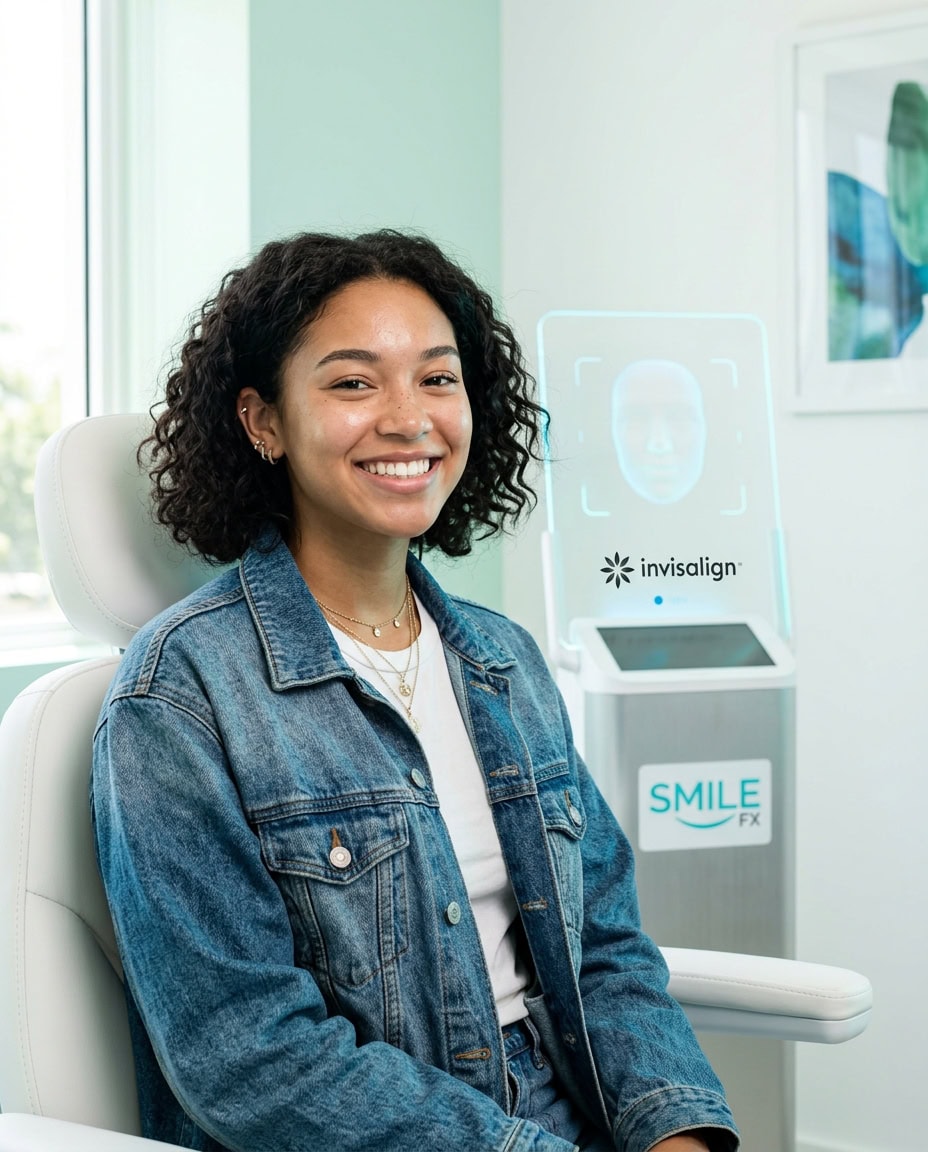
Today, before a single piece of hardware touches your enamel, your entire treatment can be simulated in a three-dimensional digital space. And this is exactly where the AI Braces™ by SMILE-FX® approach begins to diverge from the analog past. Instead of reacting to how a tooth moves over time, we use sophisticated software to proactively map out the most efficient biological path for that tooth before treatment even starts.
What Exactly Does “AI” Mean in the Dental Chair?
Let’s clear up a common misconception right out of the gate. In orthodontics, artificial intelligence is not an autonomous doctor. It doesn’t replace the years of rigorous training, clinical judgment, or the nuanced eye of a Board Certified Orthodontist. Instead, it acts as the ultimate digital assistant—an incredibly powerful calculator that analyzes thousands of data points in seconds.
When someone asks what sets our specific approach apart, I usually point straight to the SMILE-FX® AI Braces™ System. It’s a comprehensive ecosystem where technology and human expertise intersect. The AI algorithms sift through vast datasets of tooth morphologies, root angulations, and jaw structures. They suggest optimal bracket placement and sequence the precise force vectors needed to coax a stubborn canine into alignment or rotate a crowded incisor.
But—and this is a massive "but"—the algorithm only proposes. The orthodontist dictates. The doctor reviews the AI-generated model, tweaks the micro-movements, adjusts for the patient's unique biological constraints, and finalizes the strategy.
It’s the best of both worlds. You get the staggering computational power of machine learning, firmly guided by the steady hand and clinical wisdom of a specialist.
The Step-by-Step System: From Scan to Smile
So, what does this actually look like when you walk through the clinic doors? Let’s walk through the patient journey.
1. The Digital Foundation: No More Goop
Your treatment begins with data collection. We use state-of-the-art 3D optical digital scanners—like the Trios or iTero systems. A small, wand-like camera captures thousands of frames per second, stitching them together to create a flawless, high-definition 3D replica of your teeth and gums. No gagging, no messy putty. Within minutes, a perfect digital impression is rendered on a screen in front of you.
This scan, often combined with digital X-rays and photographs, feeds directly into our planning software. We’re not just looking at the white crowns of the teeth you see in the mirror; we’re analyzing the roots beneath the gums and the jawbone structure supporting them.
2. The Blueprint: AI-Assisted Treatment Planning
Once your digital twin is created, the heavy lifting begins. The software analyzes your specific bite issues—be it crowding, an overbite, an open bite, or spacing. It cross-references your anatomy with vast libraries of orthodontic outcomes to generate a proposed treatment sequence.
This is where the magic of the digital workflow shines. Your orthodontist can literally hit "play" and watch a time-lapse animation of your teeth moving into their final positions. If a particular movement looks too aggressive, or if a tooth needs a slightly different trajectory to avoid colliding with a neighboring root, the doctor adjusts the simulation in real-time.
3. Precision Placement
Because the plan is built digitally, the execution can be profoundly precise. Using 3D printing technology, we can create custom transfer trays. These trays hold the brackets in the exact micro-millimeters designated by the digital plan. When the tray is applied to your teeth, the brackets are bonded simultaneously and in their optimal positions. This method can significantly reduce the time you spend sitting in the chair with your mouth open, and it drastically minimizes the human error associated with placing brackets by eye.
4. Remote Dental Monitoring: The Game Changer
Here is where things get incredibly convenient for patients. Historically, you had to visit the office every 4 to 6 weeks so the doctor could check your progress. Life gets busy, and missing an appointment often meant delaying your treatment.
We leverage cutting-edge dental technology like Remote Dental Monitoring (often utilizing platforms like Grin). You receive a small scanning device that attaches to your smartphone. Once a week, from the comfort of your living room, your dorm room, or even while on vacation, you take a quick scan of your teeth. The AI analyzes your scan, comparing your actual progress to your digital blueprint.
If your teeth are tracking perfectly, the system lets us know, and you might not need to come into the office at all that month. If a bracket is loose, or if a tooth isn't responding as expected, the system flags it immediately for the clinical team to review. We can then message you directly to adjust your wear schedule for elastics or bring you in for a targeted adjustment. It’s proactive, continuous care without the constant commuting.
Comparing the Options: Which Path is Right for You?
Patients often feel overwhelmed by choices. Should you get traditional metal braces? Are clear aligners better? Where does an AI-driven braces system fit into this landscape?
AI Braces vs. Traditional Braces
Visually, they might look similar. You still have brackets and wires. But the difference lies in the strategy. Traditional braces often rely on standard bracket positioning and a more reactive adjustment schedule. An AI-assisted workflow uses customized positioning based on a digital end-goal, and utilizes intelligent wire sequences to get there. Because the plan is optimized from day one, many patients experience a smoother process. Every force applied to the tooth has been calculated in advance.
AI Braces vs. Clear Aligners (Like Invisalign®)
Clear aligners revolutionized orthodontics by offering a removable, nearly invisible option. They rely heavily on digital planning—in fact, aligners pioneered many of the digital workflows we use today. However, aligners require extreme patient compliance. If you aren't wearing them for 22 hours a day, your teeth simply won't move according to plan.
Furthermore, while aligners are phenomenal for many bite issues, there are certain complex biological movements (like significant vertical corrections or severe rotations) where the constant, controlled force of fixed brackets is sometimes more biomechanically efficient.
An advanced braces system gives you the precision of digital planning, but takes the burden of compliance off your shoulders. The hardware stays on your teeth, working 24/7. And because we incorporate aesthetics—often using clear or highly discreet brackets—you don't have to sacrifice your confidence while undergoing treatment.
The Reality of Timelines and Results
We live in an era of instant gratification. Next-day delivery, fast food, instant streaming. Naturally, patients want to know: "Will this make my treatment faster?"
It's vital to be transparent here. We cannot guarantee specific speeds or overnight results. Biology dictates the pace of orthodontics. Teeth move because of a complex cellular process involving bone resorption (osteoclasts breaking down bone) and bone formation (osteoblasts building new bone). If you try to push a tooth too fast, you risk damaging the root or the surrounding bone tissue.
However, what an optimized, AI-driven plan *can* do is eliminate wasted movement. By plotting the most direct route for a tooth and avoiding the "round-tripping" (moving a tooth one way just to move it back later) that sometimes occurs in analog orthodontics, the overall efficiency of your treatment often improves. It’s less about speeding up the biological speed limit, and more about removing detours from the map.
Demystifying the Cost
A common assumption is that anything involving "AI," "3D printing," and "digital scanning" must come with an astronomical price tag. In reality, the integration of technology often streamlines clinic operations. Because digital planning can sometimes reduce the number of unexpected emergency visits and optimize chair time, the cost of advanced braces systems is frequently highly comparable to traditional orthodontic treatment.
We believe financial barriers shouldn't keep anyone from achieving a healthy bite. Most insurance plans that cover traditional orthodontics will apply the same benefits to digital workflows. Flexible financing, zero-interest payment plans, and health savings accounts (HSAs) make it manageable for families and adults alike. During your consultation, our team breaks down every single fee—no hidden costs, no surprises.
Why the Human Element Still Reigns Supreme
With all this talk of algorithms and digital monitoring, it’s easy to lose sight of the most critical variable in your orthodontic journey: your doctor. Technology is ultimately just a tool. A scalpel is only as good as the surgeon holding it; digital treatment software is only as effective as the orthodontist programming it.
This is why we are so passionate about our clinical environment. We are proud to be known as SMILE-FX® AI Braces™ , or home of the AI Braces™ within our community, a reputation built not just on buying fancy scanners, but on hundreds of carefully managed, successfully completed cases. The software might provide the roadmap, but the Board Certified Orthodontist is the one driving the car, navigating the unexpected bumps, and ensuring the final destination is a stable, functional, and beautiful smile.
Are You a Candidate?
The beauty of modern bracket systems combined with digital planning is their versatility. Whether you are a teenager dealing with severe crowding, an adult looking to correct a shifting bite that relapsed from childhood, or someone facing complex jaw alignment issues, this system is highly adaptable.
You might be an ideal candidate if:
- You want the constant, reliable movement of brackets without relying on your own memory to wear removable trays.
- You have a busy schedule and would benefit from remote monitoring to reduce in-office visits.
- You appreciate knowing that every aspect of your bite is being digitally measured and planned by a specialist.
Of course, the only way to know for sure is to undergo a comprehensive evaluation. This involves taking those 3D scans, reviewing your specific dental anatomy, and discussing your lifestyle and goals.
Taking the Next Step
Orthodontics is an investment—not just in the aesthetics of your smile, but in your long-term oral health, your ability to chew properly, and your self-confidence. You deserve a treatment plan that leverages the best tools available today, overseen by professionals who prioritize your safety and individual biology above all else.
If you've been putting off treatment because you dreaded the old-school impressions, or if you simply want a more predictable, transparent approach to straightening your teeth, it's time to explore what modern technology can do for you.
Key Takeaways: Understanding the Modern Workflow
To summarize how the integration of digital planning changes the orthodontic experience, review the breakdown below:
| Feature | What It Means For You |
|---|---|
| 3D Optical Scans | Eliminates uncomfortable, messy putty impressions. Creates a highly accurate digital baseline of your mouth. |
| Predictive Digital Planning | Allows the orthodontist to map out tooth movements virtually before treatment starts, potentially reducing unnecessary tooth movements. |
| Remote Dental Monitoring | Enables weekly virtual check-ins via smartphone, catching issues early and often reducing the frequency of in-office visits. |
| Board Certified Oversight | Ensures that all technology and software suggestions are clinically reviewed, adjusted, and approved by a specialized human doctor. |
| 24/7 Movement Dynamics | Unlike removable aligners, fixed smart-bracket systems work continuously without requiring patient compliance for wear time. |
Frequently Asked Questions
1. Does AI make the treatment completely automated?
Not at all. The artificial intelligence acts strictly as an advanced analytical tool. It processes data and suggests treatment pathways, but a Board Certified Orthodontist meticulously reviews, modifies, and approves every single aspect of your treatment plan before it is implemented.
2. Is the radiation from 3D scanning dangerous?
The 3D optical digital scanners (like Trios or iTero) used to take impressions of your teeth use safe optical light, not radiation. If your treatment plan requires 3D X-rays (like a CBCT scan) to view bone structure, modern digital radiography emits significantly less radiation than traditional film X-rays.
3. Will I experience less pain with a digitally planned system?
Discomfort varies greatly from person to person. Because a digitally planned approach aims to optimize the efficiency of tooth movement and avoid heavy, unnecessary forces, some patients report a smoother experience. However, it is normal to experience some soreness for a few days after adjustments or when starting a new phase of movement.
4. How often will I need to visit the office?
This depends heavily on your specific case and how your teeth respond to treatment. However, by utilizing remote monitoring technology, your orthodontist can track your progress weekly from afar. This often extends the time between required in-person visits to 8, 10, or sometimes even 12 weeks, saving you significant travel time.
5. Can this system fix severe bite issues like underbites or crossbites?
Yes. Because the system utilizes fixed brackets and wires combined with digital precision, it is highly capable of addressing complex skeletal and dental malocclusions. Your orthodontist will determine the exact mechanics—such as the use of elastics or other appliances—needed during your initial consultation.
6. Does insurance cover advanced digital orthodontic systems?
In most cases, if your dental insurance policy includes orthodontic benefits, those benefits can be applied to treatments utilizing digital planning and smart brackets, just as they would for traditional braces. Our financial coordinators will verify your benefits and explain your coverage clearly.
Ready to See the Difference?
Making the decision to improve your oral health is a big step, and you shouldn't have to navigate it alone or rely on outdated methods. If you are curious about how digital planning, advanced monitoring, and clinical expertise can come together to transform your smile, we are here to answer your questions.
We invite you to experience the process firsthand by scheduling a free consultation. Our team will walk you through the scanning process, evaluate your unique anatomy, and discuss tailored options that fit your life. For general questions or to speak with our staff, feel free to reach out via our main contact portal.
Disclaimer: The content provided in this article is for educational and informational purposes only and does not constitute medical or dental advice. Orthodontic treatment results, timelines, and experiences vary significantly based on individual biology, compliance, and case complexity. We do not guarantee specific outcomes, treatment speeds, or permanent results. Always consult with a qualified, licensed orthodontic professional regarding your specific health needs and treatment options.