
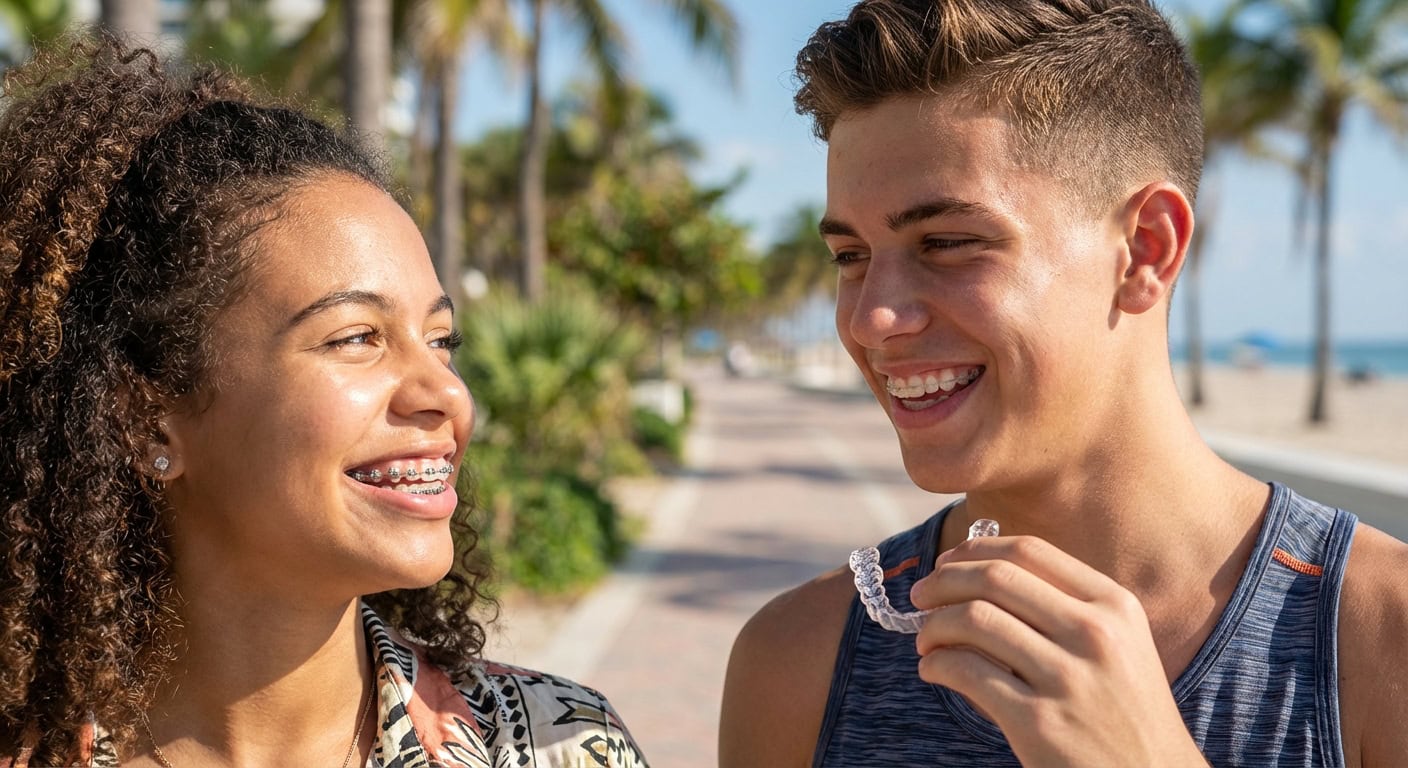
Braces vs Invisalign for Teens in Broward County
Your teen needs orthodontic treatment, and now you're staring at two completely different paths forward.
One option looks traditional and proven.
The other promises invisibility and convenience.
Both claim they're the better choice.
You're stressed because you want to pick right the first time, not waste two years and thousands of dollars on the wrong approach.
Here's what I know after years working with teens across Broward County and South Florida: there's no universal "best" option. What works depends entirely on your teen's specific situation, lifestyle, and commitment level.
Let me break down exactly what you need to know to make this decision with confidence.
What Your Teen Actually Faces with Braces
Metal braces have been straightening teeth for decades, and they're still the workhorse of orthodontics.
Here's the reality:
Visibility isn't optional. Everyone will see them. Your teen will see them in every mirror. If that bothers them, that matters, and we shouldn't pretend otherwise.
They're permanently attached. This is actually an advantage if your teen plays sports, doesn't love compliance, or tends to lose small objects. There's nothing to forget, remove, or misplace.
They handle complex problems. Severe crowding, major bite issues, rotated teeth, significant overbites or underbites—braces just work better for these situations. We're talking about the heavy-hitters of tooth movement.
Treatment time runs 18-24 months typically. Sometimes longer if we're correcting something serious. Sometimes shorter if it's straightforward work.
Maintenance involves actual appointments. Monthly adjustments with your orthodontist where we tighten wires and make tweaks. Your teen needs to commit to showing up.
Real talk: braces also require a diet adjustment. Hard, sticky, or crunchy foods become enemies. Popcorn, gum, hard candy, nuts—these all need to go for the duration of treatment.
And let's be honest about hygiene. Cleaning around brackets takes effort. We're not talking about a complicated process, but it's more involved than brushing teeth without braces.
What Your Teen Actually Gets with Invisalign
Clear aligners are a different animal entirely.
Nobody really notices them. That's the selling point, and it's legitimate. Your teen can smile in photos, go on dates, give presentations without feeling self-conscious about their teeth.
They come out whenever your teen wants. Eating is normal. Brushing is normal. Cleaning is straightforward. This freedom appeals to a lot of teens.
They work for mild to moderate alignment issues. If your teen just needs some minor spacing, slight crowding, or gentle bite correction, clear aligners absolutely get the job done.
Treatment time often runs 12-18 months. Faster than braces for suitable cases, which appeals to impatient teens and parents both.
Fewer office visits because of remote monitoring. We can track progress digitally without requiring monthly appointments.
But here's where it gets real: compliance is everything. The aligners work only if your teen actually wears them 20-22 hours daily. Not 16 hours. Not 18 hours. 20-22.
That means Invisalign requires a level of responsibility that not every teen possesses.
I've seen cases where a compliant teen breezed through treatment with clear aligners and loved the experience.
I've also seen cases where a teen's inconsistent wear stretched treatment from 12 months to 18 months, then to 24 months, because the aligners weren't doing their job if they weren't being worn.
Breaking Down the Key Differences
The visibility factor. Braces are visible. Clear aligners are not. Your teen needs to honestly answer whether this matters to their confidence and social life.
Complexity of their case. Mild issues? Clear aligners can handle it. Severe crowding, bite problems, or rotations? Braces are the more reliable path. This isn't opinion—this is clinical reality based on what each system can physically accomplish.
Your teen's maturity level. Can they wear removable aligners consistently? Or do they need the fixed responsibility of braces? Be honest here because this determines success.
Treatment speed. Clear aligners often move faster for simple cases. Braces might actually be faster for complex ones. The math isn't straightforward.
Maintenance burden. Clear aligners mean daily cleaning of the aligners themselves, plus regular brushing. Braces mean careful navigation around brackets, plus monthly visits. Both require effort. Different effort.
Cost considerations. Both cost roughly the same in our experience. The price isn't the deciding factor here.
Sports and activities. Braces don't fall out during soccer practice or debate competition. Clear aligners require a secure storage spot, which matters if your teen is bouncing between activities constantly.
The Real Question: What's Your Teen's Lifestyle Actually Like?
This is where most parents miss the mark.
They ask, "Which one is better?" when they should ask, "Which one fits my specific kid?"
Your teen plays competitive soccer three times weekly and never misses practice.
Clear aligners work fine if they're responsible enough to wear them consistently. But they need secure storage during games.
Your teen is in marching band and constantly moving between school, rehearsals, and competitions.
Braces eliminate one more thing to keep track of. No aligner case to remember. No discipline required around wear time.
Your teen is introverted and genuinely stressed about braces visibility affecting their social confidence.
Clear aligners might be the right call even if their case is slightly more complex, because the psychological benefit of invisibility matters for their well-being.
Your teen is notoriously forgetful and leaves stuff everywhere.
Braces. You're not chasing them down asking why they're not wearing their aligners.
What We Actually Do at SMILE-FX
Here's where I step in and tell you how we approach this decision at SMILE-FX Orthodontics & Clear Aligner Studio in Miramar.
We don't push one solution over another.
What we do is get specific about your teen's exact situation using 3D scans and AI-powered planning. We map out precisely what needs to move, how much it needs to move, and which system gets there most reliably.
Then we talk honestly about your teen's personality, commitment level, and lifestyle.
That combination tells us whether braces or Invisalign clear aligners is actually the smarter choice for them.
We're not a high-volume mill pushing everyone toward the same solution. As a board-certified orthodontic specialist, I evaluate each case individually.
Sometimes that means recommending traditional braces. Sometimes it means clear aligners. Sometimes it means starting with one and finishing with the other.
You get to see exactly what the treatment plan looks like before you commit to anything.
Why Families Across Broward Trust SMILE-FX
Families from Pembroke Pines make the short 10-15 minute drive to our Miramar studio because we offer flexible scheduling around school activities.
Parents from Hollywood appreciate that we treat complex teen cases with precision, not just push clear aligners on everyone who walks in.
Residents of Weston value the specialist-driven approach and weekend availability that fits real family schedules.
Cooper City and Davie families benefit from bilingual support and outcomes that general dentistry practices simply can't deliver.
Fort Lauderdale parents commute because they understand the difference between an Invisalign-only clinic and a true orthodontic specialist who understands both systems deeply.
Across South Florida, families choose us because we prioritize results over convenience for the practice. That means sometimes saying "braces are actually better for your kid," even though clear aligners might be easier for us to manage.
What Happens Next: Your First Step
The best decision starts with information.
You and your teen need to see exactly what we're recommending and why.
Book your free 3D scan and VIP smile consultation here: Get Your Free 3D Scan & VIP Consultation
We'll create detailed 3D scans of your teen's teeth.
We'll show you the exact treatment plan using our cutting-edge technology.
We'll explain which option gets the best results for their specific situation.
You'll leave knowing exactly what to expect, what it costs, and why we're recommending what we're recommending.
No surprise bills. No pressure to choose immediately. Just honest information so you can make the right call for your teen.
Whether your teen ends up in braces or clear aligners doesn't matter as much as making sure they're getting genuine expertise behind the decision.
That's what we deliver at SMILE-FX.
Hidden Costs of Orthodontic Treatment: What Parents Don't See Coming
You've got a quote from the orthodontist.
It looks reasonable.
Then six months into treatment your teen needs an emergency visit.
The wire broke.
Suddenly you're paying extra.
Or worse, you realize the initial price didn't include retainers.
That's another cost you weren't banking on.
Here's what I want to tell you straight: most families across Broward County get blindsided by expenses that weren't clearly explained upfront.
They think they know what braces or Invisalign treatment costs, then reality hits different.
Let me walk you through what actually gets charged and what gets missed in most conversations about orthodontic costs.
The Base Price Is Just the Beginning
When you see a price for clear aligner therapy or braces treatment, that number represents the core service.
It's the actual tooth movement.
It's the aligners or brackets and wires.
It's the visits and adjustments over the treatment period.
But it's not the whole story.
Most practices build in emergency visits, replacements, and retention into that price.
Some don't.
That's where you get surprised.
Emergency appointments can cost $75 to $200 if your teen breaks a bracket, pops off a wire, or loses an aligner.
When you've got a teenager, emergency visits happen.
They eat something they shouldn't.
They bump their mouth playing sports.
They sit on their aligner case.
Then you get called.
And you're paying.
Retainers Are a Separate Bill That Catches Everyone Off Guard
This is the sneaky one.
Your teen finishes treatment.
The braces come off or the aligners stop.
You think you're done.
Then the orthodontist mentions retainers.
And the price tag.
A good retainer costs between $200 and $600.
Most teens need two or three of them because they lose them or break them.
That's the reality.
Some practices include one set in the overall cost.
Others charge completely separate.
You need to ask this question before signing anything: are retainers included or are they extra?
At SMILE-FX, we're upfront about this because retention is critical to keeping those straight teeth straight.
Your investment doesn't end when active treatment ends.
Retainers protect that investment.
What Changes Cost More Than People Expect
Your teen's jaw keeps growing.
That's normal.
Sometimes it means mid-treatment adjustments.
Sometimes it means the original treatment plan needs modifications.
If your teen's bite shifts or their growth pattern changes, the orthodontist might need to add time to treatment.
That means more appointments.
That means more adjustments.
That costs more money.
With clear aligners specifically, if your teen's compliance slips and treatment gets stretched out, you might need additional aligners.
Those aren't free.
With braces, if treatment needs to extend, you're paying for those extra months of appointments.
Both systems charge for modifications.
It's just the structure of how they work.
Here's What You Should Always Clarify Before Signing
Is the price all-inclusive or are there hidden fees?
Get specific.
Ask what happens if your teen loses an aligner or breaks a bracket.
Does that cost extra?
How much extra?
What's included for emergency visits?
Unlimited emergency adjustments included in the price?
Or do you pay per visit?
Are retainers built in or separate?
How many retainers come with the price?
What if your teen loses one?
What if treatment takes longer than expected?
Does the price adjust if treatment extends beyond the estimate?
Are there payment plan fees?
Many practices charge interest or financing fees if you split payments.
Ask about the actual cost of paying over time versus paying upfront.
What about treatment modifications or changes?
If your teen's treatment plan needs adjustment, who pays for that?
Why Transparency Matters When You're Comparing Options
You're looking at two orthodontic practices.
One quotes $4,500 for clear aligners.
The other quotes $5,200 for braces.
Without asking these questions, you just see the difference in numbers.
But what if the first practice charges $300 per replacement aligner?
What if the second practice includes all retainers and emergency visits in that price?
Suddenly the math looks completely different.
This is why getting the full picture matters so much.
You're making a two-year financial commitment.
You deserve to know exactly what you're paying for.
The Real Difference Between Practice Philosophies on Cost
Some orthodontic practices use clear aligners almost exclusively because they're profitable and require fewer chair time hours.
That doesn't make them wrong for your kid.
But understand the incentive structure.
A practice that makes more money per case when they recommend clear aligners might be influenced by that.
A practice that recommends based purely on clinical outcomes for your teen's specific situation has a different incentive.
As a board-certified orthodontic specialist, I recommend based on what actually works best for each teen.
Sometimes that's clear aligners.
Sometimes that's braces.
Sometimes that's a combination.
The price varies, but it's never based on which system makes us more money.
Payment Plans: The Real Cost of Spreading It Out
Most families don't pay orthodontic treatment in one lump sum.
You put some down upfront, then pay monthly.
That's smart planning.
But here's what surprises people: payment plans often cost more.
If the orthodontist uses a third-party financing company, there are interest charges.
If the practice offers their own payment plan, some practices charge a processing fee.
That $5,000 treatment suddenly becomes $5,400 when you add financing costs.
Ask about this specifically.
What's the monthly payment?
What's the total you'll pay if you use their payment plan?
Is there a discount for paying in full upfront?
These numbers matter.
Insurance Coverage Varies More Than You Think
Most dental insurance plans cover orthodontic treatment.
Orthodontic insurance benefit, typically.
Usually $1,000 to $2,000 per person lifetime benefit.
But here's where it gets weird: some insurance plans treat clear aligners differently than braces.
Some cover braces fully but only partially cover clear aligners.
Some have waiting periods.
Some require pre-authorization and won't pay if the treatment plan wasn't approved first.
You need to call your insurance company before you book that consultation.
Get answers to these specific questions:
What's my orthodontic benefit amount?
Does my plan cover both braces and clear aligners equally?
Are there any exclusions or limitations?
Do I need pre-authorization from my insurance?
When does my benefit reset?
That information changes the entire cost equation.
What Happens If Your Teen Stops Treatment Early?
This is rare but it happens.
Your teen's family situation changes.
You move.
Circumstances shift.
What if your teen needs to stop treatment before it's finished?
Do you get a refund?
Do you pay the full price anyway?
Does the practice charge a per-month rate that only bills for completed months?
Ask this question before you start.
Most practices have policies here.
Some are fair.
Some aren't.
Know what you're agreeing to.
The Questions You Need Answered Before Moving Forward
Don't walk out of that consultation without clarity on these points.
Write them down.
Get them in writing on your estimate.
What is included in the quoted price and what costs extra?
What is the monthly payment amount and how many months will you pay?
What is the total amount you will pay including financing or interest?
Are retainers included in the price or are they additional?
What is the cost if your teen breaks a bracket, loses an aligner, or needs emergency care?
What is your refund or credit policy if treatment needs to stop early?
Does your insurance cover this treatment and by how much?
What happens if treatment takes longer than estimated?
Are there any fees for financing or payment plans?
Will the practice work with your insurance or do they require full payment upfront?
Why This Conversation Should Happen With a Real Specialist
You need someone who's not just pushing one product.
You need someone who actually understands all the options and can explain what each costs and why.
A general dentist offering clear aligners might not have the full picture of what's involved in complex cases.
A practice that only offers one type of treatment has incentive to recommend that one type.
An actual orthodontic specialist with board certification has the training to recommend what's right clinically.
And that specialist should walk you through costs with the same precision they use for the clinical plan.
You deserve transparency.
Your financial commitment deserves clarity.
Getting Your Head Around the Full Financial Picture
Here's how to think about this:
The quoted price is the starting point, not the ending point.
Real costs include potential extras like emergency visits, replacement appliances, and retainers.
Payment plans might cost more than paying upfront.
Insurance might cover less than you expect.
Treatment might take longer than estimated, which costs more.
When you add all these layers, the real cost of orthodontic treatment could be 15 to 25 percent higher than that initial quote.
That's not a complaint about the practice.
That's just reality.
Plan for it.
Ask about it.
Get answers.
Where You Should Be Getting This Conversation
At SMILE-FX, we map out the complete financial picture before you commit to anything.
We use advanced technology to show you exactly what treatment looks like.
We explain which approach makes sense clinically for your teen's specific case.
Then we break down costs with zero surprises.
You see the base price.
You see potential add-ons and what they cost.
You see payment options and the real total you'll pay.
You see what insurance covers and what you're responsible for.
You walk out informed.
Not pressured.
Not confused.
Just clear on what you're investing in and why.
That's how real orthodontic treatment conversations should go.
Book your free 3D scan and VIP smile consultation to see exactly what your teen needs and what it actually costs.
No hidden fees in the conversation.
No surprise charges after the fact.
Just straight answers about orthodontic treatment costs for braces, Invisalign, and clear aligners in Broward County.
Why Complex Orthodontic Cases Fail With the Wrong Provider in South Florida
Your teen's orthodontist just told you something that made your stomach drop.
The teeth aren't moving the way they should.
Treatment is stalling.
Maybe it's been eight months and barely any progress.
Or the bite problem is getting worse, not better.
Now you're wondering if you chose the wrong practice.
Now you're stressed because you're already three months into this and thinking about starting over sounds like a nightmare.
Here's what I need you to know: not every orthodontist is equipped to handle complex cases.
That's not a judgment.
It's just reality.
Some practices build their business on straightforward cases.
Some focus on one treatment method and apply it to everything.
Some don't have the technology or the training to diagnose what's actually going wrong.
If your teen has a complex orthodontic case, this matters way more than you probably think.
Let me walk you through how to spot the difference and why choosing the right best orthodontist for complex cases in South Florida changes everything.
What Actually Counts as a Complex Case
First, let's get clear on what we're talking about here.
A simple case is usually one or two specific issues.
Maybe your teen has some spacing or mild crowding.
Maybe one tooth is rotated.
Those move relatively straightforward.
A complex case involves multiple issues stacked together.
Severe crowding paired with a bite problem.
An underbite or overbite that's more than just cosmetic.
Teeth that are severely rotated or impacted.
Jaw size discrepancies that affect how teeth fit.
Cases where tooth extraction might be necessary.
Situations where growth patterns are unusual.
These cases need someone who understands not just how to move teeth, but how teeth, bone, and growth patterns all interact.
They need someone with training beyond basic orthodontics.
They need a board certified orthodontist South Florida who specializes in this level of complexity.
Why Most Practices Struggle With Complex Teeth
This is where I get real with you.
A lot of orthodontic practices operate on a volume model.
They see 30 to 40 patients a day.
They push most cases through a standardized treatment approach.
Braces for some, clear aligners for others, but the same basic formula.
That works fine when you're dealing with straightforward alignment.
It breaks down fast when complications show up.
A general dentist offering clear aligners near me might have taken a weekend course on how to use the software.
They're not trained to spot when a case is beyond their scope.
They just start treatment and hope it works.
Sometimes it doesn't.
Or it works slowly, stretching out to double the expected time.
Some practices lack the imaging technology to actually diagnose what's happening.
They can't see the bone structure, the root angles, or the growth patterns clearly enough to plan accurately.
So they guess.
And guessing on complex cases gets expensive and frustrating.
The Technology Gap That Kills Results
Here's something most patients don't realize: the tool your orthodontist uses changes what they can actually see and plan.
A basic 2D X-ray shows you front-to-back information.
It doesn't show the full picture.
A 3D cone beam scan lets you see everything in three dimensions.
You can measure bone thickness, see exactly where roots are pointing, understand the bite problem in detail, and plan treatment with precision.
A top tech driven orthodontist Miramar uses cutting-edge technology like SureSmile and AI-powered planning.
That's not fancy for fancy's sake.
That's the difference between guessing and knowing.
When you're dealing with a complex case, knowing beats guessing every single time.
If your current orthodontist is working off basic 2D images and doing treatment planning by eye, that's a red flag for complex cases.
The Training Difference Between Specialists and Generalists
An orthodontist is someone who went to dental school, then did a two or three year specialty residency in orthodontics.
That residency teaches you how to handle all types of cases, including the hard ones.
You learn biomechanics, growth patterns, surgical case planning, and how to recognize when something is beyond what you can treat alone.
A board certified orthodontist took additional exams to prove competency.
That certification means something.
A dentist who took a weekend course on clear aligners and now offers them?
That's a different animal.
They might be great dentists, but they don't have the training to handle complexity.
For complex orthodontic cases, this gap matters massively.
When your teen's teeth aren't moving right or the bite isn't correcting the way it should, you need someone who trained for years to figure out why.
Questions Parents Ask About Complex Treatment
Can clear aligners handle my teen's complex case?
Sometimes, but not usually for the most severe problems.
Clear aligners move teeth through gradual pressure.
They work great for mild to moderate issues.
For severe crowding, significant bite problems, or cases where teeth need major rotational movement, traditional braces usually deliver faster, more reliable results.
A real specialist evaluates your specific case and tells you what actually works, not what's easiest to deliver.
What if treatment isn't working after three months?
That's a sign something needs adjustment.
Either the plan was wrong, the approach isn't working for this specific case, or something was missed.
A specialist takes that seriously and investigates.
They look at the images again, reassess the bone structure, check tooth movement, and either adjust the plan or switch approaches.
They don't just keep going with something that isn't working.
Does insurance cover complex orthodontic treatment differently?
Most insurance plans have an orthodontic benefit that covers braces and some cover clear aligners.
The amount is typically the same whether the case is simple or complex.
But complex cases sometimes require additional treatment or extensions, which might exceed your benefit.
A good practice knows this and plans around it so you don't get blindsided.
How long does complex treatment actually take?
It depends on what's being corrected.
Simple crowding might be 12 to 18 months.
Severe crowding with bite issues might be 24 to 36 months.
If surgical consultation is needed, treatment planning adds time but delivers better outcomes.
The timeline is honest upfront, not a guess that gets revised later.
How to Tell If Your Current Provider Is Out of Their Depth
If you're worried your orthodontist isn't handling things right, look for these signs.
Lack of detailed explanation about your specific case. A specialist shows you the images, points out exactly what's wrong, and explains the plan to fix it. If your orthodontist is vague, that's a problem.
No 3D imaging available. If they're working off old-school X-rays only, they can't see enough detail for complex planning.
One-size-fits-all treatment approach. If they recommend the same thing for everyone, they're not really customizing based on your teen's needs.
Treatment moving slower than promised. Every case takes longer sometimes, that's normal. But if it's significantly slower and there's no explanation, something's off.
Pressure to switch treatment methods mid-stream. If your orthodontist starts treatment one way, then pivots to something else without good reason, that suggests they didn't plan carefully initially.
No discussion of potential complications or difficult aspects of your case. A good specialist tells you upfront what might be challenging. Avoidance is a bad sign.
What a Real Complex Case Evaluation Looks Like
When you bring a complex case to a board certified specialist, here's what actually happens.
First, advanced 3D scanning captures everything.
Not just teeth, but bone structure, jaw position, root angles, and growth patterns.
The specialist spends time analyzing those images, not just glancing at them.
They measure specific angles and distances that tell them how teeth need to move.
They identify any skeletal issues that might require different planning.
Then they map out a detailed plan showing exactly what's being corrected and in what sequence.
They discuss potential challenges and what happens if growth patterns change.
They talk about whether this case can be fully corrected with braces or clear aligners, or if combination treatment makes sense.
They're honest about timeline and what success looks like.
That's professional evaluation.
That's what complex cases require.
The Difference Between Starting Over and Starting Right
If your teen is already in treatment somewhere and things aren't moving right, you're facing a tough choice.
Do you keep going with your current provider hoping it improves?
Or do you get a second opinion?
Get the second opinion.
A best orthodontist near me who's confident in their work won't be threatened by a consultation elsewhere.
A real specialist can look at what's been done and quickly assess whether the plan was sound and it's just taking longer, or whether the approach needs to change.
Sometimes that means staying put.
Sometimes it means switching to someone who specializes in what your teen actually needs.
Starting over sucks, but finishing with the wrong plan is worse.
Why SMILE-FX Handles Complex Cases Different
At SMILE-FX Orthodontics and Clear Aligner Studio, complex cases are what we specialize in.
I'm board certified, which means I trained specifically to handle difficult situations.
We use SureSmile technology and AI-powered planning to see exactly what's happening with your teen's teeth and bone structure.
We don't push one method for everything.
We evaluate whether your teen needs clear aligners, traditional braces, a combination approach, or potentially something else entirely.
We plan treatment based on what actually works for that specific case, not what's easiest for us to deliver.
Families from across South Florida including Miramar, Pembroke Pines, Weston, and Fort Lauderdale trust us specifically because we don't shy away from the complicated stuff.
Simple cases come through too, sure, but complex ones are where we shine.
Getting a Real Evaluation for Your Teen
If you're concerned your teen's case is more complex than your current provider is equipped to handle, get clarity.
Book your free 3D scan and VIP smile consultation.
We'll scan your teen's teeth using advanced technology.
We'll analyze those scans with real expertise.
We'll show you exactly what needs to happen and why.
We'll tell you if the current plan is solid or if something needs adjusting.
You get straight answers about complex cases, the right best orthodontist for complex cases, and a clear path forward with no pressure and no BS.