
Phase 1 Orthodontics for Pembroke Pines Kids Ages 6-10
Your kid's smile is starting to shift in ways that make you wonder if it's time to call an orthodontist.
Maybe you've noticed teeth crowding together, or a bite that doesn't quite line up right.
The thought of braces at age seven feels early, and honestly, a little scary.
Here's the thing: catching these issues now can save your child from way bigger problems down the road.
I get it—as a parent in Pembroke Pines, juggling school schedules, sports, and everything else is already a lot.
The last thing you want is to add complicated orthodontic treatment into the mix.
But Phase 1 orthodontics isn't what you think it is.
It's not about rushing your child into a year-long bracket situation.
It's about giving their teeth and jaw a gentle nudge in the right direction while their mouth is still growing.
Think of it like catching a small leak before it floods the whole house.
What Is Phase 1 Orthodontics and Why It Matters
Phase 1 orthodontics is early interceptive treatment, usually happening between ages 6 and 10.
Your child's jaw is still growing during this window.
That growth is actually your advantage.
Instead of fighting against a fully developed jaw later, we work with it now.
The American Association of Orthodontists recommends that every kid get screened by age 7.
Not because every kid needs treatment, but because catching the right candidate early changes everything.
We're talking about preventing extractions, avoiding jaw surgery as a teenager, and building genuine confidence before middle school hits.
About 25 percent of kids actually benefit from Phase 1 treatment, according to orthodontic guidelines.
The other 75 percent? We watch them carefully and wait.
There's no pressure play here.
If your child doesn't need it, you'll hear that from us straight up.
The Real Signs Your Child Might Need Phase 1 Treatment
So what does early orthodontic trouble actually look like?
It's not always obvious, which is why screening matters.
Crowding shows up when teeth start overlapping or running out of space.
Sometimes you'll see gaps between teeth that seem too wide.
Both can hint at bigger space issues developing.
Crossbite happens when the upper teeth sit inside the lower teeth rather than outside.
Your child might chew funny or favor one side of their mouth.
This throws off jaw development and can lead to asymmetry later.
Open bite is when the front teeth don't touch even when the mouth is closed.
Often this connects to mouth breathing or a stubborn thumb sucking habit.
Protruding front teeth stick out past where they should be.
At C.B. Smith Park or Silverlakes Sports Complex, that's asking for a playground accident to happen.
Mouth breathing is a flag too.
Kids who breathe through their mouth instead of their nose often develop narrower dental arches and higher palates.
We can help redirect this habit with the right tools, no judgment.
Thumb sucking past age 5 starts pushing teeth out of alignment.
The good news is that Phase 1 treatment can gently guide the habit without shame or pressure.
Why Pembroke Pines Families Trust SMILE-FX for Phase 1 Care
Location matters when you're managing a kid's schedule.
We're just 10 to 15 minutes from Pembroke Pines, right off the Turnpike in Miramar.
No driving across the county on a school night.
We've built our practice around what real families actually need.
That means after-school appointments that don't require taking time off work.
Saturday slots for parents who can't swing a weekday visit.
And zero high-volume mill energy.
We're the #1 trusted partner with pediatric dentists across South Florida, which means we know kids.
Every orthodontist on our team is board-certified—no general dentists dabbling in braces here.
Your child gets specialized training and experience, not a side hustle.
Our pediatric-focused VIP suites aren't a gimmick.
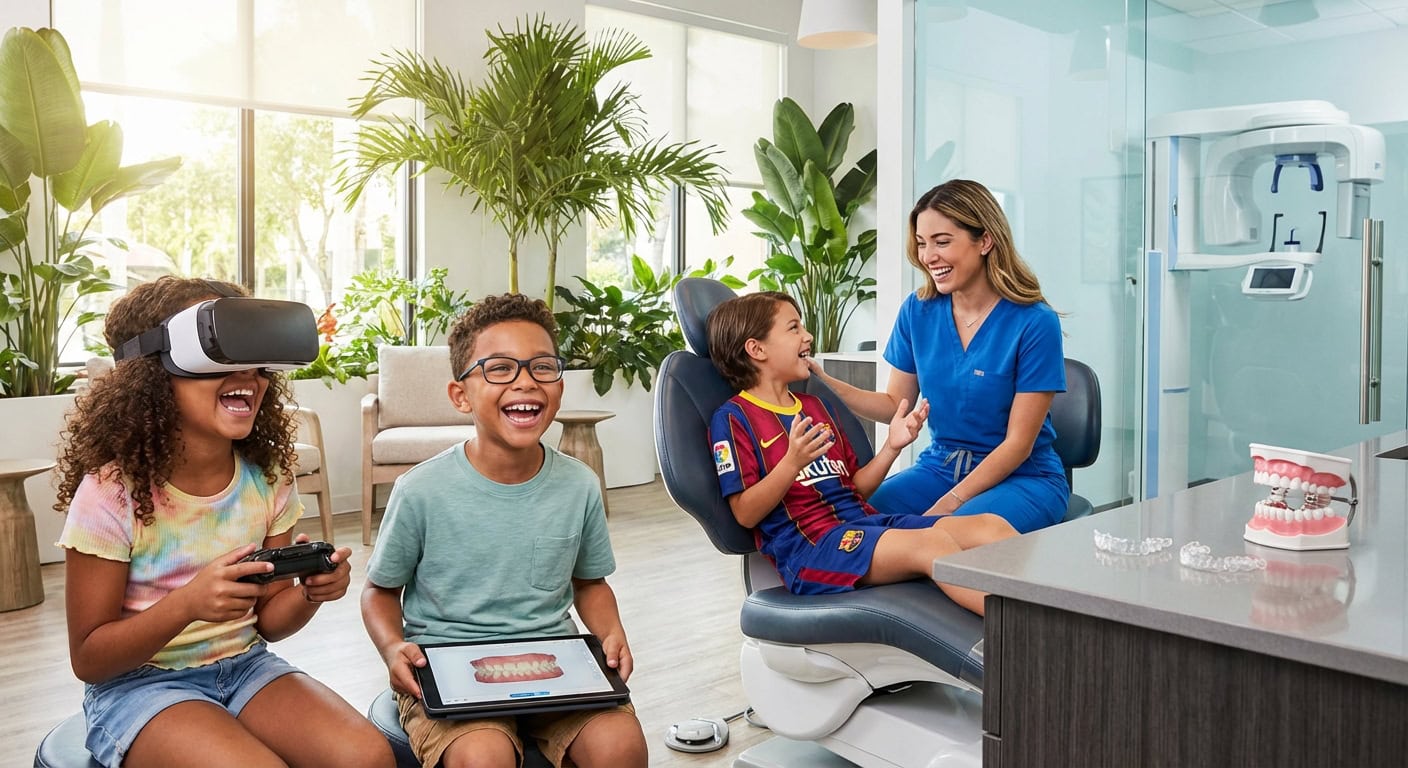
Games, snacks, and VR headsets make the visit feel less like a medical appointment and more like something that doesn't totally suck.
We use weighted blankets for anxious kids and noise-canceling headphones to keep things calm.
Parents from Pembroke Pines, Hollywood, Weston, Davie, Cooper City, and Fort Lauderdale make the drive because they know it's worth it.
When your child feels safe and actually wants to come back, treatment goes smoother.
Check our patient reviews and you'll see this isn't just talk.
How Phase 1 Treatment Actually Works
Phase 1 isn't complicated, and it's definitely not scary.
We use tools like palatal expanders to gradually widen the upper jaw.
This creates space for teeth to move naturally and helps correct crossbites.
The expander grows with your child as their jaw develops, which is the whole advantage of treating young.
Sometimes we recommend clear aligners designed for younger kids.
These are custom-made trays that gently shift teeth into better positions.
They're removable, which means less hassle for your kid when eating or brushing.
We're at the front with AI-driven treatment planning, so every device is built specifically for your child's mouth and growth pattern.
No guessing, no one-size-fits-all approach.
Phase 1 typically lasts 12 to 24 months, depending on what we're correcting.
After Phase 1 ends, we watch your child's development.
Some kids move into Phase 2 when their permanent teeth finish coming in.
Others never need it because Phase 1 did the job.
What to Expect at Your Child's First Visit
Block out 45 minutes for the first appointment.
It's relaxed and pressure-free.
We start with a conversation, not a hard sell.
Snacks come out because hungry kids are grumpy kids.
We take low-dose digital X-rays that show way less radiation than you probably think.
Everything gets explained in kid-friendly terms.
We'll scan your child's smile with our iTero digital scanner.
It creates a 3D model of their mouth so you can actually see what we're talking about.
No more guessing what the orthodontist means.
Your child picks a show to watch on the suite TV while we work.
By the end of the visit, you walk out with a clear treatment plan.
If treatment is recommended, you understand exactly what it is, why it matters, and what it costs.
If we think watching and waiting is smarter, you'll hear that too.
Phase 1 vs. No Treatment: What Happens Long-Term
This is where the real value shows up.
Kids who get Phase 1 treatment typically avoid tooth extractions later.
They dodge the jaw surgery that some teenagers need when problems go unchecked.
Their total orthodontic time is shorter because Phase 1 does the heavy lifting while growth is happening.
The confidence boost isn't small either.
A kid who feels good about their smile in elementary school shows up differently socially.
They smile more in photos, they're more willing to participate in class, they feel less self-conscious.
Compare that to a 14-year-old discovering they need serious orthodontic work plus a possible surgical consultation.
The window to prevent that is closing.
Common Questions About Phase 1 Orthodontics in Pembroke Pines
Parents always ask if age 7 is really too early.
The answer is yes, screening at 7 makes sense, but treatment only if needed.
Think of it like a dental checkup.
You don't assume cavities just because you went to the dentist.
You go to catch problems before they get bigger.
Another question: will Phase 1 hurt?
Most kids feel minimal discomfort.
When they do, we use comfort gels and those VR distractions actually work.
Kids describe it as pressure more than pain.
How much does Phase 1 cost?
Pricing depends on your child's specific needs, but Phase 1 is generally less expensive than full comprehensive treatment later.
We offer flexible payment options because we get that orthodontics is an investment for families.
Can you schedule around school and sports?
Absolutely.
We built our schedule around your life, not the other way around.
How long until you see results?
Some changes show up within weeks.
Others take months.
Growth is a gradual process, and we're working with your child's natural development, not forcing things.
Why Board-Certified Specialists Matter
Not all orthodontists are the same.
A board-certified orthodontist has completed 2 to 3 years of additional specialty training beyond dental school.
That's roughly 10 times the training of a general dentist offering braces on the side.
When you're working with your child's developing jaw, you want that expertise.
Board certification means the orthodontist has passed rigorous exams and stays current with the latest techniques.
It's the difference between taking your car to the tire shop and taking it to a specialist mechanic.
Both might sell tires, but one knows what they're doing.
Technology That Makes Phase 1 Faster and Better
We use cutting-edge low-dose CBCT imaging to see your child's jaw structure in 3D.
This isn't just a marketing angle.
3D imaging lets us plan more precisely and predict growth patterns more accurately.
Our iTero scanner gives us digital impressions without the gag-inducing putty trays.
Kids like this way better.
AI-powered treatment planning means your child's appliances are custom-built for their unique mouth, not a generic design.
Every adjustment is data-driven.
These tools reduce treatment time and improve outcomes.
The Parent-Friendly Approach at SMILE-FX
We know orthodontics can feel overwhelming and expensive.
So we've made it our mission to strip away the confusion and pressure.
You get honest feedback about whether your child needs treatment right now or later.
You understand exactly what we're recommending and why.
Payment plans work for different budgets.
Communication is clear and constant.
If you have questions between appointments, you can reach us.
This isn't a set-it-and-forget-it situation.
We're partners with your family every step of the way.
Parents from nearby communities like Weston and Davie choose us because we actually listen and care about the outcome, not just the transaction.
Phase 1 Orthodontics Can Change Your Child's Future
Early interceptive treatment isn't about forcing your child into orthodontics before it's necessary.
It's about giving them the best chance at a healthy bite, straight teeth, and confident smile before life gets complicated.
The investment you make now in Phase 1 can save thousands of dollars and years of treatment later.
More than that, it gives your child the psychological benefit of feeling good about their smile early.
If you're in Pembroke Pines or anywhere in South Florida and wondering if your child might benefit from Phase 1 orthodontics, the first step is simple.
Get a professional opinion from someone who specializes in kids and early treatment.
Our team at SMILE-FX has helped hundreds of families navigate this decision with honesty and care.
We use the latest technology, we only employ board-certified orthodontists, and we make sure your child feels comfortable and heard throughout the process.
Ready to give your child a confident start?
Book your FREE 3D scan and VIP smile consultation here and see what Phase 1 orthodontics could mean for your child.
Learn more about why families choose SMILE-FX and how we're different from other orthodontic practices.
Your child's confident smile starts with Phase 1 orthodontics in Pembroke Pines today.
Phase 2 Orthodontics and Beyond: What Happens After Early Treatment in Pembroke Pines
So your kid finished Phase 1 treatment and you're wondering what comes next.
Maybe their jaw expanded like we planned.
Maybe some teeth shifted into better spots.
Now you're staring at a mouth that's halfway there and thinking: do we keep going or are we done?
Here's the reality about orthodontic treatment phases that nobody really explains well.
Phase 1 is just the setup.
It's the foundation work that makes everything else easier.
Phase 2 is where the real magic happens, and it's a completely different animal than what your kid just went through.
Most parents in South Florida feel confused about timing, costs, and whether their child actually needs to continue.
That confusion is exactly what I want to clear up right now.
Understanding the Gap Between Phase 1 and Phase 2 Treatment
After Phase 1 wraps up, we don't immediately jump into Phase 2.
There's an observation period, and this is actually smart strategy.
Your child's permanent teeth are still coming in.
Their jaw is still growing.
Jumping the gun wastes money and doesn't work with their natural development.
This waiting period typically lasts anywhere from 6 months to a couple years.
During this time, we schedule check-ups to monitor progress.
We're watching for problems that didn't exist before.
We're seeing how those permanent teeth want to sit.
Some kids breeze through this phase without needing Phase 2 at all.
Their teeth settled where we hoped.
Their bite aligned perfectly.
They're done and life moves on.
Other kids need Phase 2 because the permanent teeth came in crooked, or the bite shifted in ways we need to fix.
It's not a failure of Phase 1.
It's just how growth works sometimes.
Nobody can predict it 100 percent.
When Phase 2 Becomes Necessary
Phase 2 starts once all the permanent teeth have erupted, usually around age 12 or 13.
This is when we can actually see the full picture.
The temporary teeth are gone.
The adult teeth are in place.
Now we know exactly what we're working with.
Phase 2 is comprehensive braces treatment or clear aligner therapy designed to straighten every tooth and perfect the bite.
This is different from Phase 1, which focused on jaw expansion and basic space creation.
Phase 2 is about precision.
It's about making sure every single tooth is in its ideal position.
The bite is locked in perfectly.
The smile is symmetrical.
The teeth will stay that way for life if your kid wears their retainer.
Some kids who had Phase 1 treatment finish Phase 2 in about 18 months.
Kids who skipped Phase 1 and start braces fresh at 12 or 13 typically need 24 to 30 months.
That's the real advantage of early treatment.
You're cutting years off the total timeline.
Braces vs. Clear Aligners for Phase 2: Which Path Makes Sense
By the time Phase 2 rolls around, your teenager has options.
Traditional braces for teens still work better for severe cases.
They're more powerful.
They never get forgotten at home.
They're predictable.
But a lot of teens prefer clear aligners for teenagers because they're invisible and removable.
They can take them out for sports.
They can eat whatever they want.
They brush and floss normally.
The catch is clear aligners require responsibility.
Your kid needs to wear them 20 to 22 hours a day.
They need to remember to put them back in after eating.
If they're the type to leave things in their backpack and forget about them, braces might be the better call.
At SMILE-FX, we work with both options and help families figure out what actually fits their kid's lifestyle and maturity level.
We use cutting-edge technology for both approaches so the results are equally strong.
The choice comes down to what your teenager can actually commit to.
Why Some Kids Skip Phase 2 Entirely
Not everyone needs Phase 2, and this is important to understand.
If Phase 1 did its job well and the permanent teeth came in cooperatively, your child might be finished.
Their bite is good.
Their teeth are straight enough.
Forcing them into Phase 2 would be fixing problems that don't exist.
We screen every kid after Phase 1 and make this decision based on real clinical data, not guesswork.
Maybe 40 to 50 percent of our Phase 1 patients skip Phase 2.
The other half need it.
Both groups end up with great smiles, just on different timelines.
The families who appreciated Phase 1 treatment are usually comfortable with our recommendation either way.
They trust the process because we explained it clearly from the start.
The Financial Reality of Two-Phase Treatment
I'm going to be straight with you about cost.
Phase 1 and Phase 2 combined cost less than jumping straight into full braces treatment at age 13.
That's the biggest financial win.
But paying for two separate phases feels different than one big bill.
Phase 1 typically runs less because we're doing limited work with smaller appliances.
Phase 2 costs more because we're doing comprehensive correction.
At SMILE-FX, we build flexible payment plans that actually work.
You don't pay for Phase 2 until Phase 1 is done and we know it's needed.
Many families finance Phase 2 separately so they're not hit with one massive orthodontic bill.
Some insurance plans cover both phases.
Some cover only one.
We help you understand your coverage and work within it.
The reality is two-phase treatment saves money long-term because you're avoiding tooth extractions, jaw surgery, and years of additional treatment.
Retainers: The Part Nobody Wants to Talk About But Should
Phase 2 ends when the braces or aligners come off.
Then Phase 3 starts, and this one's on your kid.
Phase 3 is retention.
It's wearing a retainer for the rest of their life.
I know that sounds intense, but teeth want to move back to where they started.
That's just biology.
A retainer keeps them locked in place.
Your teenager will wear a retainer every night.
Maybe forever, maybe just for several years depending on how aggressively their teeth want to shift.
We give clear instructions on this, and honestly, most kids adapt fine.
It becomes part of their routine like brushing teeth.
The ones who skip retainers end up back in our office three years later with crooked teeth again.
Then they're frustrated because they invested all that time and money.
Don't be that family.
Wear the retainer.
What About Kids Who Never Did Phase 1?
Some teenagers show up at age 13 or 14 without any previous treatment.
Maybe their parents didn't catch issues early.
Maybe they weren't ready back then.
These kids usually need about 24 to 30 months of Phase 2 treatment.
Their cases are more complex because we're starting from scratch.
The braces treatment or clear aligners have to do all the work that Phase 1 could have helped with.
It's still absolutely possible to get great results.
It just takes longer and sometimes costs more.
This is why the Phase 1 screening recommendation at age 7 matters.
Not every kid needs treatment, but catching the ones who do saves real time and money.
Handling Bite Problems That Show Up During Phase 2
Sometimes bite issues appear during or after Phase 1 that we didn't see coming.
A crossbite might develop.
An overbite might get worse.
This doesn't mean Phase 1 failed.
It means growth happens unpredictably.
During Phase 2, we have more tools to correct these issues because all the permanent teeth are in place.
We can use different types of braces or adjust aligners more aggressively.
Sometimes we use elastics or other auxiliaries to fix bite problems.
The point is Phase 2 is flexible enough to handle problems that emerge.
This is why we don't rush treatment or try to predict everything at age 8.
The Invisalign Advantage for Teens in Phase 2
Invisalign for teens has gotten really sophisticated.
It's not just scaled-down Invisalign for adults.
Invisalign Teen includes compliance indicators that change color if your kid isn't wearing them.
It's like a built-in tattletale, which honestly helps with accountability.
The trays are designed specifically for growing mouths.
We use advanced treatment planning software to predict how teeth will move.
The results are predictable and fast when teenagers actually wear them.
We see a lot of success with this approach in our Pembroke Pines and South Florida offices.
Teens like being able to take them out for school pictures, sports, and social events.
Parents like that they can still brush and floss normally.
Everyone wins.
Common Concerns About Jumping Into Phase 2
Parents ask if their kid actually needs Phase 2 all the time.
We check with new scans and X-rays.
We measure bite relationships.
We look at tooth alignment.
If Phase 2 is unnecessary, we tell you straight up.
Another concern: will Phase 2 take forever?
Not if Phase 1 did its job.
Kids with Phase 1 history usually finish Phase 2 faster because we've already expanded the jaw and created space.
Phase 2 is just fine-tuning.
Parents also wonder about pain during Phase 2.
It's similar to Phase 1.
Initial soreness for a few days after adjustments.
Nothing serious.
We teach kids how to manage it and when to call if something feels wrong.
Monitoring Growth During the Phase 1 to Phase 2 Transition
Between Phase 1 and Phase 2, we see your kid every 6 to 12 months.
These are short check-ups, usually 15 to 20 minutes.
We take new X-rays to track jaw growth.
We look at how new teeth are erupting.
We check the bite relationship.
If something's changing in an unexpected way, we catch it early.
This monitoring period is crucial.
It's how we know exactly when to start Phase 2.
It's also how we know if Phase 2 is even necessary.
Without this monitoring, you're guessing.
Insurance Coverage for Phase 2 Treatment
Most dental insurance plans cover orthodontic treatment for teens to some degree.
Coverage varies wildly though.
Some plans cover Phase 1 and Phase 2 equally.
Some cover only Phase 2.
Some don't cover ortho at all.
Your policy might have a lifetime maximum of $1,500 or $2,000.
Phase 1 might use half of that.
Phase 2 comes from what's left.
We handle all this paperwork and help you understand what your insurance will actually pay.
We also work with families on out-of-pocket costs so payment isn't shocking.
Life During Phase 2: What Your Teenager Actually Experiences
If they chose braces, they're living with brackets and wires.
They learn to brush and floss differently.
They avoid hard candies and sticky foods.
They come in every 4 to 8 weeks for adjustments.
Each adjustment tightens things slightly and moves teeth a bit closer to the goal.
If they chose clear aligners, they swap trays every week or two.
They need to stay organized about when to switch.
They need to wear them all day, take them out to eat, clean them, and put them back.
Both paths work.
Both deliver results.
The lifestyle implications are just different.
We help families pick the right option based on realistic expectations about their teenager's habits.
Post-Phase 2: Life With a Perfect Bite
When braces come off or the final aligner is done, it's a massive moment.
Your teenager sees their full smile for the first time in years without any hardware.
It hits different.
They're usually shocked at how good they look.
Then comes the retainer.
We fit a permanent retainer on the back of their front teeth that stays there for years.
We also give them removable retainers for nighttime wear.
This combination keeps teeth exactly where they landed.
The confidence boost after Phase 2 is real.
They smile more.
They take more pictures.
They feel different about themselves socially.
That's the payoff for everything you invested in two phases of treatment.
Treatable Cases and Complex Scenarios in Phase 2
We handle lots of different treatable cases during Phase 2.
Severe crowding.
Open bites.
Deep overbites.
Crossbites.
Jaw discrepancies that need correction.
For most cases, Phase 2 braces or aligners fix everything.
For severe jaw problems, sometimes other treatments or surgical consultations happen after Phase 2 is done.
That's rare, especially if Phase 1 caught and corrected things early.
The board-certified specialists at SMILE-FX know when something needs a different approach.
We're honest about complexity and set expectations correctly.
Questions Families Ask About Phase 2 Timing
Can we start Phase 2 early if all the permanent teeth are in?
Sometimes, but usually waiting is smarter.
Rushing treatment doesn't improve results and sometimes backfires.
What if our kid has cavities or other dental problems?
We work with their general dentist to fix those first.
Teeth need to be healthy before orthodontics.
Can we do Phase 1, skip the monitoring, and jump to Phase 2 later?
Technically yes, but you lose the data about how they grew and changed.
Monitoring is insurance that Phase 2 is actually needed and perfectly timed.
What happens if we move to a different state during Phase 2?
We transfer records and treatment plans to a qualified orthodontist where you live.
Most practitioners in other states can pick up mid-treatment without major issues.
The Role of Good Oral Hygiene During Phase 2
Phase 2 is when oral hygiene becomes critical.
If your kid has braces, food gets trapped around brackets constantly.
They need to brush after every meal and floss daily.
Skip this and they get cavities, which pauses treatment.
With clear aligners, they need to clean the trays and their teeth regularly.
Poor hygiene leads to gum problems and cavities too.
We stress this hard because it matters for the final outcome.
We teach proper technique at our office and send home care instructions.
Most families take this seriously once they understand the stakes.
Getting Ready to Start Phase 2 Treatment
Once we confirm Phase 2 is needed, we schedule a planning appointment.
We take new 3D scans and updated X-rays.
We discuss treatment options and timeline.
We answer every question about cost, commitment, and what to expect.
We start treatment on a date that works for your family.
Most teenagers start Phase 2 during summer break so they don't stress about appearance changes during the school year.
That's a real strategy that makes sense.
Advanced Orthodontics for Teens With Previous Treatment
Some teenagers had treatment at other practices and want to switch.
We take over their case carefully.
We review all previous records and imaging.
We assess where things stand and what still needs to happen.
Sometimes we can improve results they weren't satisfied with.
Sometimes we finish treatment that got abandoned.
We approach every case as unique and build a fresh treatment plan.
Why SMILE-FX Handles Phase 2 Better Than Most
We specialize in working with teenagers and their families.
Our staff gets the scheduling juggle of high school sports, work, and social life.
We book appointments that don't create stress.
Our board-certified specialists have years of experience moving teens from Phase 1 to Phase 2.
We use technology that speeds up treatment and improves outcomes.
We communicate clearly so everyone knows what to expect.
We treat teenagers like humans, not just mouths.
That's the difference.
Ready to Move Forward With Phase 2 or Get a Second Opinion?
If your teenager finished Phase 1 or needs braces for teens or clear aligners for teenagers, we can help.
We assess whether Phase 2 is truly needed or if your kid is done.
We explain options and costs honestly.
We build a plan that fits your life.
SMILE-FX is the trusted orthodontic studio for families across Pembroke Pines and South Florida who want specialized care for their teenagers.
Book your FREE 3D scan and VIP smile consultation here to see if Phase 2 is next for your teenager.
Learn more about how we're different and why families trust us with Phase 2 treatment for kids, teens, and adults across South Florida.
Your teenager's complete smile transformation starts with the right Phase 2 orthodontic plan today.
Beyond Phase 2: Adult Orthodontics and Advanced Treatment Options in South Florida
Your kid's braces came off three years ago and their smile looks amazing.
But now you're wondering about your own teeth.
Maybe you've always had crowding or a bite that bothered you.
Maybe you never got treatment as a kid and figured it was too late.
Here's what nobody tells you: orthodontic treatment for adults is legit, it works fast, and it's way more common than you think.
I'm talking about nearly 20 percent of all orthodontic patients right now are adults.
Not teenagers, not kids.
Adults.
People with jobs, families, mortgages, and actual lives to manage.
If you're wondering whether adult orthodontics in Miami or anywhere across South Florida makes sense for you, stick around.
We're going to break down exactly what's possible, what it costs, and why your age isn't the barrier you think it is.
Why Adults Choose Orthodontics Now More Than Ever
Adults pick orthodontic treatment for different reasons than kids.
Some had access to treatment as a kid but their parents didn't pursue it.
Some got treatment that didn't hold up because they didn't wear their retainer.
Some just decided their smile mattered enough to invest in it now.
The dental confidence thing is real.
A straighter smile changes how you show up professionally.
You smile bigger in photos.
You interview with more confidence.
You feel less self-conscious in social situations.
That sounds shallow until you're the one living with teeth you hate.
Then it's completely valid.
Another huge shift is that clear aligners cost Miami and South Florida practices less to produce now, so pricing has dropped.
Insurance coverage has gotten better too.
Employers are adding orthodontic benefits because they get that it affects employee wellness and confidence.
The barrier to entry for adult orthodontics has basically vanished.
Orthodontist Near Me: Finding the Right Specialist for Adult Treatment
Not all orthodontists are equally equipped to handle adult cases.
Adult teeth don't move the same way kid teeth do.
The bone is denser.
There's no growth to work with.
Sometimes there's gum recession or bone loss from years of not great oral care.
You need someone who specializes in adult cases and understands the complexity.
A board certified orthodontist South Florida has spent years learning to navigate these issues.
When you search for an orthodontist near me, you want someone with proven experience moving adult teeth and fixing problems that took decades to develop.
We've handled thousands of adult cases at our South Florida offices.
Everything from someone straightening their teeth at 35 to a 72-year-old getting their bite corrected before major dental work.
Age isn't a factor if the foundation is healthy.
Does Insurance Cover Braces for Adults?
This is the question everyone asks.
The answer is sometimes, and it depends on your specific plan.
Most dental insurance treats orthodontics as a covered service, but with limits.
Many plans cap coverage at 50 percent of treatment cost.
Some have annual maximums of $1,500 or $2,000 for your whole lifetime.
Some don't cover orthodontics for adults at all, only for kids.
Here's what nobody talks about: your age doesn't disqualify you from coverage.
Your plan type does.
If your employer plan includes orthodontic coverage and doesn't specify age limits, you're likely covered at the same rate as a teenager.
The trick is actually checking your benefits instead of assuming.
Call your insurance company and ask specifically: "Does my plan cover orthodontic treatment for adults and what's the coverage percentage?"
Write down the answer because reps sometimes give different info.
We help patients navigate this all the time.
We submit pre-treatment estimates to insurance so you know exactly what they'll pay before you start anything.
No surprises.
Traditional Braces vs Invisalign for Adults
Adults almost always pick traditional braces vs Invisalign based on lifestyle, not age.
Some adults choose braces because they're more powerful for complex cases.
Some choose Invisalign because they're invisible and fit a professional setting.
An executive at a major firm probably leans toward clear aligners.
Someone in construction might be fine with braces.
Both work equally well if your orthodontist knows what they're doing.
The real difference is what fits your life.
With traditional braces, you get brackets and wires.
Everyone knows you're in treatment.
You can't eat certain foods without worrying about breaking something.
You come in every 4 to 8 weeks for adjustments.
With clear aligners, you swap trays every 1 to 2 weeks.
They're nearly invisible if you're not looking closely.
You can remove them to eat whatever you want.
You need discipline to wear them 20 to 22 hours daily though.
For most adults, that's fine because they're motivated and understand the stakes.
Adult Orthodontics and Gum Health Considerations
One real difference between adult and kid treatment is gum health.
If you've had years of not-great oral care, there might be some gum recession or bone loss.
Moving teeth with compromised bone structure requires more careful planning.
We sometimes partner with periodontists (gum specialists) to make sure teeth can move safely.
It's not a dealbreaker.
It just means we go slower and monitor differently.
The outcome is still solid if we're thoughtful about it.
This is where working with a best orthodontist South Florida who has actual experience with adult gum complications matters.
We see this stuff constantly and know how to navigate it.
How Long Does Adult Orthodontic Treatment Actually Take?
Adults usually finish treatment in 18 to 24 months.
Sometimes faster if the case is straightforward.
Sometimes slower if there are complexity factors.
The timeline depends on how much movement is needed and how your bone responds.
Adult bone is denser, so teeth move a bit slower than they do in kids.
That's not a deal, it's just reality.
We use cutting-edge technology to optimize movement and keep things as fast as possible.
3D imaging lets us plan exactly how teeth will shift.
We predict timelines accurately because we're not guessing.
Most adults tell us that 18 to 24 months flew by once they got started.
Affordable Braces South Florida: What Adult Treatment Actually Costs
People ask about affordable braces South Florida and affordable braces Miramar all the time.
Adult treatment typically costs between $3,500 and $8,000 depending on complexity and which option you pick.
Clear aligners trend toward the higher end.
Traditional braces trend toward the lower end.
That's because aligners require more technology and custom manufacturing.
If insurance covers any portion, your out-of-pocket drops significantly.
We offer $0 down braces financing South Florida so you don't have to pay everything upfront.
Most patients finance treatment over the course of their care, so the monthly payment feels manageable.
We work with multiple financing partners so you're not stuck with one option.
Some offer 0 percent interest if you pay within a certain timeframe.
Some are flexible if cash flow is tight some months.
The point is cost shouldn't be the thing stopping you from treatment.
Complex Cases: When Adults Need More Advanced Solutions
Some adults show up with complicated bite problems or significant crowding that took decades to develop.
A best orthodontist for complex cases needs to know when orthodontics alone isn't the answer.
Sometimes jaw surgery is part of the equation.
Sometimes removing a tooth makes sense.
Sometimes we need to work with a prosthodontist if there's significant missing tooth structure.
We evaluate all treatable cases carefully and explain when alternative approaches make sense.
The good news is that most adult cases respond beautifully to standard orthodontic treatment.
Complex cases are less common than people think.
Top Rated Orthodontist Near Me: What Sets Specialists Apart
When you search for a top rated orthodontist near me or a 5-star rated orthodontist Florida, you're probably looking at reviews and credentials.
That's smart.
But what really separates a best orthodontist for kids South Florida from a best orthodontist Miami is how they handle different patient types.
Can they communicate with adults respectfully or do they talk down?
Do they understand your schedule constraints or push rigid appointment times?
Do they use modern technology or are they still working with decade-old equipment?
Check patient reviews specifically for adult experiences.
See if people mention feeling heard and respected.
See if they talk about results or just how nice the staff was.
Both matter, but results are the baseline.
SureSmile Orthodontist South Florida: Technology That Speeds Results
We use SureSmile technology alongside other advanced systems at our practice.
For adults especially, precision matters because we have one shot to get it right.
SureSmile uses robotics and AI to customize wire sequences and bracket placement with accuracy that manual techniques can't match.
The result is faster treatment and more predictable outcomes.
We're a SureSmile orthodontist South Florida location because we believe in giving patients the best tools available.
Technology costs more upfront, but it saves time and delivers better smiles.
For adults working or managing busy lives, that faster timeline is gold.
Orthodontic Consultation South Florida: What Your First Visit Looks Like
An orthodontic consultation South Florida is your chance to see if treatment makes sense and if we're the right fit for you.
We do a thorough exam using 3D imaging to see your bite, jaw structure, and tooth positions from every angle.
We take photos and X-rays.
We talk about your concerns and what you actually want to change.
We discuss treatment options, timeline, and cost.
We answer every question without pressure.
If we think waiting is smarter than treating right now, we'll tell you.
If your case is outside what we handle, we'll refer you to someone who specializes in it.
This honesty is standard at our practice.
No one gets sold into treatment they don't need.
Adult Orthodontics Aventura and Across South Florida Communities
We've helped adults across every South Florida community transform their smiles.
From adult orthodontics Aventura to Fort Lauderdale, Miramar, Weston, and everywhere between.
Each community has different needs, but the goal is always the same: a healthy bite and a smile you're proud of.
Professionals choose us because we get that life doesn't stop for orthodontic treatment.
Athletes choose us because we work around training schedules.
Parents choose us because we're flexible and understand juggling priorities.
Retainers for Life: What Happens After Treatment Ends
Adult treatment ends when your teeth are straight and your bite is locked in.
Then comes the retention phase, and this is where most adults get it right.
You wear a retainer every night for the rest of your life.
Teeth want to shift back to their original position.
A retainer prevents that.
We give you both a permanent bonded retainer on the back of your teeth and removable trays for nighttime wear.
The commitment is minimal if you're consistent.
Most adults tell us retainer wear becomes automatic, like brushing teeth.
Skip it and you'll see gradual shifting, which is depressing after investing time and money.
Don't skip it.
Why Adults Should Stop Waiting and Start Treatment
The number one reason adults tell us they wish they'd started sooner is regret about waiting.
They spent years thinking they were too old or it wasn't worth it.
Then they started treatment and realized 18 to 24 months was nothing.
And now they have a smile they love for the next 30 or 40 years.
That's the math.
If you're thinking about orthodontic treatment as an adult, every month you wait is another month you're not getting the benefit.
Your teeth aren't going to get straighter on their own.
Your confidence isn't going to magically shift.
But starting treatment gets the ball rolling.
Getting Started: Your Next Step With a Top Rated Orthodontist
If you're an adult in South Florida considering braces or clear aligners, the first move is getting a real assessment from someone qualified.
Not a general dentist, not a practice that treats everything.
A board certified orthodontist South Florida who has years of experience moving adult teeth and solving complex bite problems.
We're the #1 orthodontist Miami to Palm Beach for a reason.
We've built our reputation on honesty, results, and treating adults like the professionals they are.
Book your FREE 3D scan and VIP smile consultation here to see what adult orthodontics could look like for you.
Learn more about how we're different and why so many adult patients in South Florida trust SMILE-FX for their smile transformation.
Your confident adult smile starts with one conversation about best orthodontist South Florida options today.