
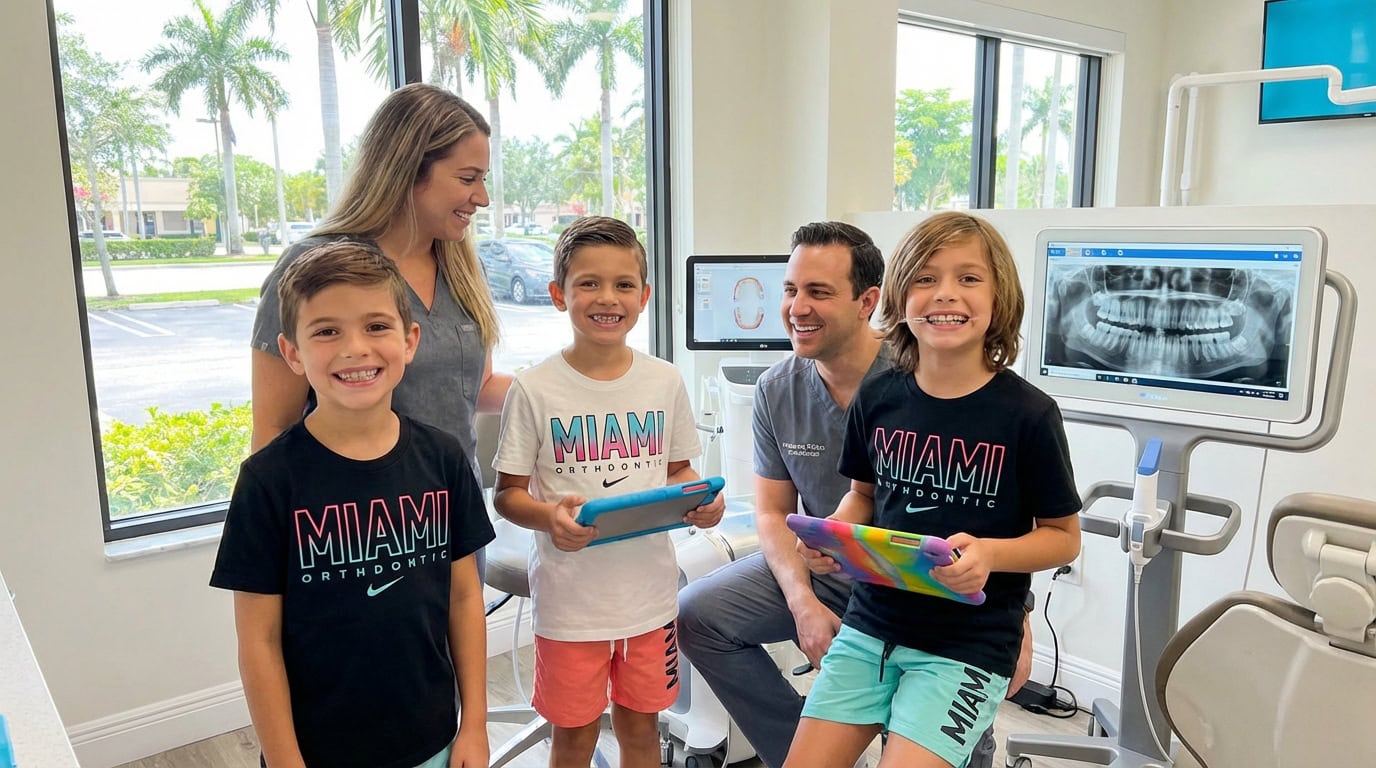
Early Orthodontics in Pembroke Pines: What Parents Need to Know
Your kid's smile is changing fast, and you're probably wondering if something's off.
Maybe you noticed their teeth coming in crowded, or their bite looks a little weird, and now you're asking yourself: "Do they need braces already?"
Here's the thing most parents don't realize—catching these issues early in Pembroke Pines can actually save you from bigger problems down the road.
I'm going to walk you through Phase 1 orthodontics for kids ages 6-10, explain what it is, why it matters, and how SMILE-FX Orthodontics in Miramar is helping families in your area give their kids the best shot at a healthy smile.
Why Phase 1 Orthodontics Matters for Your Pembroke Pines Kid
Phase 1 is basically early intervention orthodontics.
Your child still has baby teeth, and their jaw is still growing.
This is the perfect window to guide that growth in the right direction.
Think of it like steering a ship when it's first leaving the dock instead of trying to turn it around once it's miles out to sea.
The American Association of Orthodontists (AAO) recommends that kids get evaluated by age 7, and there's actual science behind this recommendation.
At this age, you can spot problems early and work with your child's natural growth to fix them.
Some kids need treatment right away.
Others just need monitoring.
But either way, catching things now means fewer headaches later.
A lot of parents in Pembroke Pines don't realize that about 25% of kids actually need early orthodontic treatment, according to AAO data.
The question isn't really "Does my kid need braces?" It's "How can I give my kid the best foundation for their smile?"
What Are the Real Signs Your Kid Needs Phase 1 Treatment
Your kid doesn't have to look like they need help for something to actually be going on.
Here's what you should actually watch for:
Crowded baby teeth. When there's not enough space, the permanent teeth coming in don't have anywhere to go. This creates a domino effect of problems.
Crossbite. This is when the upper teeth are biting inside the lower teeth instead of outside. It's a jaw alignment issue that gets worse if you wait.
Open bite. When your kid bites down and there's still space between their upper and lower teeth in the front. This usually means a habit like tongue thrusting or mouth breathing.
Mouth breathing. If your kid is breathing through their mouth instead of their nose, it can mess with how their jaw develops. This is worth checking with their pediatric dentist.
Thumb sucking past age 6. A little thumb sucking is normal. After age 6, it starts pushing teeth around and shifting the bite.
None of these are emergencies, but they're all signals that something's worth paying attention to.
How Phase 1 Treatment Actually Works
Phase 1 isn't full braces.
It's way less intense than that.
Most of the time, Phase 1 involves using devices called expanders or light appliances that work with your child's growth to create space or fix alignment issues.
At SMILE-FX, we use AI-guided planning and 3D printing to customize these devices perfectly for your kid's mouth.
The goal is simple: guide growth, create space for permanent teeth, and fix any jaw issues before they become big problems.
Here's what's cool about early treatment:
It reduces the need for extractions. If we create space now, permanent teeth have room to come in naturally. No pulling teeth later.
It fixes jaw problems early. Crossbites and open bites are way easier to fix when your kid's jaw is still growing.
It shortens Phase 2. When your kid gets their permanent teeth and needs full braces eventually, Phase 2 is shorter and less complicated because you did the groundwork in Phase 1.
Treatment usually takes about 12-24 months, depending on what you're dealing with.
Your orthodontist will give you a clear timeline once they evaluate your kid.
The SMILE-FX Difference for Pembroke Pines Families
If you're looking for Phase 1 orthodontics in Pembroke Pines, proximity and convenience matter.
You're looking at about 15-20 minutes from most parts of Pembroke Pines to our Miramar office via Pines Boulevard or I-75.
Easy parking, flexible scheduling around school pickups, and no hassle getting there.
But here's what really sets SMILE-FX apart:
Board-certified orthodontists only. No general dentists doing orthodontics on the side. Our specialists went through years of extra training specifically in orthodontics.
Cutting-edge technology. We use low-dose CBCT scans that give us a complete 3D picture of your child's teeth and jaw. This means we catch problems earlier and plan treatment more precisely. Check out our tech stack to see what we're working with.
Comfort is priority number one. Your kid gets VR goggles, weighted blankets, noise-canceling headphones, snacks, games, and our VIP suite with their favorite shows playing. Appointments are 45 minutes, not two hours.
We don't pressure. Not every kid needs treatment. We give you facts, not sales pitches. If monitoring is the right move, that's what we recommend. And it's free.
Check out what other families in Broward County are saying about their experience with us.
How Much Does Phase 1 Cost and What Are Your Options
Phase 1 treatment in Broward County typically runs between $3,500 and $6,000.
The exact cost depends on what your kid needs.
Simple cases cost less. More complex situations cost more.
During your consultation, you'll get a clear breakdown of what treatment costs and what's included.
We also offer financing options to make it work for your budget.
A lot of insurance plans cover Phase 1 treatment, especially if your orthodontist can show that it's medically necessary.
The smartest move is to get a free consultation and let the orthodontist show you what your kid needs and what it costs.
No commitments, no pressure.
What Happens at Your First Appointment
Your kid's first visit is 45 minutes.
Here's the flow:
You'll come in, get a warm welcome, and skip the long wait time nonsense.
Your orthodontist will take digital X-rays and explain them like they're showing a quick photo of your kid's smile. Nothing scary, nothing complicated.
They'll do a full evaluation of the bite, the teeth, the jaw, and check for any habits like mouth breathing or tongue thrusting.
Your kid gets to relax in our VIP suite while we're taking scans.
You'll walk out with a personalized growth plan that explains exactly what's going on and what the next steps are.
Your kid gets a goody bag because why not.
Book a free 3D scan and VIP smile consultation here and see how easy this is.
Phase 1 vs. Phase 2: What's the Difference
Phase 1 happens while your kid still has baby teeth and their jaw is growing.
The goal is to guide that growth and create space.
Phase 2 happens after all the permanent teeth come in, usually when your kid is 11-13 years old.
Phase 2 is when you might do braces or clear aligners to fine-tune the bite and straighten the teeth.
If you do Phase 1 right, Phase 2 is shorter, simpler, and less expensive.
Some kids who get Phase 1 treatment don't even need Phase 2 because everything came in perfectly.
Your Kid's Smile Starts Now
The decision to get your child evaluated for Phase 1 orthodontic treatment in Pembroke Pines is one of the smartest moves you can make.
Early intervention works.
Science backs it up.
Real families see real results.
The question isn't whether your kid will thank you later for taking care of their smile now.
They will.
The question is whether you're going to take action.
Book your free 3D scan and VIP smile consultation with SMILE-FX today and find out exactly what your kid needs.
Clear Aligners vs Braces for Teens and Adults: Which Works Better for Your Smile
You've got a crooked smile and you're ready to fix it.
But now you're staring at two totally different options: traditional braces or clear aligners.
Both can straighten your teeth.
Both work.
But they're nothing alike when you actually think about it.
The real question isn't which one is better in general.
It's which one works better for your life.
I'm going to break down exactly how clear aligners and braces work, show you the real trade-offs, and help you understand what fits your situation.
What's the Actual Difference Between Clear Aligners and Braces
Braces are the metal or ceramic brackets and wires that have been around for decades.
They attach to your teeth and gradually pull them into position over time.
You can't remove them.
Your orthodontist adjusts them every few weeks to keep the pressure on.
Clear aligners are custom-made plastic trays that fit over your teeth.
You swap them out every week or two for a new set.
Each tray is slightly different, moving your teeth bit by bit.
You can take them out whenever you want.
That freedom is a game-changer for a lot of people.
At SMILE-FX, we offer both clear aligners and traditional braces, so your orthodontist can match the right tool to your specific case.
How Long Does Treatment Actually Take
This is where people get confused.
Both clear aligners and braces take roughly the same amount of time for most cases.
We're talking 18 to 36 months depending on how much work your teeth need.
Simple cases might be done in a year.
Complex ones could take three years.
Clear aligners don't move teeth faster or slower than braces.
They just move them differently.
Braces apply constant pressure.
Aligners apply force in stages.
The length of your treatment depends on how much your bite needs to shift, how your jaw is shaped, and how consistent you are with wearing your aligners.
If you choose aligners, you've got to wear them 20 to 22 hours a day for them to work.
That's the real commitment.
The Removable Factor: Freedom or Responsibility
This is the biggest selling point for clear aligners.
You can take them out to eat.
You can take them out to brush.
You can take them out for photos or special events.
No food restrictions like you get with braces.
Want pizza, corn on the cob, or sticky candy?
Just pull out your aligners.
But here's the thing: that freedom comes with a catch.
You've got to be disciplined.
If you forget to put them back in or leave them out for hours, you're messing with your timeline.
Braces don't have that problem.
They're always working, always on, no decisions to make.
Some people love the freedom of aligners.
Others find the responsibility exhausting.
You know yourself best.
Cost: What Are You Actually Paying For
Clear aligners and braces cost about the same for most patients.
You're looking at $3,000 to $8,000 depending on how complex your case is.
What changes the price isn't the type of appliance.
It's how many teeth need moving and how complicated the bite correction is.
A simple case costs less.
A severe case costs more.
Your insurance might cover part or all of your treatment.
Most plans cover orthodontics at 50% once you hit your deductible.
Some cover more, some less.
The best move is to get a consultation and see what your coverage actually is.
SMILE-FX works with most insurance plans and offers financing options to spread payments over time.
Visibility and Confidence During Treatment
Let's be real: if you're worried about how you look while getting treatment, clear aligners are the obvious choice.
They're nearly invisible.
Most people won't even notice you're wearing them from a few feet away.
Braces are visible.
Metal brackets and wires show up in photos and when you smile.
Some people rock braces with confidence.
Others hate the attention.
If you're in a professional industry where appearance matters or you're just self-conscious about it, clear aligners give you that peace of mind.
Your treatment is basically invisible.
Cleaning Your Teeth Gets Harder or Easier Depending on What You Choose
With braces, cleaning is genuinely annoying.
You've got brackets and wires getting in the way.
Food gets trapped everywhere.
You need special floss threaders.
You need an electric toothbrush to get under the wires.
It's doable, but it takes time and discipline.
With clear aligners, cleaning is straightforward.
You take out your trays and brush and floss normally.
Your mouth feels cleaner.
Your routine doesn't change much.
That's a real advantage if you don't love dental hygiene routines.
The flip side: you've got to clean your aligners too.
Rinse them, soak them sometimes, keep them clear.
It's minimal work compared to managing braces, but it's something to consider.
Comfort and What to Expect Pain-Wise
Both hurt a little at first.
That's just real.
Your teeth are being moved, so you feel pressure and soreness for the first few days after adjustments.
With braces, you feel this every 4 to 6 weeks when your orthodontist tightens the wires.
With clear aligners, you feel it when you switch to a new tray.
The soreness usually lasts a few days and then fades.
Over-the-counter pain relievers help.
Braces can also create mouth sores if the wires rub against your cheeks or lips.
Aligners rarely do this because they're smooth plastic.
Long-term comfort usually favors aligners.
No sharp wires, no adjustments causing temporary discomfort every month.
Which Option Works Better for Complex Cases
Here's something people don't always know: braces are still better for severe bite problems.
If you've got a major overbite, underbite, or open bite, braces give your orthodontist more control.
Aligners can handle most cases, but extreme situations sometimes need the precise force that braces deliver.
SMILE-FX can treat a wide range of cases with both clear aligners and braces, but your orthodontist will recommend the best option after looking at your teeth and jaw.
This is why the consultation matters.
Not every case works perfectly with your preferred option.
Sometimes the right tool is the one that fits your situation, not your preference.
Real Talk About Compliance and Success Rates
Here's the thing nobody talks about enough: your treatment only works if you follow through.
With braces, compliance isn't really an issue.
You can't forget to wear them or take them off when you feel like it.
With clear aligners, compliance is everything.
If you don't wear them 20 to 22 hours daily, your teeth won't move as expected.
Your treatment stretches longer.
Your results get compromised.
Some people are great at this.
Others struggle.
Know yourself before you commit to aligners.
If you have a history of losing things, forgetting routines, or not sticking with habits, braces might be the safer bet.
You won't have to think about it.
What About Teenagers and Young Adults
Teens getting braces or aligners deal with peer dynamics differently.
Some teen patients feel self-conscious about braces.
Others genuinely don't care.
Clear aligners let them keep their appearance mostly unchanged during treatment, which matters to some.
But here's the responsibility issue again: teenagers sometimes struggle with consistency.
Aligners require remembering to wear them, removing them for meals, putting them back in.
Some teens kill it with that responsibility.
Others forget their aligners in their backpack for hours.
Your orthodontist can help you figure out what's realistic for your teen's personality and maturity level.
The Technology Behind Each Option
Both clear aligners and braces have gotten way more advanced.
SMILE-FX uses cutting-edge technology for both treatment types, including 3D scanning and AI-guided planning.
With aligners, the technology maps out your entire treatment from start to finish before you start.
You see a digital preview of where your teeth will be.
With braces, your orthodontist adjusts them based on how your teeth are actually moving in real time.
Both approaches work.
They're just different philosophies on the same problem.
Sports, Activities, and Lifestyle Fit
If you play contact sports, clear aligners have a real advantage.
You can take them out and wear a mouthguard without worrying about brackets and wires getting messed up.
With braces, you need a custom mouthguard that fits around the brackets, which is pricier and more annoying.
For musicians who play wind instruments, braces can be uncomfortable against your lips and teeth.
Aligners let you practice and perform without that issue.
If you're constantly eating social meals, going out, or traveling, aligners give you fewer restrictions.
No food limitations, no embarrassment about eating in public.
What Happens After Treatment Ends
Both braces and clear aligners require retention when you're done.
Your teeth want to shift back to their original position.
You'll need to wear a retainer, usually nightly, for years or even the rest of your life.
This applies to everyone, regardless of which treatment you chose.
Retention is non-negotiable if you want your results to stick.
Some people use fixed retainers bonded to the back of their teeth.
Others use removable retainers like clear trays or traditional wire retainers.
Your orthodontist will recommend what's best for your situation.
How to Actually Know Which One Is Right for You
Here's what matters: get a real consultation with a board-certified orthodontist who can actually see your teeth and jaw.
SMILE-FX's specialists can assess your case and tell you what's possible with both options.
Ask yourself these questions:
Do I need something invisible or can I handle braces?
Am I disciplined enough to wear aligners 20+ hours daily?
Do I have food restrictions that bother me?
Do I play sports or musical instruments?
How complex is my bite correction?
What does my insurance cover?
Your answers point toward what's actually best for your life, not just in theory.
Questions People Actually Ask About This Stuff
Can aligners really fix my overbite?
Most yes, some no.
It depends how severe it is.
Your orthodontist can tell you after a 3D scan.
Will aligners stain or get discolored?
Not if you clean them properly and avoid drinking anything but water while wearing them.
Can I get aligners if I have crowded teeth?
Usually yes, even severely crowded cases can work with aligners.
Do I need to wear my retainer forever?
Yes, ideally.
At minimum every night for years.
Your teeth shift on their own if you don't.
Are aligners cheaper than braces?
No, they cost about the same.
Price depends on complexity, not the type of appliance.
Your Next Step Forward for Straightening Your Teeth
You don't have to pick between clear aligners and braces based on guessing.
Get a proper evaluation from someone who can actually look at your mouth and jaw.
Book a free 3D scan and VIP smile consultation with SMILE-FX and get real answers about what works best for your teeth, your lifestyle, and your situation.
You'll see your teeth mapped out in 3D, understand exactly what treatment looks like, and know your options before making any commitment.
Stop guessing about whether clear aligners or braces is right for you.
Get the facts and make the decision that fits your actual life.
The Real Cost of Braces and Clear Aligners in South Florida: What You'll Actually Pay
You want straighter teeth but you're terrified of the price tag.
That's the conversation I have with almost every patient who walks in asking about braces or clear aligners.
The cost question is legitimate.
Orthodontic treatment isn't cheap, and you deserve to know what you're actually paying for before you commit.
Here's what I'm going to do: break down the real numbers on orthodontic treatment costs, show you what insurance actually covers, and explain how to find affordable braces in South Florida without sacrificing quality.
I work with families across Broward, Miami-Dade, and Palm Beach County every single day, and the cost confusion keeps coming up.
Let me clear it up once and for all.
What's the Actual Price Range for Orthodontic Treatment South Florida
Traditional braces in South Florida run anywhere from $3,000 to $7,000 for full treatment.
Clear aligners like Invisalign cost roughly the same, between $3,500 and $8,000.
The price isn't random.
It depends on what you need fixed.
A simple spacing issue costs less than a severe overbite that needs jaw correction.
Mild crowding is cheaper than complex bite problems.
The orthodontist can't give you a real number until they actually look at your teeth and jaw.
This is why the free consultation matters.
You're not guessing about price anymore.
You've got actual numbers based on your actual situation.
At SMILE-FX, we offer a free 3D scan and VIP smile consultation so you see exactly what your treatment looks like and costs before spending a dime.
How Much Does Insurance Actually Cover for Braces
Here's the part nobody explains properly: insurance coverage for orthodontics varies wildly.
Most dental insurance plans cover orthodontics at about 50% once you hit your deductible.
Some plans cover up to 70%.
Some cover nothing.
Many plans cap the total benefit at $1,500 to $2,000 per lifetime.
That cap is what matters most.
If your treatment costs $6,000 and your insurance caps lifetime benefit at $1,500, you're paying $4,500 out of pocket.
The cap doesn't change just because you need more treatment.
You've got to check your specific plan.
Call your insurance company and ask these exact questions:
Do I have orthodontic coverage?
What's my annual deductible?
What percentage does the plan cover after deductible?
What's the lifetime maximum benefit?
Are there age limits for coverage?
Most plans cover kids under 18 but not adults.
Some do cover adult orthodontics, but it's rare.
Write down the answers.
When you come in for your consultation, bring this information with you.
Your orthodontist's office can usually verify benefits and tell you exactly what your insurance will pay.
Breaking Down the Cost: What's Included in the Price
When you get a quote for orthodontic treatment, the number includes a bunch of things.
It's not just brackets and wires.
Here's what you're actually paying for:
The initial consultation and 3D scanning technology that maps your teeth and jaw in complete detail.
The treatment plan based on that scan.
All office visits for the entire treatment duration, usually 12 to 36 months.
All adjustments and wire changes for braces or new aligner trays.
Emergency visits if something breaks.
A retainer at the end to keep your teeth straight forever.
Some offices charge separately for the retainer.
Some include it.
Ask about this when you get your quote.
The difference between one office and another isn't usually the quality of the brackets.
It's the technology they use, the expertise of the orthodontist, and how much they value your experience.
SMILE-FX uses AI-guided treatment planning and advanced 3D imaging to give you precision and shorter treatment times, which saves you money long term.
Adult Orthodontics Cost More or Less Than Kids
Here's something people wonder about: does it cost more to straighten adult teeth?
Not necessarily.
The price is based on complexity, not your age.
An adult with mild crowding costs the same as a kid with mild crowding.
An adult with a severe bite problem costs more, just like a kid would.
What changes for adults is insurance coverage.
Most plans don't cover adult orthodontics.
So adults pay out of pocket what kids with insurance don't.
That's the real cost difference.
If you're an adult looking at orthodontic options, you're probably paying the full amount yourself.
This is why financing options become really important.
Affordable Braces Options in Broward, Miami, and West Palm Beach
Finding affordable braces South Florida doesn't mean finding cheap braces.
It means finding quality work at a reasonable price.
Here's what to look for:
Board-certified orthodontists with proper credentials and training, not general dentists doing orthodontics on the side.
Offices that use modern technology like 3D scanning and treatment planning instead of old-school wire adjustments.
Transparent pricing with no hidden fees or surprise charges halfway through.
Financing options that fit your budget.
Practices that work with multiple insurance plans to maximize your coverage.
You don't save money by going to the cheapest option.
You save money by going to someone who does it right the first time, so you're not retreating teeth that weren't corrected properly.
SMILE-FX offices across South Florida offer affordable braces and clear aligners with flexible payment options so cost isn't the barrier to getting your smile fixed.
What About $0 Down Braces Financing
Most orthodontists, including the best orthodontist for complex cases in your area, offer financing plans so you don't pay everything upfront.
Some offer $0 down financing where you start making monthly payments immediately with nothing due at the start.
Monthly payments for treatment usually run $150 to $300 depending on the total cost and how long you spread payments.
This makes orthodontics way more manageable for most families.
Here's what matters: read the financing agreement carefully.
Check if there's interest.
Ask if you can pay it off early without penalty.
Know exactly what happens if you miss a payment.
Some orthodontists work with third-party financing companies like Care Credit that offer interest-free periods if you pay off the balance within a set timeframe.
This can actually be cheaper than paying monthly if you're disciplined about it.
Invisalign Cost South Florida and Clear Aligners Pricing
Invisalign is one brand of clear aligners.
It's popular, but it's not the only option.
Invisalign cost in South Florida runs $3,500 to $8,000, same as other clear aligner brands.
The price difference between brands comes down to how many trays you need and how long treatment takes.
Mild cases might need 20 trays over 10 months.
Severe cases might need 50 trays over two years.
The brand doesn't change the price much.
What matters more is finding an Invisalign provider or clear aligner provider that uses modern planning technology.
SMILE-FX is an Invisalign provider and clear aligner specialist that uses advanced 3D planning to give you accurate treatment timelines and costs.
Does Your Employer's Dental Plan Actually Help With Orthodontics
Some employers offer dental plans that cover orthodontics.
Most don't.
If your employer does offer coverage, check whether it's the same as individual insurance or if it's better.
Some employer plans are generous on orthodontics.
Others barely cover anything.
Ask your HR department what your actual coverage is.
Then bring that information to your orthodontist consultation.
The best practice will help you understand how to use your benefits to minimize out-of-pocket costs.
What Affects the Total Cost of Your Orthodontic Treatment
Several factors change the final price you pay.
How complex your bite is matters most.
Severe overbites, underbites, and crossbites cost more because they take longer to fix.
How crowded your teeth are affects cost.
Mild crowding is simpler than severe crowding.
Whether you need extractions or jaw correction adds cost and time.
Your age impacts treatment time.
Kids' jaws are still growing, so Phase 1 treatment for kids sometimes reduces or eliminates Phase 2 needs later.
Adults don't have that advantage, so their treatment might take longer.
The technology the orthodontist uses affects cost and treatment time.
Offices using AI-guided planning and advanced 3D imaging often finish treatment faster, which means less total cost even if the monthly price is the same.
Your compliance with treatment matters.
If you follow directions and wear aligners as prescribed or take care of your braces, treatment stays on schedule.
If you don't, treatment takes longer and costs more.
Can You Get Braces or Clear Aligners Without Insurance
Absolutely yes.
Tons of people get orthodontic treatment without insurance.
You just pay out of pocket.
The benefit is you're not limited by what your insurance covers.
You can choose the treatment method you prefer instead of what insurance prefers.
You might also get discounts for paying in full upfront.
Some offices reduce the total cost by 5 to 10% if you pay before treatment starts.
The downside is you're paying the whole thing yourself.
This is where financing becomes crucial.
Breaking the cost into monthly payments makes it manageable for most families.
Pediatric Orthodontist Costs for Kids and Phase 1 Treatment
The best pediatric orthodontist South Florida will explain that Phase 1 treatment for kids costs less than Phase 2 braces.
Phase 1 usually runs $3,500 to $5,500 and takes 12 to 24 months.
Phase 2, which happens after permanent teeth come in, costs $3,000 to $5,500.
Total orthodontic care for a kid doing both phases might be $6,000 to $11,000.
But here's the thing: if Phase 1 is done well, Phase 2 is shorter and simpler, so it costs less on the backend.
You actually save money long term by investing in Phase 1.
Plus, insurance sometimes covers Phase 1 when it won't cover Phase 2 for kids under 18.
How to Compare Orthodontist Pricing and Make Sure You're Getting Value
Get at least two consultations.
One office might quote $5,000 while another quotes $7,000 for the same case.
The difference usually comes down to technology and experience.
A top rated orthodontist Fort Lauderdale or top rated orthodontist Miramar might charge slightly more because they use better technology and have better outcomes.
That's worth the extra cost.
A board certified orthodontist South Florida with advanced training will give you better results than someone without those credentials.
Don't just compare price.
Compare the orthodontist's qualifications, the technology they use, and what other patients say about them.
A slightly higher cost from a better orthodontist often means shorter treatment time and better results, which is actual value.
Your Next Step: Get Real Numbers on Orthodontic Cost
Stop guessing about affordable braces or clear aligners cost.
Book your free 3D scan and VIP smile consultation with SMILE-FX and get exact pricing based on what you actually need.
We'll run your insurance benefits, show you financing options, and give you a transparent quote before you commit to anything.
Finding the best orthodontist near you that fits your budget is possible when you get real information instead of guessing.