
Phase 1 Orthodontics for Kids Ages 6-10 in Pembroke Pines
Your kid comes home from school and you notice their teeth are starting to crowd together, or maybe their jaw looks a little off-center when they smile.
Your stomach drops.
Is this going to need braces? How much will this cost? Are they going to be uncomfortable?
If you're a parent in Pembroke Pines with a child in that 6 to 10 age range, these questions probably keep you up at night.
Here's the thing though: catching orthodontic issues early isn't about panic. It's about opportunity.
Phase 1 orthodontics is preventive care that works with your child's natural growth. Think of it like steering a ship while it's still in the harbor rather than trying to change course once it's in open water.
At SMILE-FX Orthodontics in Miramar, we've helped hundreds of Broward families navigate this exact situation. Just a 15-minute drive from Pembroke Pines, our team specializes in early orthodontic care for kids your child's age.
Let me break down what Phase 1 treatment actually is, why your kid might benefit, and what you can really expect.
What Phase 1 Orthodontics Actually Means
Phase 1 is the first stage of orthodontic care during childhood.
Ages 6 to 10 is prime time because your kid's permanent teeth are coming in while their jaw is still growing.
The goal isn't to straighten every tooth right now.
Instead, we're creating space, guiding jaw development, and correcting bite issues that could get worse.
Think of it as setting the foundation.
A good Phase 1 plan can mean Phase 2 (usually in early teens) is shorter, less intensive, or sometimes not needed at all.
Here's what makes it different from full braces: Phase 1 treatment uses removable appliances or light wire braces.
Your kid can take them out to eat, brush their teeth, and play sports.
No food restrictions.
No complicated cleaning routines.
This is why families choose SMILE-FX for early intervention. We know your life is already packed.
The Real Signs Your 6-10 Year Old Might Need Phase 1
Not every kid needs Phase 1.
Some kids' teeth come in perfectly fine.
But if your child shows these signs, it's worth a conversation with an orthodontist:
Crowding or overlapping teeth: Baby teeth aren't making room for permanent ones coming in. This sets off a chain reaction where permanent teeth get pushed out of line.
Crossbite: The upper teeth bite inside the lower teeth instead of outside. This affects how the jaw grows and can cause uneven wear on teeth later.
Underbite or overbite: When the lower jaw sits too far forward or the upper jaw sits too far forward, it changes the whole bite pattern. Early correction prevents jaw joint issues down the road.
Open bite: Front teeth don't touch when the mouth is closed. Often linked to thumb sucking or tongue thrusting habits.
Mouth breathing: If your kid breathes through their mouth instead of their nose, it affects palate development and teeth positioning. This one's sneaky because it impacts growth patterns over time.
Persistent thumb sucking past age 6: This habit literally pushes teeth out of alignment and can widen the gap between front teeth.
None of these are emergencies.
None of them mean your kid did something wrong.
They just mean that early guidance could save money and stress later.
Why Age 7 Is the Sweet Spot (But It's Flexible)
The American Association of Orthodontists recommends kids get an orthodontic screening by age 7.
Why 7?
At this age, enough permanent teeth have come in that we can see the real bite pattern.
Your child's jaw is growing fast, and we can work with that growth to our advantage.
Early intervention at 7 or 8 is like catching a small leak before it becomes water damage.
That said, if your kid is 9 or 10, don't stress thinking you've missed the window.
Every child develops differently.
Some kids benefit more from waiting until 8 or 9.
Others need to start at 6.
Our board-certified specialists look at your specific kid's growth timeline, not just their age.
How Phase 1 Orthodontics Works With Your Kid's Growth
Here's the science behind why catching this early matters:
Your child's bones are still soft and responsive to gentle pressure.
A removable expander can guide the palate to grow wider, creating natural space for teeth.
Light braces on just a few teeth can guide the jaw to grow in the right direction.
Habit-breaking appliances can stop thumb sucking or tongue thrusting without stress.
All of this happens while your kid is still growing.
Once the permanent teeth are done coming in and the jaw stops growing (usually around age 12 or 13), these options aren't as effective.
That's why timing matters.
But here's what we tell every parent: we're not rushing you into treatment you don't need.
Some kids just need a watchful waiting approach where we check in every 6 months.
Others benefit from immediate Phase 1 care.
We'll be honest about which camp your kid falls into.
What Your First Visit Actually Looks Like
A lot of parents worry the first visit will stress their kid out.
We get it.
Most kids' dental visits involve sitting still, fluoride tastes weird, and there are strange tools in their mouth.
At SMILE-FX, we've built the first visit to feel nothing like that.
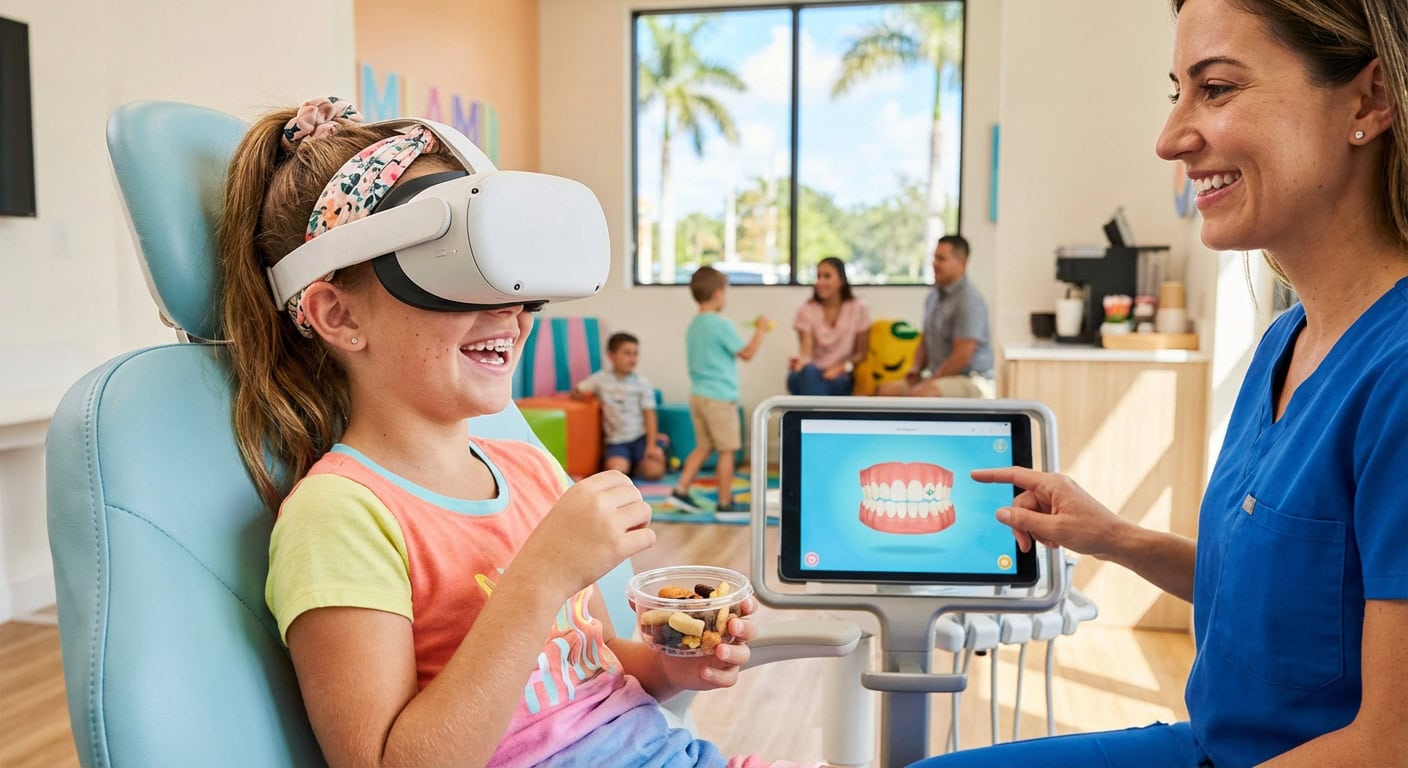
Your kid walks into our Miramar location and sees a VIP suite (not a sterile clinical room).
We've got noise-canceling headphones, TV shows, games, and snacks ready.
We use cutting-edge technology like low-dose digital X-rays and 3D CBCT scans that take seconds, not minutes.
We explain everything in plain language so your kid understands what we're doing and why.
No surprises.
No scary stuff.
The visit takes about 45 to 60 minutes total.
You can relax nearby with coffee while we work with your kid.
By the end, most kids ask when they can come back.
That's how you know we're doing something right.
The Cost Question Parents Always Ask
Phase 1 orthodontics in Broward County typically runs between $2,500 and $5,000 depending on what your kid needs.
Some kids need just a simple expander for a few months.
Others need braces for 18 to 24 months.
We're transparent about costs from day one.
No hidden fees.
No surprises at the end of treatment.
We also offer flexible payment plans because we know most families can't write a check for thousands upfront.
Many families tell us that Phase 1 care actually saves them money because Phase 2 becomes shorter or unnecessary.
Less time in treatment later means lower overall costs.
Check out why families choose SMILE-FX to see real costs and patient stories.
Pembroke Pines Families Choose SMILE-FX for This One Reason
We're board-certified orthodontists, not general dentists offering braces on the side.
That's the difference.
General dentists mean well, but they see 50 different dental issues every day.
We see one thing: how to guide young teeth and jaws to grow correctly.
Every team member at our Miramar office specializes in kids' orthodontics.
We schedule appointments around school, after sports, and on weekends because we know your family is busy.
We have patient reviews from Pembroke Pines families, Hollywood parents, Fort Lauderdale professionals, and everyone in between.
They're not saying nice things because we asked them to.
They're saying nice things because we deliver results without stress.
Why Your Kid's Activity Level Matters in Phase 1
Your kid plays soccer, takes swimming lessons, or does karate.
We get it.
South Florida families are active.
Phase 1 appliances work for active kids because most are removable.
Your kid takes out the expander for sports, puts it back in when they get home.
If we do light braces, we can use sports-friendly brackets and wires.
No impact on performance.
No restrictions on what your kid can do.
This is different from full braces in teenage years where food restrictions and extra cleaning become part of daily life.
The Mouth Breathing Connection Nobody Talks About
Here's something we see a lot that parents don't realize: mouth breathing in childhood literally changes how the face and jaws grow.
Kids who breathe through their mouth develop a narrower palate, longer face, and different bite patterns.
Sometimes it's allergies causing mouth breathing.
Sometimes it's a habit.
Either way, Phase 1 care can address the orthodontic side while we might refer you to an ENT for the medical side.
Fixing this habit early prevents a whole cascade of problems down the road.
The Habit-Breaking Side of Phase 1
Thumb sucking, tongue thrusting, and mouth breathing are habits that directly affect tooth and jaw position.
Instead of just telling a kid to stop (which never works), Phase 1 includes gentle appliances designed to break these habits naturally.
We combine the appliance with positive reinforcement, progress tracking, and sometimes games or rewards.
Kids actually want to cooperate because they see the results.
Ready to Get Real Answers for Your Kid
You don't need to guess whether your child needs Phase 1 orthodontics.
You don't need to stress about costs, discomfort, or whether you're making the right call.
Book a free 3D scan and VIP smile consultation at SMILE-FX and get real answers from a board-certified orthodontist.
We'll scan your kid's teeth and jaw, show you exactly what we see, and tell you whether Phase 1 is right for them.
No pressure.
No sales pitch.
Just honest guidance from specialists who work with kids your child's age every single day.
Book your free 3D scan and VIP smile consultation here.
Spots fill up fast for Pembroke Pines families, so lock in your appointment this week and give your kid the gift of a confident smile for life.
What Happens After Phase 1: The Real Timeline Parents Need to Know
Your kid finished Phase 1 treatment six months ago.
Their teeth look better.
Their bite is improving.
But now you're wondering: what's next?
Do they need Phase 2?
How long will that take?
Will it cost more money?
These are the questions that hit after your kid's done with the first round of early orthodontic care.
The truth is, Phase 1 is just the beginning.
What comes after matters just as much as what came before.
Let me walk you through exactly what to expect as your kid grows into their teenage years and how Phase 2 treatment fits into the bigger picture.
The Gap Between Phase 1 and Phase 2: What's Actually Happening
After Phase 1 ends, your kid enters what we call the observation period.
This isn't a delay.
This isn't us telling you to come back later.
It's the smartest part of the whole process.
During this time, your kid's remaining permanent teeth are still coming in.
Their jaw is still growing.
We see them every four to six months to make sure everything is tracking the way we planned.
Think of it like a landscaper checking on a freshly planted garden.
You don't dig everything up and replant it.
You watch, adjust, and let nature do its work.
Most kids enter Phase 2 when they're around 11 or 12 years old, but that timeline changes depending on when their permanent teeth finish coming in and how their jaw develops.
Some kids are ready at 10.
Others don't start until 13.
We're not watching a calendar.
We're watching your kid's mouth.
Phase 2 Treatment: Finishing What You Started
Phase 2 is where we fine-tune everything.
By now, all the permanent teeth have erupted.
Your kid's jaw growth is nearly complete.
The bone has had time to remodel around the changes we made in Phase 1.
Phase 2 usually involves full braces or clear aligners to align every tooth perfectly and lock in the bite correction we started earlier.
Because of the groundwork laid in Phase 1, Phase 2 is typically faster and less complicated.
We're talking 18 to 24 months instead of the 24 to 36 months kids need if they never had Phase 1 treatment.
That's real time savings.
That's real money savings.
Your kid also handles Phase 2 better emotionally because they've already done this before.
They know what to expect.
They know it's not painful.
They know they can still eat most foods and play sports.
Anxiety drops significantly.
When Phase 2 Isn't Necessary (Yes, It Happens)
Here's the part that surprises a lot of parents: some kids who complete Phase 1 never need Phase 2.
Maybe their teeth straightened naturally as the rest of their permanent teeth came in.
Maybe their bite corrected itself as their jaw finished growing.
Maybe the expander did its job so well that crowding just stopped being an issue.
This happens more often than you'd think, and it's the whole reason Phase 1 exists.
At your kid's observation visits, we'll tell you straight: "We can either watch and see if Phase 2 is needed, or we can start Phase 2 now to guarantee perfect alignment."
Some families choose to wait and skip Phase 2 entirely.
Others want full alignment and choose Phase 2.
Both are good choices depending on what matters to your family.
Braces vs. Clear Aligners in Phase 2: Which Fits Your Kid Better
By the time Phase 2 rolls around, your kid has opinions.
They care about how they look.
They might have friends with braces or clear aligners, and they're comparing notes.
At SMILE-FX, we offer both traditional braces and clear aligners like Invisalign for Phase 2 treatment.
Braces are faster for complex cases and work well for kids who are less focused on cleaning them perfectly.
Clear aligners are nearly invisible and let your kid eat whatever they want, but they require more responsibility because the patient has to remember to wear them.
Here's what I tell parents: ask your kid which one they'd actually use.
A responsible 12-year-old wearing aligners religiously will get better results than a kid who forgets to put them in.
We've seen it both ways.
The best option is whichever one your kid will commit to wearing.
The Behavioral Change Between Phase 1 and Phase 2
Something shifts when kids hit their teenage years.
In Phase 1, you were making a lot of the decisions.
You booked the appointments.
You reminded them to wear their appliance.
You handled the responsibility.
By Phase 2, your kid is old enough to take ownership.
They want a say in what kind of braces or aligners they get.
They remember appointments on their own (mostly).
They understand why oral hygiene matters because they don't want cavities.
This is actually a gift.
Kids who take responsibility for their Phase 2 treatment have better outcomes because they're invested in the process.
At our office, we talk directly to your teenager about their treatment options, not just to you.
We make them part of the team.
Cost Reality for Phase 2: Is It More Money?
This is the question parents ask at every observation appointment.
The answer is: not as much as you'd think.
Phase 1 costs somewhere between $2,500 and $5,000.
Phase 2 typically adds another $3,000 to $4,500 depending on what your kid needs.
But here's the kicker: that total is less than if your kid never had Phase 1 and went straight to full braces as a teenager.
Full teen orthodontics without Phase 1 treatment runs $5,000 to $7,000 because the work is more complicated.
So when you add up Phase 1 plus Phase 2, you're actually ahead financially.
We also apply Phase 1 payments toward Phase 2.
Your deposit carries over.
Your payment plan continues.
We're not starting from scratch with your family's finances.
What About Wisdom Teeth During Phase 2?
This question comes up constantly.
During Phase 2, your kid's wisdom teeth might start showing up on X-rays, or they might not erupt until years later.
If wisdom teeth are going to be a problem, we spot it early during Phase 2 treatment.
Sometimes we work around them.
Sometimes extraction makes sense before Phase 2 or after Phase 2 finishes.
We're not making that call without talking to you first.
Your family dentist or an oral surgeon can help with wisdom teeth decisions if they become necessary.
The Retention Phase After Everything is Done
Here's what every parent needs to understand: braces and aligners come off, but the work isn't finished.
Your kid's teeth want to move back to where they started.
That's biology.
That's why retention is non-negotiable.
After Phase 2 finishes, your kid wears a retainer every night for years.
Some kids wear a fixed retainer bonded behind their teeth permanently.
Others wear a removable retainer at night.
Most kids do both.
This isn't us being paranoid.
This is us protecting the investment you've made and the results your kid has earned.
The families who skip retainers end up back in the chair in their twenties saying, "Why did my teeth shift back?"
The families who wear retainers keep the smile they got in Phase 1 and Phase 2 for life.
Real Talk: The Mental Side of Two Phases of Treatment
I'm going to be honest with you.
Some kids hate the idea of two rounds of orthodontic treatment.
The thought of braces again in a few years feels like punishment.
But here's what actually happens: after Phase 1, kids understand the process.
They see the results.
They know their teeth are getting better.
When Phase 2 comes around, they're actually excited rather than anxious.
They talk about their results with friends.
They show off their straighter teeth during the observation period.
By the time Phase 2 starts, they're ready.
This is way different from a kid who's terrified of their first braces experience.
Frequently Asked Questions About Phase 2
Will my kid need rubber bands or other appliances in Phase 2?
Possibly.
If we need to fine-tune the bite further, rubber bands or other small appliances might be part of Phase 2.
We're not adding these for fun.
We're using them because they solve specific problems.
Can my kid play sports with braces in Phase 2?
Absolutely.
We use mouth guards with braces all the time.
If they choose clear aligners, they take them out for sports and put them back in after.
Zero restrictions.
What if my kid's Phase 2 isn't done before they graduate high school?
Sometimes treatment runs longer than we initially estimated.
Life happens.
Growth changes things.
We work around your kid's schedule, including finals, college visits, and everything else.
Is there any way to avoid Phase 2?
Sometimes teeth straighten naturally during the observation period.
But if we see that Phase 2 will be needed, skipping it usually means your kid ends up with a less-than-ideal bite or smile alignment.
Phase 2 exists because Phase 1 alone can't deliver perfect results for most kids.
How SMILE-FX Handles the Phase 1 to Phase 2 Transition
We don't make you wait in limbo wondering if Phase 2 is coming.
Every six months during your kid's observation visits, we give you a clear update: "We're on track. Phase 2 will probably start in about a year," or "Phase 2 isn't necessary. Your kid's teeth and jaw are developing perfectly."
No surprises.
No hidden treatment plans.
We also make sure you understand exactly what Phase 2 involves before it starts.
We show your kid the treatment plan on our 3D technology, so they see what their smile will look like after braces or aligners come off.
That's motivation right there.
When your kid can see their own future smile, they stop complaining about treatment.
Insurance Coverage Across Both Phases
Most dental insurance plans cover orthodontics, and many specifically cover Phase 1 treatment.
We handle insurance verification for you.
We let you know exactly what your plan covers and what your out-of-pocket costs will be.
Some plans cover Phase 1 and Phase 2 together as one case.
Others treat them separately.
We know your plan details and we work with that.
No surprises at billing time.
Getting Started With Phase 1 Today Means Planning for Tomorrow
If your kid is between 6 and 10 years old and you're thinking about Phase 1, understand that you're making a smart long-term investment.
Phase 1 isn't just about fixing teeth right now.
It's about setting your kid up for a shorter, easier Phase 2 down the road.
>
It's about preventing problems instead of treating them later.
It's about giving your kid the confidence of a great smile for the rest of their life.
The families who choose SMILE-FX for Phase 1 treatment get honest guidance about whether Phase 2 will be needed, realistic timelines, and board-certified specialists who prioritize your kid's individual development.
We're not here to push treatment you don't need or drag out treatment longer than necessary.
We're here to guide your kid's smile the right way from the start.
If you have questions about Phase 1 and Phase 2 treatment for your kid, book a free 3D scan and VIP smile consultation at SMILE-FX.
We'll show you exactly what we see, walk you through the timeline, and explain what Phase 2 might look like for your specific kid.
No pressure.
No sales pitch.
Just real answers about early orthodontic care and how Phase 1 and Phase 2 treatment work together to build your kid's confident smile for life.
Spots fill up fast, so schedule your free consultation here and take the first step toward straightening your child's teeth the smart way.
Understanding Your Orthodontic Options: Braces vs. Clear Aligners vs. Invisalign for South Florida Families
You're standing in the orthodontist's office and your doctor just asked the question that makes every parent freeze.
"So, do you want traditional braces or clear aligners?"
Your kid is looking at you.
You're looking at the price sheet.
Nobody knows what the right answer is.
This is the moment where most families feel stuck.
You know your kid needs orthodontic treatment, but picking between traditional braces, clear aligners, and Invisalign feels like choosing between three languages you don't speak.
The truth is, there's no one-size-fits-all answer.
What works for your best friend's kid might be terrible for yours.
What costs less money might take longer.
What looks invisible might require way more discipline.
Let me walk you through exactly what sets these options apart, who they actually work best for, and how to figure out which one is right for your family's situation in South Florida.
Traditional Braces: The Workhorse of Orthodontics
Let's start with the classic option that's been straightening teeth since your parents were kids.
Traditional braces have metal brackets glued to each tooth connected by a wire that gets tightened over time.
They work fast.
They work on basically every case.
They don't require your kid to remember anything because they're staying on 24/7.
Here's what parents in Miami, Fort Lauderdale, and Miramar tell us once their kid gets braces: the first two weeks suck, and then it becomes completely normal.
Your kid eats around them, brushes around them, plays sports with a mouthguard over them, and stops thinking about them after a while.
The speed is the real selling point.
Most cases finish in 18 to 24 months.
Complex cases might run longer, but we're still talking about a defined timeline where you know when treatment ends.
With traditional braces, we control the pressure and timing completely.
We tighten the wire, teeth move, we tighten again.
No guessing.
No wondering if your kid is wearing them enough.
Just results.
The cost for traditional braces usually lands between $3,500 and $7,000 depending on your case complexity.
Many South Florida families find this more affordable than clear aligner options, especially when insurance kicks in.
Clear Aligners and Invisalign: The Invisible Option Everyone Wants
Clear aligners are custom-made plastic trays that fit snugly over your teeth and move them gradually.
Invisalign is the brand name most people know, but clear aligners come from multiple manufacturers.
The appeal is obvious: nobody can see them.
Your kid can take them out to eat, brush, and floss.
No food restrictions.
No metal in their mouth.
No squeaky-clean routine that takes forever.
This sounds perfect on paper.
Here's where reality hits: your kid has to actually wear them.
We're talking 20 to 22 hours every single day.
Not most days.
Not when they remember.
Every day.
I've watched responsible kids forget aligners at restaurants, lose them in backpacks, or decide they don't feel like wearing them because they want to eat snacks with friends.
If your kid is not someone who follows through on daily stuff without reminders, clear aligners become a nightmare.
The cost for clear aligners runs $4,000 to $8,000, and Invisalign tends to be on the higher end because it's brand name.
Insurance coverage varies wildly.
Some plans cover them like regular braces.
Others cover them less or not at all.
We check your specific coverage before you commit to anything.
The treatment timeline is similar to braces when patients actually wear them consistently, but we've seen cases drag out months or even years because kids weren't compliant.
How Clear Aligners Actually Work: The Technology Side
Clear aligners use 3D scanning technology to map your teeth and predict exactly how they'll move.
We take a digital scan, send it to the lab, and they create 20 to 40 custom trays depending on your case.
Each tray is slightly different from the last, moving teeth in micro-increments.
You wear one tray for about two weeks, then swap to the next one.
It's like a slow-motion version of what braces do, except you have to be the one managing the schedule.
This is why cutting-edge technology matters so much.
Better scanning means more accurate movement predictions.
Better predictions mean fewer surprises and less treatment time.
SMILE-FX uses the latest 3D technology to scan and plan clear aligner cases, which means we catch problems early and adjust the plan before something goes wrong.
The Real Talk About Invisalign Cost South Florida
Everyone asks the same question: what's the actual Invisalign cost in South Florida?
The answer depends on whether you need basic aligner treatment or complex case correction.
Simple cases might be $3,500 to $4,500.
Complex cases can run $6,000 to $8,000 or more.
Your dental insurance might cover part of it if your plan includes orthodontia.
We offer flexible payment plans and financing options that make it work for most families.
We also have $0 down braces financing options in South Florida so you're not paying everything upfront.
The real question isn't just cost though.
It's cost plus results.
If your kid won't wear clear aligners, the cheapest option becomes the most expensive because you'll end up switching to braces halfway through.
Does Insurance Cover Braces and Aligners?
Most dental insurance plans in South Florida do cover orthodontic treatment, including both traditional braces and clear aligners.
Coverage typically tops out at $1,500 to $2,000 per person per year.
Some plans have a lifetime maximum of $1,500 total.
Some have no coverage at all.
We verify your insurance before treatment starts so you know exactly what you're paying out of pocket.
No surprises at the end.
No shock bills.
Here's what most families don't realize: whether you pick braces or aligners, the insurance coverage is usually the same amount.
So the decision should be based on what works best for your kid's life and habits, not on the assumption that one costs less.
Traditional Braces vs. Invisalign: Which One Finishes Faster?
If speed is your priority, traditional braces win almost every time.
We control the force, the timing, and the movement completely.
With aligners, we're counting on your kid to wear them correctly.
If they skip days or wear them less than 20 hours daily, treatment stretches out.
I've seen aligner cases that were supposed to take 18 months stretch to 30 months because the patient wasn't consistent.
Braces don't have this variable.
Your kid wears them, teeth move predictably, treatment finishes on schedule.
For teenagers especially, this predictability matters because they can plan around graduation, school events, and college.
The Mouth Care Reality: Braces vs. Clear Aligners
With traditional braces, brushing and flossing get more complicated.
You have to clean around brackets and wires.
Most kids need an electric toothbrush and floss threaders to do it right.
It takes longer, but it's still totally doable.
With clear aligners, you take them out and brush normally.
No special tools.
No weird flossing techniques.
Just regular oral hygiene.
However, you also have to clean the aligners themselves to prevent bacteria buildup and discoloration.
Some kids treat this like a chore.
Others don't bother.
If your kid is already inconsistent with basic tooth brushing, clear aligners might create more problems than they solve.
Sports, Activities, and Lifestyle Fit
Your kid plays contact sports, and you're worried about getting hit in the face.
With braces, we fit a mouthguard over them.
Works fine.
No impact on athletic performance.
With clear aligners, your kid removes them for sports, which is actually ideal because nobody wants to risk damaging an expensive aligner with a hard hit.
They put it back in after the game.
Both options work for active kids.
The difference is mental: braces stay on all the time, so your kid adapts.
Aligners come out, which means your kid has to remember to put them back in.
That's the real issue.
If they're playing three sports and have a busy schedule, remembering to reinsertion aligners after every activity becomes a pain point.
Braces eliminate that friction entirely.
Complex Cases: When Your Options Get Limited
Not every orthodontic situation can be handled with clear aligners.
Severe crowding, significant bite problems, and jaw alignment issues sometimes need traditional braces.
Clear aligners work great for mild to moderate cases.
For complex orthodontic cases, traditional braces or a combination approach works better.
The board certified orthodontist will tell you straight whether your kid's case can be treated with aligners or if braces are the smarter choice.
Don't let the invisibility appeal cloud your judgment if your kid actually needs braces.
The Hybrid Approach: Combining Braces and Aligners
Here's an option a lot of families don't know about: some cases benefit from starting with braces to move teeth quickly, then finishing with aligners for fine-tuning.
This gives you the speed of braces plus the cosmetics of aligners.
It works especially well for teenagers who can't stand braces but also need faster results.
Your orthodontist will recommend this if it makes sense for your specific case.
Making the Decision: What Actually Matters
Stop thinking about which option is objectively better.
The best option is the one your kid will actually use consistently.
Ask yourself these questions honestly.
Is your kid disciplined enough to wear aligners 20 plus hours daily without reminders?
Does your kid care more about appearance or comfort during treatment?
Is your kid involved in activities where removing aligners multiple times daily becomes a hassle?
Does your kid's case have complexity that might limit aligner options?
How much is budget a factor in your family's decision?
Your answers to these questions tell you way more than any chart I could show you.
The SMILE-FX team will walk through this with you and your kid, not just push you toward whichever option makes us more money.
We respect that every family is different and every kid is different.
Getting Your Free Consultation to See All Your Options
You don't need to make this decision alone in your living room at night.
Book a free 3D scan and VIP smile consultation at SMILE-FX and see exactly what your kid's case actually needs.
We'll scan your kid's teeth, show you the 3D model, explain which treatment options work for their specific situation, and break down the real costs and timeline.
You'll get honest guidance from the best orthodontist for kids South Florida has to offer.
No pressure.
No sales pitch.
Just straight answers about braces, clear aligners, Invisalign, and which path makes sense for your family's lifestyle and budget.
Whether you're looking for affordable braces in Miramar, affordable braces in Broward, or the best orthodontist near you, SMILE-FX has flexible financing, world-class technology, and a team that actually cares about your kid's smile.
Lock in your free consultation today and take the guesswork out of choosing between traditional braces versus clear aligners.