

Phase 1 Orthodontics for Kids Ages 6-10 in Pembroke Pines
Your kid's smile matters.
When you're watching your child grow up in Pembroke Pines, you start noticing things.
Maybe their teeth are coming in crooked.
Maybe they're sucking their thumb at age seven.
Maybe their bite looks off.
And suddenly you're wondering: should I be doing something about this now?
The answer might be yes, and that's where Phase 1 orthodontics comes in.
It's not about rushing your kid into braces.
It's about working with their natural growth to guide their teeth and jaw into the right spot before things get complicated later.
Think of it like steering a ship while it's still in calm waters instead of waiting until there's a storm.
At SMILE-FX Orthodontic & Clear Aligner Studio in Miramar, just 15 to 20 minutes from Pembroke Pines, we've been helping families like yours navigate early orthodontics with real expertise and zero pressure.
Board-certified specialists, cutting-edge tech, and a team that actually understands what it's like to raise kids in South Florida.
That's what sets us apart.
Why Your Pembroke Pines Dentist Might Recommend an Orthodontist Visit
Here's the thing nobody tells you: the American Association of Orthodontists says kids should see an orthodontist by age seven.
Not because they necessarily need braces.
But because that's when you can spot problems early and fix them the easy way.
When your child's baby teeth are still coming in, their jaw is still growing.
That gives you a window of opportunity.
You can guide that growth.
You can create space for permanent teeth.
You can correct bad habits before they change your kid's whole facial structure.
Miss that window, and you're dealing with a much bigger problem at thirteen.
The American Association of Orthodontists isn't making this stuff up.
Early intervention saves time.
Early intervention saves money.
Early intervention means your kid spends less time in braces overall.
What Phase 1 Orthodontics Actually Does
Phase 1 treatment is designed specifically for growing kids.
It's not the same as what a teenager gets.
The goal is to guide jaw growth, create space, and fix problems that could get worse fast.
Some kids need expanders.
Some need partial braces on just their front teeth.
Some need spacers or other appliances.
The point is, everything we do is designed around how your kid's mouth is actually developing, not just slapping brackets on teeth and hoping for the best.
Most Phase 1 treatment runs about six to twelve months.
Then your kid takes a break while their permanent teeth come in.
Then Phase 2 is usually much shorter and simpler because you've already done the hard work.
The Signs Your Pembroke Pines Child Might Need Phase 1
Not every kid needs treatment.
But some warning signs are worth paying attention to.
Crowding or gaps between baby teeth: If your kid's baby teeth are pushing against each other or have weird gaps, that's telling you something.
Baby teeth are guides for permanent teeth.
If there's not enough space now, permanent teeth won't have space later.
Crossbite: This is when the upper and lower teeth don't line up side to side.
Your kid's top jaw might be narrower than their bottom jaw, or vice versa.
This affects how they chew, how they breathe, and it can change their whole face shape if you don't catch it.
Overbite: When the top front teeth overlap the bottom ones way too much.
A little overlap is normal.
A lot of overlap causes problems.
Mouth breathing: Kids who breathe through their mouth instead of their nose tend to have narrower palates.
This creates crowding.
This is a habit worth breaking early.
Thumb sucking past age five: Your kid sucks their thumb, and they're past kindergarten.
That habit is literally pushing their teeth out of alignment and changing their jaw shape.
Early wear on baby teeth: If your kid's teeth are wearing down weird or breaking, their bite is off.
That's a Phase 1 conversation.
See one or two of these?
Schedule a consultation.
At SMILE-FX, we're transparent about what kids actually need.
About eighty percent of the kids we see are just monitored for now.
We tell you straight.
What a First Visit Actually Looks Like at SMILE-FX
Your kid comes in.
You're both probably a little nervous.
That's normal.
We spend about forty-five minutes on that first visit.
We take low-dose digital X-rays so we can see what's happening with baby teeth, permanent teeth, and jaw growth.
We explain everything in language your kid gets.
No weird dental jargon.
No scary stuff.
We have a play area.
We have games.
Your kid's not sitting in some sterile room wondering what's happening next.
They're comfortable.
Then we tell you exactly what we see.
Yes, Phase 1 makes sense.
Or no, let's just watch and recheck in six months.
Or yeah, we need to address this specific thing.
You get facts.
You get a plan.
You don't get pressure.
One of the things parents love about our approach is that we use cutting-edge technology to make sure every recommendation is backed by data, not guesswork.
CBCT scans, digital scanners, and real precision diagnostics.
The Phase 1 vs Waiting Comparison Nobody Talks About
Here's the real math.
If you do Phase 1 early, your kid spends about six to twelve months on treatment now.
Then Phase 2 later is shorter and less complicated because you've already guided the growth.
Total time in orthodontics: maybe twenty to twenty-four months.
If you wait until your kid is a teenager, they might need full braces for two to three years.
The teeth are harder to move.
The jaw's done growing.
You're fighting against their biology instead of working with it.
Cost-wise, Phase 1 early usually ends up cheaper overall.
You're preventing problems, not fixing severe ones.
Comfort-wise, kid-friendly appliances feel way better than full braces on a teenager.
The American Association of Orthodontists has data on this.
Early intervention wins.
Why Pembroke Pines Families Choose SMILE-FX for Phase 1
Location matters when you've got kids.
We're in Miramar, close to Pembroke Pines.
You can get there fast via Pines Boulevard or I-75.
You're not sitting in car rides for an hour to go to an appointment.
Scheduling matters too.
We have weekend slots.
We have after-school slots.
We get that Broward families are busy.
You've got work, you've got school pickup, you've got a million things happening.
But here's what really makes the difference: our team is board-certified specialists.
Not general dentists doing braces on the side.
Not dental mills churning through a hundred kids a day.
We're board-certified orthodontists who actually care about getting this right.
Parents from Pembroke Pines, Weston, Cooper City, Davie, and Fort Lauderdale come to us because they see the results.
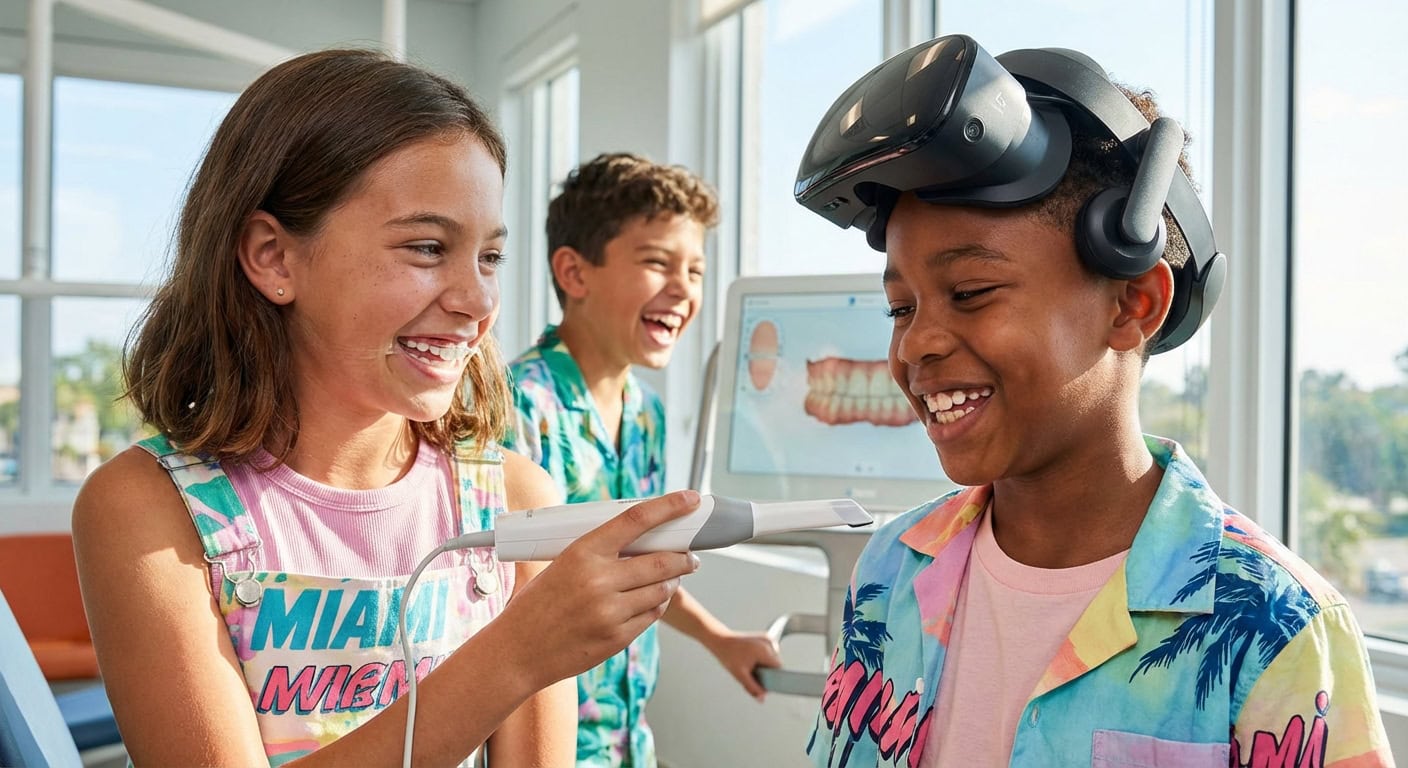
We use VR goggles to distract kids during appointments.
We use weighted blankets.
We have noise-canceling headphones.
Personal VIP suites with TVs.
Post-visit snacks and games.
Read what actual families say on our patient reviews page.
These aren't fake testimonials.
These are parents telling other parents what it's actually like.
Phase 1 Appliances and What They Actually Do
Expanders are the most common Phase 1 appliance.
They gently widen the upper jaw.
Your kid gets used to them in about a week.
They're way less scary than they sound.
Partial braces on just the front teeth address specific problems without treating the whole mouth.
Your kid might have them for six months, then they come off.
Space maintainers keep room open for permanent teeth that haven't come in yet.
Simple.
Effective.
The goal of every Phase 1 appliance is the same: work with your child's growth to prevent problems from getting worse.
None of these things hurt.
None of them stop your kid from eating, playing, or doing normal kid stuff.
The Real Questions Parents Ask About Phase 1
How much does Phase 1 cost? It varies based on what your kid needs, but you're usually looking at less than full braces later.
We work out payment plans.
We work with insurance.
We don't make it harder than it needs to be.
Can my kid eat normal food? Depends on what appliance they have, but mostly yes.
We give you a list of stuff to avoid.
It's not a big deal.
Will Phase 1 definitely mean they won't need braces later? No.
Most kids still need Phase 2 braces after Phase 1 wraps up.
But Phase 1 makes Phase 2 shorter and simpler.
That's the whole point.
What if we wait and see? Sometimes waiting is the right call.
We'll tell you if that's the case.
But some problems get harder the longer you wait.
Crossbites get worse.
Jaw growth gets more lopsided.
That's why the AAO recommends checking by age seven.
How SMILE-FX Keeps Kids Comfortable During Treatment
Kids are honest.
If something hurts or feels weird, they'll tell you.
We design our treatment plans around making sure your kid feels good about coming to appointments.
Our team explains everything in kid language.
We show them pictures.
We let them see the appliances before they go in.
We don't spring surprises.
During appointments, we distract with VR, music, or just good conversation.
Adjustments are quick and gentle.
We're not in a rush.
Parents tell us their kids actually look forward to appointments because the experience is that good.
That's not a coincidence.
It's intentional design.
Check out how we're different from other ortho offices.
It's worth reading.
Getting Started With Phase 1 Orthodontics
The first step is simple.
You call.
You come in for a consultation.
We look at your kid's mouth, we take some X-rays, and we tell you what we see.
If Phase 1 makes sense, we explain exactly what that means and what to expect.
If it doesn't, we tell you that too and when to come back.
You're not locked into anything on day one.
You get to make an informed decision based on real information.
Ready to give your Pembroke Pines kid the best start?
Book a free 3D scan and VIP smile consultation with SMILE-FX.
This isn't some quick five-minute checkup.
We spend real time with you.
We answer your questions.
We show you exactly what's happening and what the options are.
Spots fill fast, so move on this if you're thinking about it.
Phase 1 orthodontics for kids in Pembroke Pines is about catching things early when you can guide growth naturally.
Let SMILE-FX be your partner in that.
Beyond Phase 1: What Happens Next in Your Kid's Orthodontic Journey
So you've done Phase 1.
Your kid wore their expander or partial braces.
Things are looking better already.
Now what?
This is the part nobody really explains.
You're sitting there thinking your kid's done with orthodontics.
Then their permanent teeth start coming in and you realize there's a whole other phase ahead.
That's Phase 2, and it's different from what came before.
The gap between Phase 1 and Phase 2 is actually important.
Your kid's jaw is still growing.
Permanent teeth are still erupting.
This resting period lets everything settle naturally before we make the next move.
At SMILE-FX Orthodontic & Clear Aligner Studio, we monitor this transition closely.
We're not just handing you off to someone else.
We're tracking your kid's growth, watching for problems, and planning the next step before it becomes an emergency.
Understanding the Waiting Period Between Phases
After Phase 1 wraps, your kid gets a break.
This isn't downtime where nothing happens.
It's actually crucial time.
Your kid's adult teeth are moving into position.
Their jaw is still growing and developing.
The foundation you've already built with Phase 1 is guiding all of this naturally.
We see your kid every six months during this period.
Quick checkups.
No adjustments.
We're just making sure everything's tracking right.
Sometimes we catch small issues early and fix them before they get big.
Sometimes we see that things are tracking perfectly and Phase 2 won't need to be as intense as we initially thought.
Parents ask us all the time: why not just do all the orthodontics at once?
Because you can't.
Your kid's mouth isn't finished growing.
If we tried to do everything now, we'd be fighting against their natural development instead of working with it.
When Phase 2 Actually Starts
Phase 2 usually starts when most of your kid's permanent teeth have come in.
That's typically around age eleven or twelve, but it varies.
Some kids are ready at ten.
Some don't need to start until they're thirteen.
We don't go by a calendar.
We go by what we see in your kid's mouth.
Here's the tell: when the baby canines (those pointy teeth on the sides) have shed and the adult ones are coming in, we start thinking about Phase 2.
We'll call you in for an appointment and say something like: "We think it's time to start thinking about the next phase."
Then we show you exactly why and what it'll look like.
What Phase 2 Actually Involves
Phase 2 is usually full braces or clear aligners on all the teeth.
This is when we're straightening everything out and getting the bite perfect.
By the time Phase 2 starts, most of the heavy lifting is done.
Your kid's jaw is already in a better position.
Their teeth have more room.
The permanent teeth are coming in more naturally.
Phase 2 typically runs eighteen to twenty-four months.
Sometimes shorter if Phase 1 did its job really well.
Sometimes you can do Invisalign during Phase 2 if your kid's teeth are ready for clear aligners.
The beauty of clear aligners is they're way less visible than metal braces.
For a kid worried about how they look at school, that matters.
We talk to families about options.
Traditional braces work great.
So do clear aligners.
Your kid's compliance and preference matters here.
How Phase 2 Feels Different from Phase 1
Phase 2 feels easier because the hard work is behind you.
Your kid's already been through an appliance.
They know the drill.
They know how to take care of their teeth with orthodontics on.
They're not scared anymore.
Adjustments are gentler because the teeth are easier to move now.
We're not fighting against crowding or bad bite patterns.
We're refining.
Your kid can eat more foods with clear aligners than they could with Phase 1 appliances.
If you go with traditional braces, the food rules are pretty similar to what they already know.
The big difference: by Phase 2, your kid usually cares about their smile.
They're motivated.
They want braces off.
They actually help us out instead of resisting.
Timing Questions Parents Always Ask
What if my kid's teeth aren't ready for Phase 2 yet?
We wait.
No point forcing Phase 2 if the permanent teeth aren't fully erupted.
We keep monitoring.
It'll happen when it's supposed to happen.
Can Phase 2 start before all permanent teeth are in?
Sometimes, yes.
If the pattern is clear and we can work around the teeth that are still coming, we might start Phase 2 while a few teeth are still erupting.
It depends on the specific case.
What happens if we wait too long between phases?
That's rare, but if a kid's jaw changes a lot between Phase 1 and Phase 2, we might need to adjust our plan.
That's why those checkup appointments matter.
We're staying on top of it.
Can my kid wear a retainer instead of Phase 2?
No.
If Phase 1 found problems that need fixing, Phase 2 fixes them.
A retainer holds teeth in place.
It doesn't straighten them.
The Role of Treatable Cases and Specific Issues
Some kids sail through Phase 1 and Phase 2 with no complications.
Other cases are more complex.
If your kid has a severe overbite, underbite, or crossbite, Phase 2 might take longer.
If they have missing teeth or extra teeth, we plan differently.
This is where having board-certified specialists matters.
We've seen hundreds of cases.
We know how to handle the ones that aren't textbook.
We talk to you about realistic timelines.
We don't promise miracles.
We promise we'll do it right.
Cost and Time: The Real Numbers
Total orthodontics from Phase 1 through Phase 2 usually runs twenty-four to thirty-six months.
Not three to four years like if you waited until your kid was a teenager.
Cost-wise, Phase 1 plus Phase 2 together is usually similar to the cost of doing everything in one long treatment as a teenager.
Sometimes cheaper because you prevented problems from getting worse.
We offer payment plans.
We work with insurance.
We figure out what works for your family.
The real value isn't just in money saved.
It's in your kid spending less time uncomfortable, fewer adjustments total, and better long-term results.
What About Retainers After Everything's Done
Here's what people forget: orthodontics doesn't end when the braces come off.
Teeth want to move back.
That's just biology.
Retainers prevent that.
We typically recommend night-time retainers indefinitely.
Or a combination of night retainers and fixed retainers on the back of the teeth.
Your kid's going to be wearing something to keep their smile straight for years.
That's the deal with orthodontics.
The good news: retainers are way less noticeable than braces.
Most retainers are either clear or bonded to the back of teeth where nobody sees them.
Preparing Your Kid for Phase 2
When Phase 2 is coming up, talk to your kid about it.
Show them pictures of what braces or aligners look like.
Explain that their teeth are going to get even straighter.
Let them know they already did the hard part.
If they have a choice between braces and aligners, let them help decide.
Ownership matters.
If they chose it, they're more likely to take care of it.
Answer their questions honestly.
Will it hurt?
A little soreness for a few days after adjustments, but nothing intense.
Will they look weird?
Less weird than you'd think, especially with clear aligners.
The kids who do best in Phase 2 are the ones who understand why it matters.
Not because their parents made them do it.
Because they get that they're building their own smile.
How SMILE-FX Manages the Transition
We don't let you fall through the cracks between phases.
You're on our radar.
We're checking in every six months.
We're planning ahead.
When Phase 2 is ready to start, we have a conversation with you about what comes next.
We use cutting-edge technology to plan Phase 2.
3D scans of your kid's teeth and jaw.
We show you exactly what the end result will look like before we start.
Your kid sees the plan too.
They know what they're working toward.
That motivation matters.
Check out why families choose SMILE-FX for their complete orthodontic journey.
It's not just about the first phase.
It's about staying with you through the whole thing.
Real Families, Real Results
We've taken hundreds of kids from Phase 1 all the way through Phase 2 and into perfect smiles.
The families tell us what they value most isn't just the end result.
It's the fact that we stayed consistent, answered their questions, and made the whole process way less stressful than they expected.
Read the patient reviews from Pembroke Pines and surrounding areas.
These are real families sharing what it's actually like.
Common Mistakes Families Make During the Waiting Period
Some parents think the waiting period means nothing.
Then they skip checkup appointments.
Then they miss early warning signs that could've been fixed with a simple adjustment.
Come to the six-month checkups.
They're short.
They're free if it's just a monitoring visit.
We catch things early.
Other families wait too long between phases.
Their kid's now a teenager, jaw growth has shifted, and Phase 2 needs to be bigger than it would've been.
That's why we schedule Phase 2 appointments ahead of time.
We're not waiting for you to call us.
We're calling you.
Some kids slack on their retainer after Phase 1.
Then their teeth start moving back.
When Phase 2 starts, we have to re-correct things that should've stayed put.
Retainers matter.
They're not optional.
We're straight with families about that from the start.
When to Contact SMILE-FX During the Waiting Period
If something looks off between checkups, don't wait.
Call us.
If your kid's complaining about tooth pain, call us.
If you notice teeth moving backward, call us.
If your kid lost a retainer or it broke, call us.
We're here during the waiting period too.
It's not like we disappear.
Next Steps: Getting Your Kid Ready for the Full Journey
If your kid's already in Phase 1, great.
You're on the right track.
Keep those checkup appointments.
Stick with the retainer routine.
We'll tell you when Phase 2 is ready.
If your kid hasn't started yet and you're thinking about Phase 1, the time to move is now.
Kids at the right age benefit the most from early treatment.
We offer a free 3D scan and VIP smile consultation.
Bring your kid in.
We'll show you exactly what we see and what makes sense for them.
Not sure if your kid needs Phase 1?
That's fine.
Come in anyway.
We'll assess them and tell you straight if treatment makes sense or if we should just monitor for now.
Book your free 3D scan and VIP smile consultation here.
We're in Miramar, fifteen to twenty minutes from Pembroke Pines.
Weekend and after-school appointments available.
Your kid's orthodontic journey from Phase 1 through Phase 2 and beyond is worth getting right.
SMILE-FX Orthodontic & Clear Aligner Studio handles braces, clear aligners, and Invisalign for all ages.
Let's build that perfect smile together.
Invisible Orthodontics vs Traditional Braces: Which Path Works for Your Family
You're standing in a orthodontist's office with your kid and somebody's asking a question you didn't expect to have to answer: braces or clear aligners?
It feels like a big choice.
And honestly, it is.
But not for the reasons you think.
The real question isn't which one's better.
It's which one fits your life, your kid's commitment level, and what actually needs to happen in their mouth.
Most families at SMILE-FX Orthodontic & Clear Aligner Studio come in thinking clear aligners are just the fancy option.
Turns out it's way more complicated than that.
And once you understand what's actually going on, the choice becomes obvious.
Why This Decision Matters More Than You Think
Your kid's going to be wearing something for months.
Maybe years.
If they hate it, they won't take care of it.
If they don't take care of it, the treatment takes longer.
If treatment takes longer, you're paying more and your kid's frustrated.
That's why choosing the right option up front saves you from all that headache.
We talk to families every week who wish they'd picked differently.
Not because the treatment didn't work.
But because it didn't fit their life.
Understanding Traditional Braces in 2024
Braces aren't what they were in the 90s.
The metal brackets are smaller.
The wires are gentler.
The whole experience is way less intense than your parents probably had.
Here's what happens with braces: we bond small brackets to your kid's teeth, thread a wire through them, and gradually tighten that wire to move teeth into position.
The wire does the heavy lifting.
Your kid can't take it off.
That's actually the advantage for some families.
If your kid has a history of losing things, forgetting to wear stuff, or just not following instructions, braces eliminate that problem.
They're always working.
Adjustment appointments happen every four to six weeks.
We tighten the wire, check progress, make sure nothing's loose.
Food restrictions are real but manageable: no sticky stuff, no hard candy, no popcorn, no nuts.
Your kid figures it out pretty quick.
Cleaning takes extra time.
They need a special brush that fits under the wire.
But it's not complicated once they get the hang of it.
What Clear Aligners Actually Bring to the Table
Clear aligners are custom-made plastic trays that fit snug over your kid's teeth.
They look almost invisible.
Nobody at school knows your kid's wearing them unless they tell.
We use cutting-edge 3D technology to create a series of aligners.
Each one moves teeth slightly forward, backward, or rotated.
Your kid switches to a new aligner every week or two.
The big difference: your kid controls when they wear them.
And that's exactly where things go sideways for some families.
Clear aligners only work if they're in your mouth.
The target is twenty-two hours a day minimum.
That means eating, drinking water, brushing teeth, then putting them right back in.
They also need to be worn consistently to get results.
If your kid takes them out for three days straight, the teeth don't move.
The treatment timeline gets longer.
But if your kid's disciplined, clear aligners win on every front: no food restrictions, almost invisible, easier cleaning, fewer office visits.
The Reality About Food and Lifestyle
With Invisalign or other clear aligner brands, your kid eats whatever they want.
They just take the aligners out.
No special diet.
No avoiding their favorite foods.
That appeals to a lot of teenagers.
With traditional braces, you're managing food choices.
Spaghetti is fine, just need extra floss.
Pizza crust is okay in small bites.
Hard tacos are a no.
Sports and activities change things too.
Contact sports with braces mean extra protection.
A mouth guard is essential if your kid plays football or hockey.
With clear aligners, mouth guard fits over top.
Same protection, easier to manage.
Swimming, running, every other activity works fine with either option.
That's not really the deciding factor for most families.
Cost Differences Between Your Options
A lot of families ask: which one costs less?
The answer is usually neither.
They cost roughly the same amount.
The difference comes in how you pay.
Affordable braces in South Florida come with payment plans.
We work with insurance.
We offer $0 down financing for families that need it.
The real cost factor isn't the treatment itself.
It's the timeline.
If your kid doesn't wear clear aligners consistently, treatment takes longer.
Longer treatment means paying more overall.
Sometimes significantly more.
If your kid does wear them consistently, clear aligners often finish faster.
Faster treatment means lower total cost.
Braces are predictable.
Timeline is set.
Cost is set.
No surprises.
Compliance: The Honest Truth About Who Succeeds With What
This is what we really care about.
Some kids see clear aligners and think: easy, I'll just take mine out whenever.
Wrong answer.
Those kids end up in braces two years later because their teeth didn't move.
Other kids get braces and actually prefer it.
The appliance does the work.
They don't have to think about anything except brushing better.
Here's how we figure it out with families: we ask your kid direct questions.
Are you going to remember to put something back in your mouth twenty-two hours a day?
Can you commit to that?
Or would you rather have something you can't take off?
Honest answers matter here.
We're not judging.
We just need to know what's realistic.
A teenage girl who's worried about appearance usually picks clear aligners and crushes it.
A ten-year-old boy who forgets to take a backpack to school needs traditional braces.
Your kid knows themselves.
If they're being honest, we can pick the right option.
Comfort and Pain: What Actually Happens
Both options cause some soreness.
It's not pain exactly.
It's more like pressure and minor discomfort.
With braces, you get soreness for a few days after each adjustment.
Then it goes away.
Then we tighten again and it comes back briefly.
With clear aligners, the first couple days in a new tray feels uncomfortable.
Then your mouth adjusts and it feels normal.
Then we switch to the next tray.
Some kids say clear aligners feel gentler because the pressure's constant and predictable.
Other kids say braces are easier because they adjust faster.
We give you options to manage soreness either way.
Warm salt water rinses, soft foods for the first few days, over-the-counter pain relief if needed.
Most kids handle it fine.
The soreness isn't debilitating.
It's just annoying for a couple days.
Appearance Matters More Than You Think
Let's be real: your kid cares about how they look.
Even if they say they don't.
Clear aligners win on this front, hands down.
Nobody sees them unless they get really close.
Your kid doesn't feel self-conscious at school or in photos.
Modern braces are smaller and less noticeable than they used to be.
But they're still visible.
Your kid knows people are seeing them.
For some kids, that's fine.
Braces are normal now.
A lot of their friends have them too.
For other kids, especially teenagers, the invisibility of clear aligners is the deciding factor.
And that's valid.
Your kid's confidence matters.
If they feel better in clear aligners, they'll take care of them better and you'll get better results.
Appointment Schedule and Time Commitment
With traditional braces, you're in our office every four to six weeks.
Appointment takes thirty to forty-five minutes.
We adjust the wire, check everything, send you on your way.
With clear aligners, you can come in every six to eight weeks.
Some of our patients like remote check-ins where we just verify progress with photos.
For busy Pembroke Pines and Miramar families, fewer appointments can be a big deal.
That's worth considering.
But here's the thing: both require commitment to the process.
Skip appointments and nothing works right.
We make scheduling easy.
Weekend slots.
After-school appointments.
Virtual consultations available.
Long-Term Results: Does It Matter Which Path You Take?
This is the important part.
When treatment's done, the results look the same.
Straight teeth.
Proper bite.
Great smile.
What matters for long-term results is what happens after: retainers.
Your kid's going to wear a retainer no matter which option you pick.
Usually indefinitely.
Teeth shift if you don't hold them in place.
That's not because of braces or aligners.
That's just biology.
Night-time retainers are the standard.
Some patients get fixed retainers on the back of their teeth too.
Either way, commitment to retainers matters more than which treatment path you took.
Special Cases and Complex Orthodontic Problems
Some bite problems respond better to one option than the other.
Severe crowding sometimes needs braces first to make room, then clear aligners for refinement.
Significant overbites or underbites might need braces for the heavy lifting.
That's where having a board-certified specialist makes a difference.
We know which cases work with aligners and which need traditional braces.
Sometimes the choice is made for you based on what's actually happening in your kid's mouth.
That's why the consultation matters.
We assess and recommend what makes sense.
Questions Families Ask When Deciding
Can my kid switch from aligners to braces if they're not compliant?
Yes, but you'll lose money.
You'll also add months to treatment.
Better to pick right the first time.
Do clear aligners work for every age?
Mostly.
Younger kids sometimes need traditional braces because their mouths are still developing.
Teens and adults usually do great with aligners if they're committed.
Will insurance cover both options the same?
Different plans cover different things.
We check your coverage and explain what's paid, what's your responsibility.
Some plans cover a portion of either option.
Some have limits.
Is getting braces later always more expensive than starting now?
Usually yes.
Earlier treatment is cheaper and takes less time.
That's why the best orthodontist recommendations emphasize early intervention.
Making the Final Decision
Here's what we do at SMILE-FX.
We assess your kid's teeth and bite.
We tell you what needs to happen.
Then we present both options and explain the pros and cons of each.
We don't push you toward whichever option makes us more money.
We recommend what works best for your kid's situation and personality.
Your kid gets a say too.
If they're going to wear it, they should want to wear it.
Some families take time to decide.
That's fine.
Call us back when you're ready.
Others decide right there in the consultation.
Also fine.
The top-rated orthodontist reviews from families in South Florida show that what matters most isn't which treatment path.
It's having a team that listens, explains clearly, and sticks with you through the whole process.
Ready to figure out which option works for your family?
Book your free 3D scan and VIP smile consultation here.
We'll show you exactly what your kid needs and what your options are.
No pressure, just straight talk.
We're the best orthodontist near you in Miramar, serving Pembroke Pines and all of South Florida with board-certified specialists and cutting-edge technology for braces, clear aligners, and Invisalign at every age.