

Phase 1 Orthodontics for Pembroke Pines Kids Ages 6-10
Your kid's dentist just mentioned something about early braces, and suddenly your head's spinning with questions.
Is it really necessary?
Will it hurt?
How much is this going to cost?
I get it—I've been there as a parent watching my own child navigate these exact concerns.
The truth is, Phase 1 orthodontics isn't about jumping into treatment for no reason.
It's about catching real issues early when your child's jaw is still growing, making corrections gentler and faster down the road.
At SMILE-FX Orthodontics, we've worked with hundreds of families in Pembroke Pines doing exactly this—using smart timing and growth to set kids up for confident smiles without the headache or the scary stories.
What Actually Is Phase 1 Orthodontics?
Phase 1 treatment happens between ages 6 and 10 when your child still has a mix of baby teeth and adult teeth coming in.
This is the sweet spot for orthodontic intervention.
The jaws are still growing, bones are still soft, and we can guide things into place using that natural growth instead of fighting against it.
The American Association of Orthodontists (AAO) recommends getting kids evaluated by age 7.
Not because every kid needs braces that early, but because catching certain issues at the right moment can mean the difference between a simple fix now and a bigger, more complicated fix later.
Think of it like catching a small leak in your roof before it becomes water damage.
When we start Phase 1 treatment, the goal is to create space, correct bite issues, and guide jaw growth in the right direction.
Then Phase 2 comes later—usually around age 12 or 13 when all the adult teeth are in—and that's when we fine-tune everything into place.
Many kids who go through Phase 1 need less time in Phase 2 braces, sometimes cutting that commitment in half.
Why Pembroke Pines Parents Trust SMILE-FX for Early Orthodontics
Location matters when you're juggling school pickups and sports schedules.
Our Miramar office is just 10 to 15 minutes from Pembroke Pines—close enough that it doesn't feel like a production to get your kid there.
We're also board-certified specialists, which means we spent extra years training in orthodontics specifically.
We're not general dentists dabbling in braces on the side.
This focus shows in everything we do, from how we diagnose issues to the technology we use.
We use cutting-edge technology like low-dose CBCT scans that give us a 3D picture of your kid's jaw and teeth.
It's safer and more precise than old school X-rays, and it helps us build a treatment plan tailored to exactly what your child needs.
Parents from Hollywood, Weston, Cooper City, Davie, and Fort Lauderdale make the drive because they know we get it—kids are different from adults.
They need patience, comfort, and clear explanations they can actually understand.
Our pediatric-friendly scheduling means morning slots before school or after-school appointments that don't mess up your whole day.
That's the kind of thing that makes a real difference when you're managing a family's schedule.
The Warning Signs Your Child Might Need Phase 1 Treatment
Not every kid needs early orthodontics, but some do.
Watch for these red flags:
Crowding or gaps between teeth. When baby teeth aren't spaced right or adult teeth start coming in crooked, Phase 1 can create space naturally and prevent worse crowding down the line.
Crossbite. This is when the upper teeth sit inside the lower teeth instead of outside.
Left alone, it can affect how the jaw grows and even impact breathing and eating.
Mouth breathing or persistent thumb sucking. These habits shift how jaws develop.
Our expanders help gently correct the underlying issue without forcing anything.
Early or late loss of baby teeth. Sometimes teeth come out at the wrong time, and if they're not managed, adult teeth tip and crowd in weird ways.
Underbite or overbite. Extreme bites can be corrected easier during growth than trying to fix them later with surgery or extensive treatment.
Here's the thing though—sometimes a kid looks a little off and actually doesn't need treatment yet.
Our board-certified orthodontists monitor growth and only recommend treatment when it actually makes sense.
We don't push kids into braces they don't need.
That's how trust gets built.
How Your First Visit Actually Works
You walk in and it's not the sterile, scary dental office your kid imagined.
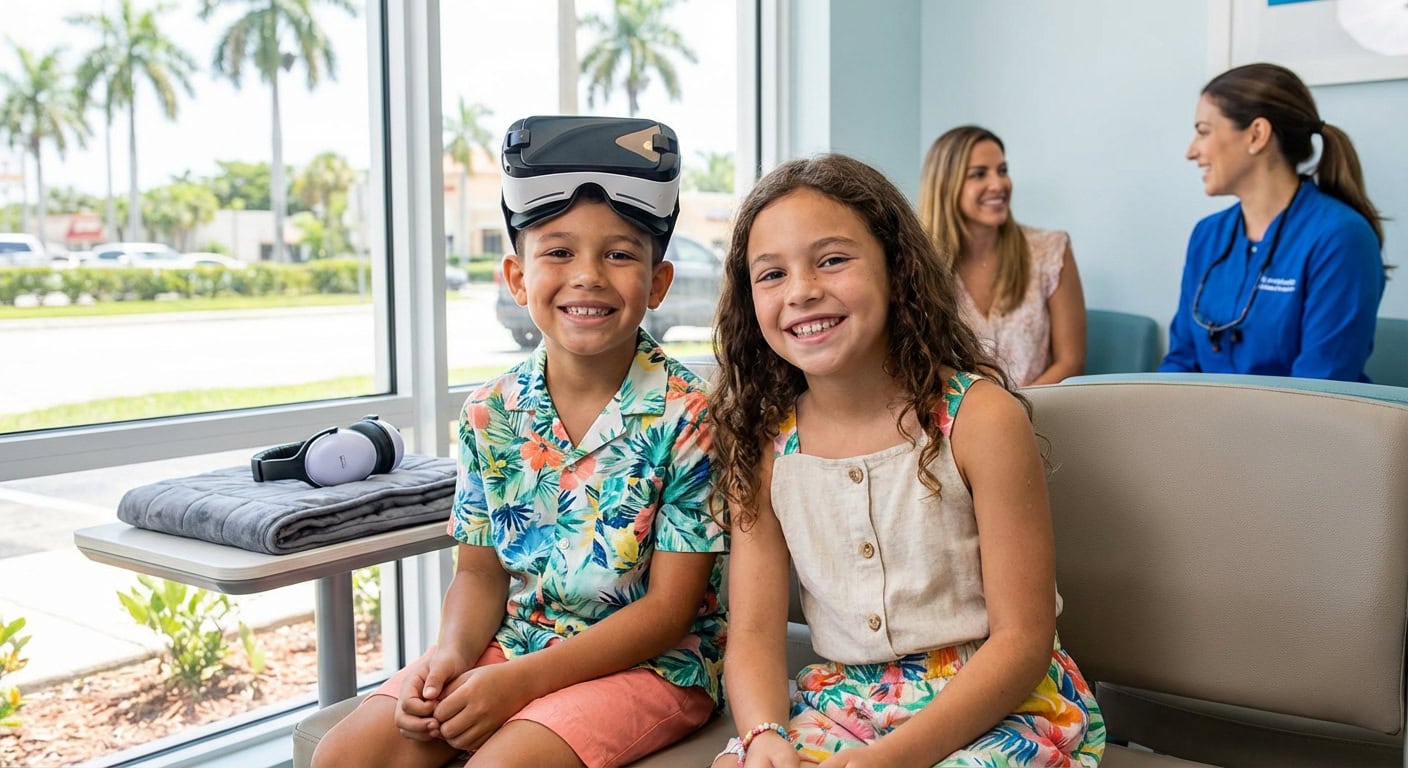
Our VIP suite has personal TV shows, noise-cancelling headphones, weighted blankets, and VR games.
After treatment, there's snacks.
The whole visit takes 30 to 45 minutes.
We sit down and talk family history—do parents or siblings have bite issues, what's the kid's lifestyle like, any specific concerns.
Then we take digital X-rays or a CBCT scan, which is basically a fast 3D photo of the teeth and jaw.
It's safer and gives way more detail than traditional X-rays.
We explain everything in words your kid can understand, show them what we see, and answer questions.
Kids leave feeling informed and actually kind of excited about their smile.
Parents leave knowing exactly what's happening and why.
See how we're different—it's comfort first, always.
Real Benefits of Starting Phase 1 Now
Here's what actually happens when your child gets Phase 1 treatment at the right time.
Gentler corrections. We're working with growth, not against it, so the movements are easier on the teeth and jaw.
Shorter overall treatment time. Phase 2 often takes only 12 to 18 months instead of 2+ years of braces.
Better breathing and jaw function. Correcting crossbites and expanding the upper arch opens airways and improves how the jaw closes.
Fewer extractions. Creating space early often means your kid keeps all their teeth instead of needing some removed.
Less complicated Phase 2. When you've already handled the big structural stuff, the second phase is just putting the finishing touches on alignment.
It's like the difference between fixing a problem when it's small versus when it's become a full-blown mess.
Clear Aligners vs. Traditional Braces for Phase 1
Not every Phase 1 case needs metal braces.
Clear aligners work for some kids, especially if they're responsible and will actually wear them.
The advantage is they're basically invisible and you take them out to eat and brush.
The catch is they only work if your kid wears them 20+ hours a day.
Some kids are great at this, some aren't.
Traditional braces are locked on, so there's no guesswork about compliance.
We talk through both options and help you pick what makes sense for your family.
What About Cost and Insurance?
Phase 1 treatment typically costs less than waiting and doing everything in Phase 2.
Most insurance plans cover at least part of orthodontic treatment, especially when it's interceptive like Phase 1.
We work with your insurance to figure out exactly what's covered, and we offer flexible payment plans so cost isn't the thing that keeps your kid from getting help they need.
Real talk: doing nothing now and dealing with bigger problems later almost always costs more money and time.
The Bottom Line on Phase 1 in Pembroke Pines
Phase 1 orthodontics isn't a sales pitch or something every kid needs.
It's a real option for kids with real issues caught at the right time.
When it's the right move, starting early changes the whole trajectory of your kid's smile and bite.
Shorter treatment overall, fewer procedures, better outcomes.
SMILE-FX is here to give you straight talk about whether your child needs it, what it involves, and what to expect.
We're trusted by families across South Florida because we show up with expertise, comfort, and no pressure sales tactics.
Your kid's smile matters, and so does the experience getting there.
If you're noticing issues or just want to know whether your child should be evaluated, book a FREE 3D scan and VIP smile consultation here.
Let's build that confident smile together.
Beyond Phase 1: What Happens During Phase 2 Orthodontic Treatment and When Your Teen Gets Braces
So Phase 1 is done, and now you're looking at Phase 2 braces for your teenager.
Your kid's probably asking the same questions you did a few years ago.
How long will this take?
Will it hurt?
Can I still eat the foods I like?
The good news is Phase 2 is the home stretch.
If your kid went through Phase 1 early, Phase 2 moves faster and smoother because you've already handled the hard structural stuff.
But even if you're starting braces for the first time now, Phase 2 orthodontic treatment is straightforward.
I'm going to walk you through what actually happens, what your teen can expect day to day, and why timing this right matters for the final result.
Phase 2 Braces: When It Starts and Why Age Matters
Phase 2 typically kicks off around age 12 or 13, once all the adult teeth have come in.
Your teen has a full set of permanent teeth, the jaw is mostly done growing, and now it's time to align everything into the right position.
If your kid did Phase 1, Phase 2 usually takes 12 to 18 months.
If you're starting from scratch with no prior treatment, expect 18 to 24 months depending on the complexity of the case.
That's still way better than adults who sometimes need 2.5 to 3 years because their bones have hardened and aren't as responsive to movement.
Timing matters because you want the orthodontic work done before your teen hits age 16 or 17 if possible.
Why?
Because senior photos, prom, college freshman year, first jobs.
Getting braces off before those milestone moments hits different.
Plus, the younger the patient, the faster the teeth move and the better they hold their final position long-term.
Metal Braces vs. Clear Aligners for Teens: What's Actually Better
This is the big question teens ask.
Can I get Invisalign instead of metal braces?
The short answer: it depends on the case and your teen's responsibility level.
Metal braces are still the gold standard for Phase 2 because they work on everything.
Complex rotations, bite corrections, spacing issues—metal braces handle it all.
They're also bonded to the teeth, so there's zero chance your teen forgets to wear them.
That compliance factor is huge.
Clear aligners like Invisalign for teens are invisible and removable, which sounds perfect.
But they only work if your teen wears them 20 to 22 hours a day.
Take them out for lunch and never put them back in?
Teeth don't move.
Lost the aligner?
That's money down the drain.
I've seen plenty of cases where clear aligners got abandoned halfway through and the parent had to switch to braces anyway.
What we typically recommend is assessing your teen's maturity level and their specific orthodontic needs.
Some cases work great with aligners, some need braces.
At SMILE-FX Orthodontic & Clear Aligner Studio, we talk through both options and help you pick what actually works for your family's situation, not just what sounds coolest.
What Phase 2 Braces Actually Feel Like Week One
Your teen gets braces bonded on, and for the first few days, that's weird.
The brackets feel bulky on the teeth.
The wire feels tight.
Some soreness is normal, especially when chewing.
This isn't unbearable pain—it's more like muscle soreness after a workout.
We recommend soft foods for the first week: yogurt, scrambled eggs, mashed potatoes, smoothies, pasta.
Your teen can go back to normal eating pretty quick, but they need to avoid hard, sticky, or crunchy stuff that could break the brackets.
No popcorn, no nuts, no hard candy, no chewing ice.
The soreness usually fades by day five or six.
After that, it's just maintenance.
Adjustments every four to six weeks are mildly uncomfortable for about 24 hours, then it settles down again.
Your teen gets used to it faster than you'd think.
The Real Day-to-Day Stuff: Eating, Sports, and Keeping Braces Clean
Braces don't stop your teen from living their life, but there are adjustments.
Eating becomes strategic.
They need to cut apples and carrots into small pieces instead of biting into them.
Burgers and sandwiches get messy with braces, so some teens prefer eating them open-faced.
Pizza is fine, just bite carefully.
After meals, your teen needs to brush and floss around the brackets, which takes a bit longer than normal brushing.
This is non-negotiable because food stuck under braces turns into cavities fast.
We recommend an electric toothbrush and water flosser—makes the whole process way easier than traditional floss.
Sports and activities?
Your teen can do everything except contact sports without a mouthguard.
If they play football, hockey, lacrosse, or do martial arts, they need a custom mouthguard that fits over the braces.
This is important because a hit to the mouth with braces can cause serious injury.
We can make a proper sports mouthguard at our office that actually protects.
Comfort stuff:
Orthodontic wax is your friend.
If a bracket catches the inside of the cheek or lip, a little wax smooths it out.
Some soreness is normal after adjustments, but if something feels genuinely wrong, your teen should text or call the office.
We're here to fix problems, not have your kid suffer through it.
How Adjustments Work and What to Expect Every Visit
Appointments typically run 20 to 30 minutes.
The hygienist or orthodontist removes the wire, cleans around the brackets, checks for any issues, and then puts a new or adjusted wire back in.
The new wire applies gentle pressure to move the teeth incrementally.
Each appointment moves your teen closer to the end goal.
You don't always need a new wire.
Sometimes the same wire just needs to be tightened.
The spacing of appointments matters too.
If you space them too far apart, the teeth can move backward and you lose progress.
If you bunch them too close together, the teeth don't have time to move properly.
Four to six weeks is the sweet spot where your teen's teeth are ready for the next adjustment.
Missing Appointments and Slowing Down Treatment
Here's something parents don't always think about: skipping appointments makes treatment take longer.
A lot longer.
If your teen misses adjustments, the teeth don't get the stimulation they need to move.
That three-month gap turns what should be a 18-month case into a 24-month case.
We build appointment schedules around school calendars and sports seasons as much as possible to make it realistic.
But we also need your teen to show up consistently.
That's the deal with Phase 2 braces.
It's predictable, it's manageable, but it requires commitment.
Cost and Insurance for Phase 2 Braces
Most dental insurance covers a percentage of braces, usually 50 percent after the deductible.
Some plans cap coverage at a certain dollar amount per year.
What you actually pay depends on your specific plan.
We work with your insurance upfront so there are no surprises.
We also offer payment plans that spread the cost over the treatment period, so it's not a giant hit to your wallet all at once.
If your teen went through Phase 1, many plans cover Phase 2 braces more fully because it's considered continuation of interceptive treatment.
The total out-of-pocket cost varies, but braces are an investment in your teen's confidence and long-term oral health.
It's worth it when you see them smile without feeling self-conscious in photos.
Common Orthodontic Issues Phase 2 Fixes
Phase 2 braces treat a wide range of cases.
Crowding: Too many teeth for the space available, causing overlap and misalignment.
Spacing: Gaps between teeth from missing teeth or a smaller jaw.
Overbite: Upper teeth stick out in front of lower teeth too far.
Underbite: Lower teeth are in front of upper teeth.
Crossbite: Some upper teeth bite inside the lower teeth.
Open bite: Front teeth don't meet when the back teeth are closed.
Rotations: Teeth are twisted or turned.
Most teens have a combination of these issues, and Phase 2 braces address all of it systematically.
The Retention Phase: Don't Forget This Part
When the braces come off, your teen's done, right?
Not quite.
The teeth want to move back to where they came from.
This is called relapse.
To prevent it, your teen needs to wear a retainer every single night for at least the first year.
Most people need to wear retainers indefinitely, but at least every night permanently.
Some wear them just a few nights a week after the first year.
The point is, the retention phase is just as important as the braces phase.
Skip retainers and you're watching the teeth drift backward.
That's frustrating because your teen just spent 18 to 24 months in braces.
We make this easy by providing clear retainers and traditional wire retainers.
Most teens prefer clear retainers because they're invisible.
The commitment to nightly wear is real though.
Questions Teens Actually Ask About Phase 2
Will my friends make fun of me? Maybe for like two days, then nobody cares.
Braces are so common now that it's not the big deal it was 20 years ago.
Half the school probably has them or had them.
Can I play an instrument? Yes, but it takes practice to adjust.
Brass players might find it trickier than string or wind players, but it's totally doable.
Will my teeth be sensitive? Some mild sensitivity is normal, especially after adjustments.
We recommend sensitivity toothpaste, and it usually resolves quickly.
Can I get my braces removed early? Not without compromising the result.
Removing braces before the teeth are fully positioned means relapse and a worse final outcome.
Patience here pays off.
The Reason to Start Phase 2 Now vs. Waiting
Some parents think their teen should wait until high school is over to get braces.
That's backwards.
Starting Phase 2 in middle school or early high school means braces come off before senior year.
Your teen gets their confident smile for prom, college visits, and freshman year photos.
Waiting until junior or senior year means braces stay on through those milestone moments.
Plus, teen jaws are still slightly growing and responding to orthodontic forces better than adult jaws.
Treatment is faster and the teeth settle into their final position more stably.
Starting Phase 2 at the right time is a no-brainer.
Why SMILE-FX Is the Right Choice for Phase 2 Treatment
Your teen deserves more than a sterile waiting room and a quick appointment.
We get it.
Teens are navigating braces while juggling school, social stuff, and their own stress.
Our approach is different because we treat teens like people, not just patients.
Our office is comfortable, the staff actually talks to your teen about their day, and appointments run on time so you're not sitting around forever.
We're board-certified orthodontists, not general dentists adding braces to their practice.
That specialist training shows in how we diagnose, plan treatment, and handle complications.
We use the latest technology to make sure your teen's treatment is as efficient and comfortable as possible.
Your teen gets 3D scans, digital treatment planning, and a clear path to their best smile.
Families across South Florida trust us because we deliver results without the high-pressure sales nonsense.
We're honest about timelines, realistic about cost, and focused on making your teen's braces experience actually positive.
Your teen's confidence matters, and Phase 2 braces are the tool that builds it.
If you're ready to start Phase 2 orthodontic treatment or want to know if your teen is a candidate, book a FREE 3D scan and VIP smile consultation here at SMILE-FX Orthodontic & Clear Aligner Studio.
Let's get your teen's braces journey started right.
Life After Braces: Retainers, Maintenance, and Keeping Your Smile Perfect Long-Term
Your braces just came off.
You're staring in the mirror at your kid's or your own straight teeth, and it feels like you just won the lottery.
Then your orthodontist says something that kills the vibe a little: you need to wear a retainer every night for the rest of your life.
Wait, what?
After spending months or years in braces, the idea of being tied to another appliance sounds like punishment.
But here's the real talk: your teeth have a memory, and without a retainer, they go right back to where they started.
I'm going to break down exactly what happens after your braces come off, how retainers actually work, and why this part of your orthodontic journey is just as important as everything that came before.
Because the best orthodontist near me isn't the one who just puts braces on and sends you home.
It's the one who makes sure your smile stays perfect once the hardware comes off.
Why Your Teeth Want to Move Back: Understanding Relapse
After braces come off, your teeth don't just sit there happy and straight.
They want to move.
This is called relapse, and it's biology, not a failure of your treatment.
Your teeth have periodontal ligaments that are like elastic fibers holding them in place.
Braces stretched those fibers to new positions over months or years.
The ligaments remember where the teeth were before, and they're constantly trying to pull them back to the original position.
Think of it like pulling a rubber band away from its resting spot.
The second you let go, it snaps back.
Your teeth do the same thing without a retainer holding them in their new position.
Some teeth move back faster than others, usually the bottom front teeth, which are the smallest and the easiest to shift.
That's why retainer wear is non-negotiable if you want to keep the smile you just paid for.
Types of Retainers: What's Right for Your Situation
Clear retainers are what most people want because they're basically invisible.
They look like thin plastic trays that fit over your teeth.
They're custom-made from a mold of your teeth after braces come off.
The downside is they're a little fragile.
You can crack or puncture them if you bite down too hard or lose them if you wrap them in a napkin at dinner and throw them away by accident.
They also wear out over time, usually lasting 6 to 12 months depending on how well you care for them.
Bonded wire retainers are fixed to the back of your bottom front teeth.
They're permanent, which means you can't lose them or forget to wear them.
The trade-off is they're harder to clean around, and if the wire breaks, you need to replace it.
Most people use these on the bottom teeth where relapse happens fastest.
Traditional metal wire retainers are removable and look like a thin wire with acrylic across the roof of your mouth.
They're durable and work well, but they're visible and some people find the plastic uncomfortable.
The best approach is usually a combination: a bonded wire on the bottom for permanent stability and clear retainers on top for daytime wear if needed.
We customize this based on your teeth and your lifestyle.
The Retainer Schedule: How Often You Actually Need to Wear Them
The first three months after braces come off are critical.
Your teeth are still settling into their new position, and the bone around them is still hardening.
You need to wear your retainer every single night, no exceptions.
Some orthodontists recommend 24-7 wear for the first few months, only taking them out to eat and brush.
After the first three months, if you've been consistent, you can usually switch to night-only wear.
Most people maintain night-only wear forever, or at least several nights a week permanently.
The key is consistency.
Skipping retainers for a week is enough to let your teeth start shifting.
If you skip for a month, you might notice real movement.
This is frustrating because you just finished braces, but it's the reality of how teeth work.
At SMILE-FX, we're honest about this upfront so you know what you're signing up for.
No surprises after treatment ends.
Caring for Your Retainers: So They Last
Clear retainers need gentle care.
Rinse them with cool water after meals before putting them back in.
Don't use hot water because heat can warp the plastic.
Clean them with a soft toothbrush and maybe a tiny drop of mild dish soap.
Never use toothpaste because it's abrasive and can scratch the plastic, making it cloudy.
Store them in a retainer case when you're not wearing them, not wrapped in napkins or left sitting on the counter.
Bonded wire retainers need careful flossing.
You can't use regular floss because the wire is in the way.
Use a water flosser or special floss threaders to get under the wire.
This is annoying, but it keeps your teeth healthy and the retainer clean.
Avoid hard or sticky foods that could damage either type of retainer.
Your retainer made it through braces treatment with you.
Treat it with respect and it'll keep your teeth straight for years.
Common Retainer Questions Nobody Talks About
Can I get a new retainer if mine breaks? Yes, but it costs money and it takes time to make a new one.
Usually 1 to 2 weeks.
In the meantime, if you don't have a bonded retainer as backup, your teeth can shift.
This is why backup retainers are smart.
What if I forgot to wear my retainer for weeks? Your teeth might have moved a little.
Put the retainer back in and wear it consistently again.
Sometimes your teeth will shift back toward straight after a few weeks of retainer wear.
If significant relapse happened, you might need touch-up braces or aligners.
Do I really need to wear it forever? Yes.
Your teeth will always want to go back to their original position.
This isn't a thing that stops after a year.
That said, after the first 1 to 2 years, many people can get away with wearing retainers just a few nights a week.
But night-time wear forever is the safest bet.
Life With Retainers: Eating, Speaking, and Adjusting
If you wear clear retainers 24-7 for those first few months, you take them out to eat.
This means keeping them safe while you're eating lunch at work or at a restaurant.
Bring a small retainer case so you're not wrapping them in napkins.
Some people put a note in their phone to remind them to put the retainer back in after eating.
Speech might sound a little different at first with a bonded wire retainer, but you adjust within a week or two.
Clear retainers sometimes cause a slight lisp the first few days, but that goes away too.
Your mouth adapts to foreign objects pretty fast.
Saliva production might increase a little, especially with clear retainers, but that's temporary.
When You Might Need a Better Orthodontist for Retainer Issues
If your retainer breaks and you can't get in to replace it right away, or if your teeth are relapsing despite retainer wear, you need an orthodontist near me who actually has office hours that work for your life.
A board-certified orthodontist South Florida isn't just someone with a license.
It's someone who cares enough to make sure you can get help when you need it, not whenever they feel like scheduling you in three months out.
At SMILE-FX, our board-certified specialists make retainer care and maintenance part of the package.
You're not just getting braces and being sent off into the world.
We're invested in your long-term smile.
Insurance and Retainers: What Actually Gets Covered
Most dental insurance plans don't cover retainers after braces come off.
Retainers are usually considered a separate, out-of-pocket expense.
The cost varies depending on the type: clear retainers usually run $300 to $600 per set, bonded wire retainers $150 to $300, and traditional wire retainers $200 to $400.
Some orthodontists include one set of retainers in the braces treatment cost, but many don't.
We recommend clarifying this upfront so you know what to expect.
If your retainer breaks or wears out after a year or two, you'll need to pay for a replacement.
That's why taking care of the one you get is worth the effort.
The Role of Bonded Retainers in Long-Term Stability
A lot of people ask whether they really need a bonded retainer if they wear clear retainers consistently.
Honestly?
If you're perfect with compliance, clear retainers alone can work.
But most people aren't perfect.
People get busy, travel, forget their retainers at home, or just get lazy.
A bonded retainer on the bottom front teeth gives you a safety net.
Even if you skip your clear retainers for a couple weeks, the bonded wire is holding those teeth in place.
The bottom front teeth are where relapse happens fastest and is most visible, so this is insurance against undoing your treatment.
It's like having a backup plan that actually works.
What Happens if You Don't Wear Your Retainer: Real Examples
I've seen patients come back a year after braces came off asking for touch-up treatment because they ditched their retainers.
The bottom front teeth are usually the first to shift back toward their original crowding.
Sometimes the bite shifts, meaning your upper and lower teeth don't line up the way they did when braces came off.
The more time goes by without a retainer, the more relapse happens, and the more work needed to fix it.
In some cases, people end up needing another round of braces or aligners.
That's expensive and time-consuming when a retainer would have prevented the whole thing.
On the flip side, I've also seen patients who've been meticulous about retainer wear for 10, 15, even 20 years and their smile looks exactly like it did the day braces came off.
The difference is consistency and caring about keeping what you built.
Advanced Retainer Options and Tech-Driven Solutions
Some orthodontists now use SureSmile retainers, which are custom 3D-printed retainers made with advanced technology.
They're more durable than traditional clear retainers and fit more precisely.
The downside is they cost more upfront, but they last longer, so the value might be better.
At SMILE-FX, we use the latest technology to make sure your retainers are made with precision and care.
We're not stuck in the past with outdated materials.
We're using what actually works best for your specific teeth and your lifestyle.
Your Role in Keeping Your Smile: A Real Conversation
Here's the thing about orthodontics that nobody likes to hear: the orthodontist does the hard work getting your teeth straight, but you do the work keeping them that way.
The retainer phase is where your commitment matters most.
It's the difference between a perfect smile that lasts 20 years and needing repeat treatment.
We can give you the best braces, the best aligners, the best technology, but if you don't wear your retainer, you're undoing it all.
That's on you, not us.
That's also why finding the right best orthodontist near me matters.
You need someone who's honest about this from the start, not someone hiding the truth until after treatment is done.
At SMILE-FX, we're different because we tell you straight up what the commitment looks like after braces come off.
We don't oversell the experience.
We're real about what it takes to keep your teeth straight long-term.
Getting Started With the Right Orthodontist for Your Whole Journey
Whether you're just starting your orthodontic journey with braces or clear aligners, or you're worried about keeping your smile after treatment, pick an orthodontist near me who thinks about the whole picture.
Not just the braces part.
Not just the first year.
The whole 20, 30, 40 year journey of keeping your teeth straight.
That's what SMILE-FX Orthodontic & Clear Aligner Studio does differently.
We're board-certified orthodontists South Florida who've treated thousands of patients from kids to adults across Broward, Miami-Dade, and Palm Beach counties.
We use top tech-driven solutions to make treatment faster and more comfortable, and we're obsessed with long-term results.
Your retainer care is part of our commitment to you, not something we forget about after treatment ends.
If you're ready to start your orthodontic journey the right way, or you need help with retainer issues, book a FREE 3D scan and VIP smile consultation.
Let's make sure your smile stays perfect for life.