
Phase 1 Orthodontics in Miramar: Early Care That Changes Everything
Your 7-year-old just lost their first tooth, and you're wondering: is it too early to think about braces?
The answer might surprise you.
Phase 1 orthodontics, also called interceptive treatment, happens during those golden years between ages 6 and 10, when your child's jaw is still growing and their baby teeth are making room for permanent ones.
This isn't about straightening every tooth yet.
It's about giving your child's smile the healthiest foundation possible.
At SMILE-FX Orthodontics & Clear Aligner Studio in Miramar, we've helped hundreds of South Florida families understand that early intervention isn't rushing.
It's actually preventing bigger problems down the road.
Why Age 7 Matters (And It's Not What You Think)
The American Association of Orthodontists recommends that every child have an orthodontic evaluation by age 7.
This isn't because we want to put braces on babies.
It's because by age 7, enough permanent teeth have erupted that we can spot real issues.
We're talking about crowding that will only get worse, bite problems that affect how your child chews and speaks, or habits like mouth breathing that impact facial growth.
Think of Phase 1 like getting your home inspected before small problems become expensive renovations.
We're looking ahead, not panicking about today.
Here's the thing that most parents don't realize: by the time you notice a problem, it's already been developing.
That's why catching things early matters so much.
Five Signs Your Miramar Child Might Benefit From Phase 1 Care
Let me walk you through the five biggest red flags we see in kids who need Phase 1 treatment.
1. Crowding That's Obvious Even to You
If your child's permanent teeth are coming in and they're clearly too big for the space, that's crowding.
Left alone, it often gets worse as more teeth erupt.
Phase 1 can create the space they need naturally by expanding the jaw at the right time in their growth.
2. A Crossbite (Top Teeth Bite Inside Bottom Teeth)
This one actually matters for growth.
A crossbite can cause your child to shift their jaw to one side when they bite down.
Over years, that affects how their whole face develops.
Catching it at age 7 or 8 is transformative.
3. An Open Bite (Front Teeth Don't Touch When Smiling)
If you can see a gap between your child's upper and lower front teeth when they bite down, that's an open bite.
Usually it's caused by thumb sucking or tongue thrusting.
Phase 1 can help correct the bite pattern and support your child in breaking the habit.
4. Mouth Breathing (Not Nose Breathing)
Watch your child while they sleep or concentrate.
If their mouth hangs open, they're a mouth breather.
This affects everything: tooth development, facial growth, even sleep quality.
Phase 1 orthodontics, combined with our team's guidance, helps retrain this pattern before it locks in.
5. Significant Overbite or Underbite
If your child's lower jaw is noticeably behind or ahead of their upper jaw, early intervention can guide growth in the right direction.
This is especially powerful during Phase 1, when growth is still happening.
What Phase 1 Actually Does (And What It Doesn't)
Here's what confuses a lot of parents: Phase 1 isn't about straightening every tooth.
Your child will still lose more baby teeth, and more permanent teeth will come in.
That's the whole point.
What Phase 1 actually does:
- Create space for permanent teeth by expanding the jaw when needed
- Guide jaw growth into a healthier pattern
- Correct harmful bite patterns early
- Sometimes prevent the need for tooth extractions later
- Make Phase 2 (comprehensive braces, usually ages 11-13) shorter and simpler
Most Phase 1 cases at SMILE-FX Orthodontics & Clear Aligner Studio involve simple appliances.
Maybe a palatal expander or a light wire.
We're working with your child's natural growth, not against it.
Many kids finish Phase 1 and go into a "resting period" where we monitor their growth until Phase 2 begins.
What Happens During Phase 1 Treatment
Let me be straight with you: Phase 1 is not a one-size-fits-all situation.
Every kid is different, and their treatment looks different too.
Some kids might wear a palatal expander for 6 to 12 months.
The expander slowly widens the upper jaw so incoming permanent teeth have room.
It sounds intense, but kids adapt fast.
They usually forget they're even wearing it.
Other kids might get a simple wire or other growth-guiding appliance.
The whole goal is to work with their growing jaw, not against it.
Treatment typically takes 12 to 24 months, depending on what your child needs.
We're not rushing.
We're working with biology, which means the timeline is actually shorter than if you waited and did everything in Phase 2 later.
The SMILE-FX Difference for Phase 1 in Broward
Families from Miramar, Pembroke Pines, Hollywood, Weston, Cooper City, and across Broward choose SMILE-FX for Phase 1 care because we don't treat kids like tiny adults.
Board-Certified Specialists Only
We're orthodontists, not general dentists dabbling in braces.
Every Phase 1 case is managed by a specialist trained specifically in growth guidance and interceptive care.
Your child isn't an experiment.
They're getting the expertise that actually understands facial development.
That matters because board-certified specialists have spent years learning exactly how kids' faces grow and what to do about it.
Pediatric-Focused Comfort
Your child's first orthodontic experience shapes how they feel about dental care for life.
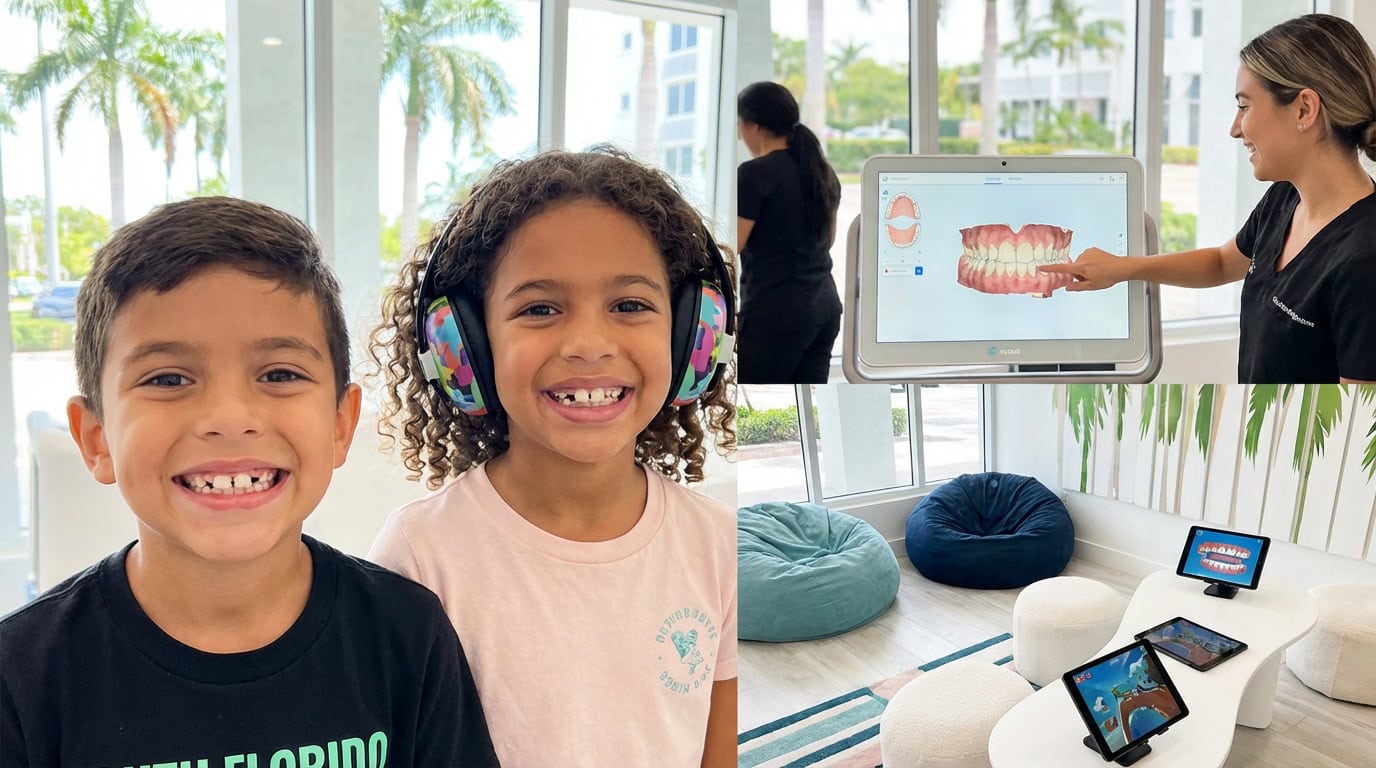
Our Miramar practice is designed for kids: we have games in the waiting room, noise-canceling headphones during appointments, weighted blankets for anxious kids.
We explain everything in language your 7-year-old understands.
We also offer virtual reality distraction during treatment.
Some kids actually ask to come back for appointments because it feels fun, not scary.
Growth Guidance, Not Just Appliances
We don't just put an expander in and hope for the best.
Our team helps parents understand habits that affect growth: mouth breathing, thumb sucking, tongue thrusting.
We guide your child toward healthier patterns.
It's partnership, not pressure.
Cutting-Edge Diagnostics
Our low-dose 3D imaging technology gives us a complete picture of your child's jaw growth without unnecessary radiation.
We can see growth patterns other practices miss, which means we catch opportunities early.
We also use AI-assisted treatment planning to show you exactly what we expect to see as your child grows.
No guessing.
Just science.
When Phase 1 Isn't Needed (And We'll Tell You)
Here's what builds trust: sometimes a child has a perfect bite pattern and healthy growth trajectory, even if their teeth look a little crowded.
Baby teeth are supposed to have gaps.
We call them "ugly duckling" years, and they're actually a sign things are developing normally.
If your child doesn't need Phase 1, we tell you clearly.
You won't hear sales pressure.
You'll hear the truth.
We recommend monitoring some kids for a year or two before starting treatment.
Others don't need Phase 1 at all.
They'll go straight into Phase 2 later if needed.
Every child is different, and that's exactly how we treat it.
What Your Child's First Visit Looks Like
Nervous about that first appointment?
Here's the reality:
Time Expectation: About 45 Minutes
Your child isn't in the chair the whole time.
We spend time talking with you about concerns, then we do a visual exam, take some digital photos, and explain what we see.
If we recommend 3D imaging, that takes about 5 minutes.
Quick, painless, and your child will barely notice.
No Scary Surprises
We walk your child through every step.
"Now I'm going to look at your bottom teeth" - that's how we talk.
We ask permission.
We go slow.
Kids who feel in control stay calm.
We Use the Latest Technology
Our 3D imaging is faster and lower-radiation than traditional X-rays.
No awkward bite wings that make kids gag.
Digital photos mean we can show your child exactly what we're seeing on the screen.
Kids actually like seeing their own teeth up close.
Honest Conversation With You
After the exam, we sit down with you and your child and explain what we found.
If your child needs Phase 1, we show you the specific issues and what we'd do about them.
If they don't need treatment yet, we tell you that too.
If they need treatment with another specialist first, like a pediatric dentist for cavities, we'll refer you to our trusted partners.
Cost and Payment Options for Phase 1 Treatment
Phase 1 treatment typically costs between $1,500 and $3,000, depending on what your child needs.
Many families spread this across 12-24 months of treatment.
Most insurance plans cover 50% of orthodontic care, and SMILE-FX works with every major plan in South Florida.
We also offer flexible payment plans because we know not every family can pay upfront.
That shouldn't stop you from getting your child the care they need.
Why This Matters Right Now
The window for Phase 1 is real, but it's not forever.
By age 11 or 12, your child's jaw has finished most of its growth.
Once that happens, the opportunity for interceptive treatment closes.
That's not fear-mongering.
That's just how biology works.
The families who get the best results are the ones who get their kids evaluated early.
Not because we push them into treatment, but because we catch problems when they're easiest to fix.
Families From Across Broward Trust SMILE-FX
Whether you're in Miramar, Pembroke Pines, Hollywood, Weston, Cooper City, or Fort Lauderdale, families trust us because we treat their child as an individual, not a case number.
Our board-certified orthodontists have seen thousands of growing smiles.
We know what normal looks like, what needs attention, and what can wait.
We communicate clearly, we never pressure, and we've earned the trust of pediatric dentists across South Florida who refer their families to us.
Your child's smile isn't just about straight teeth.
It's about confidence, healthy growth, and the best possible foundation for their smile for life.
That starts now.
What About Clear Aligners and Other Options?
Sometimes parents ask about clear aligners for younger kids.
Here's the honest answer: during Phase 1, traditional braces or growth-guiding appliances usually work better because they guide the jaw as it grows.
Clear aligners work great for kids who are older and can handle the responsibility.
But for Phase 1, we stick with what works best.
If you want to explore all your options, check out our treatable cases page to see what we handle.
Take Your Next Step
Wondering if your child might benefit from Phase 1 orthodontics?
There's only one way to know: bring them in for a consultation.
We offer a free 3D scan and VIP smile consultation at our Miramar location, and we'll give you honest answers.
No pressure.
No sales pitch.
Just the truth about your child's smile.
Book your free 3D scan and VIP smile consultation here, or contact us to discuss your child's specific situation.
We're here for families across Miramar, Pembroke Pines, Hollywood, Weston, Cooper City, and all of Broward.
Your child's smile deserves expertise, and Phase 1 orthodontics in Miramar is where early care changes everything.
Phase 2 Orthodontics in Miramar: Completing Your Teen's Smile Journey
Your teenager's baby teeth are mostly gone now, and you're noticing their permanent teeth are finally coming in.
This is where Phase 2 orthodontic treatment comes in, and it's the game-changer that turns a good foundation into a genuinely great smile.
If your child had Phase 1 treatment, Phase 2 picks up where that left off.
If this is their first time in braces or aligners, that's fine too.
Either way, Phase 2 is when we get serious about aligning every tooth perfectly and creating a bite that works for life.
What Is Phase 2 Orthodontic Treatment, Anyway?
Phase 2 happens when most or all of your child's permanent teeth have erupted, usually between ages 11 and 13, though it can happen later depending on their growth.
This is comprehensive orthodontic treatment where we align all the teeth, not just guide growth.
We're looking at the full picture: how the teeth line up, how the bite closes, and making sure everything functions and looks amazing.
The cool part is that if Phase 1 did its job right, Phase 2 takes less time and is often less complicated.
Your teen might spend 18 to 24 months in braces or aligners instead of the 24 to 36 months kids sometimes need when they skip Phase 1.
When Should Your Teen Start Phase 2?
The timing depends on a few things.
Most of your child's permanent teeth need to be in place first.
We're talking about the second molars in the very back, which sometimes don't show up until age 13 or even 14.
If your teen had Phase 1 treatment, we've been monitoring them anyway, so we know exactly when to start Phase 2.
If this is their first orthodontic visit, we'll take a full set of records and figure out the perfect timing based on where they are in their growth.
Starting too early or too late makes a difference, so this isn't something we guess on.
Braces vs. Clear Aligners: Which Works Better for Teens?
This is probably the question I hear most from parents of teenagers in Miramar.
Both work.
The key is picking what your teen will actually stick with.
Traditional Braces: The Reliable Option
Braces are still the gold standard for most teenagers.
Why?
They're on 24/7, so there's no way to forget about them or take them off.
They handle complex tooth movements efficiently.
And honestly, they're the most cost-effective option.
Modern braces look way different than they did ten years ago.
We have tooth-colored brackets, clear elastic ties, and even self-ligating brackets that work with lighter forces.
Your teen's friends won't be judging them the way kids used to.
Teens are also way better at managing braces than younger kids because they understand the commitment.
Clear Aligners: The Invisible Option
This is where Invisalign and other clear aligners come in.
Your teen wears a series of custom-made trays that gradually shift their teeth.
The trays are nearly invisible, which some teens love.
They can take them out to eat and brush, which feels less restrictive.
But here's the honest part: they only work if your teen actually wears them 20 to 22 hours a day.
And some teenagers aren't there yet.
If your teen is responsible, organized, and actually wants invisible braces, clear aligners are fantastic.
If they're the type to lose things or forget stuff, traditional braces might be the better call.
We can usually tell which option fits better after that first conversation.
The Teeth That Phase 2 Fixes
Phase 2 treatment handles basically everything Phase 1 didn't, plus some new stuff now that all the permanent teeth are here.
Crowding and Spacing
If teeth are still crowded or have gaps, Phase 2 fixes that by moving every single tooth into its proper position.
Bite Problems
We correct overbites, underbites, and open bites that weren't fully addressed in Phase 1.
The goal is a bite where the top and bottom teeth meet perfectly when your teen closes their mouth.
Tooth Rotation
Some teeth come in twisted or turned.
Phase 2 rotates them into proper alignment.
Midline Issues
The center line of the top teeth should match up with the center line of the bottom teeth.
If they don't, Phase 2 corrects that.
Vertical Issues
Sometimes some teeth are higher or lower than they should be.
We level everything out so the bite is even and functional.
What Happens During Phase 2 Appointments
Your teen will come in every 6 to 8 weeks, depending on what we're doing.
If they're in traditional braces, we're adjusting the wires and checking that everything is moving smoothly.
If they're in clear aligners, we're making sure they're tracking well with the treatment plan and switching to the next set of trays at the right time.
Each appointment takes about 30 to 45 minutes.
We're checking how the teeth are moving, how the bite is developing, and making small adjustments to keep things on track.
Your teen should expect a little soreness for a day or two after each appointment as the teeth shift.
That's normal and means things are working.
Pain management is usually just over-the-counter ibuprofen and soft foods.
The Real Cost of Phase 2 Treatment
Phase 2 comprehensive treatment typically runs between $3,500 and $6,000 depending on complexity and whether your teen uses braces or aligners.
That sounds like a lot, but remember: this is a two to three year investment in your child's confidence, function, and oral health for the next 60+ years.
Most dental insurance plans cover 50% of orthodontic treatment.
SMILE-FX works with every major insurance plan in South Florida, and we always run your benefits before starting treatment so you know exactly what you're paying out of pocket.
We also offer flexible payment plans that break the cost into manageable monthly payments.
Many families find that spreading payments over 24 months makes it completely doable.
Life With Braces: What Your Teen Actually Needs to Know
If your teen goes the traditional braces route, here's what life actually looks like.
Food Restrictions Are Real But Not Permanent
Hard, sticky, and crunchy foods can damage braces or get stuck.
We're talking no popcorn, no caramel, no hard candy, no chewing ice.
It sounds restrictive until you realize your teen can still eat pizza, sandwiches, pasta, most normal stuff.
They just need to break things into smaller pieces.
Cleaning Is Harder But Important
Braces create more places for food and plaque to hide.
Your teen needs to brush after meals and before bed, and they should floss daily.
We recommend a water flosser or floss threader because traditional floss is tough with braces.
If your teen doesn't keep up with cleaning, they risk cavities and gum problems.
Sports and Activities Are Fine
Your teen can still play sports, play instruments, and do basically everything they did before.
For contact sports, we recommend a mouthguard.
Just make sure it's the kind that fits over the braces without damaging them.
Life With Clear Aligners: The Other Side of the Story
Clear aligners offer different advantages and challenges.
No Food Restrictions
Your teen takes out the aligners to eat, so they can eat anything without worrying about damaging their treatment.
That's huge for a teenager.
Easier Cleaning
Without brackets and wires, teeth are easier to clean.
Your teen brushes and flosses normally.
Responsibility Is Everything
The downside is that aligners only work if your teen wears them.
If they forget to put them back in after eating, or they lose them, or they just don't wear them enough, treatment stalls.
We can track wear time with our smart technology, so we know if there's an issue.
It's not a punishment thing.
It's just helping your teen stay on track.
What Makes Phase 2 Different at SMILE-FX
We Treat Teens Like Almost-Adults
Your teenager isn't a little kid anymore, and we don't treat them like one.
We explain what we're doing, why we're doing it, and what they can expect.
We also listen to what they care about.
If they're worried about appearance, we talk about that.
If they're worried about food, we address it.
Your teen feels like part of the team, not just a passenger.
Our Board-Certified Specialists Know Growth Still Matters
Growth doesn't completely stop at age 13.
A board-certified specialist understands how remaining growth might affect treatment and accounts for it.
General dentists offering braces sometimes miss this.
We don't.
Cutting-Edge Technology Makes Everything Faster
Our 3D imaging and AI-assisted planning mean we're not guessing about where teeth should go.
We can show your teen a digital preview of their final smile before we even start treatment.
That changes how they feel about the whole process.
Knowing what the end result will look like makes the 24 months feel purposeful instead of just annoying.
Common Questions About Phase 2
Will My Teen's Teeth Shift Back After Treatment?
Not if they wear their retainer.
After Phase 2 is complete, your teen will wear a retainer to hold their teeth in place.
Most teens wear it every night for the first few months, then several nights a week for years after.
Some of our patients wear retainers long-term and that's totally fine.
Teeth want to shift, especially in the first year after braces come off.
The retainer prevents that.
What If My Teen Had Phase 1 But Didn't Need Phase 2?
This happens sometimes.
If Phase 1 did its job perfectly and your teen's teeth erupted and aligned beautifully, they might not need Phase 2.
We monitor them carefully to make sure, but it's possible.
Can My Teen Bleach Their Teeth Before Phase 2 Starts?
No, not yet.
Wait until after the braces come off.
When braces are on, they cover part of the tooth, and bleaching wouldn't reach that area.
You'd end up with uneven whitening.
After Phase 2 is done, whitening is totally fair game.
What If We Can't Afford Phase 2 Right Now?
We work with families on this all the time.
If your teen needs Phase 2 but now isn't the right time financially, we can wait a bit.
Teeth won't shift dramatically in a few months.
We'll keep monitoring, and when you're ready, we'll start.
We also break payments into monthly installments so you're not paying everything upfront.
After Phase 2: Life With Your Teen's New Smile
When the braces come off or your teen finishes their aligners, it's honestly one of the best feelings.
They'll be shocked at how different their smile looks and feels.
Eating feels easier.
Smiling for photos feels natural.
The confidence boost is real and noticeable.
From that point forward, they wear a retainer to keep everything in place.
We fit them with a custom retainer that holds their teeth exactly where we put them.
It's the final piece of the puzzle.
Why SMILE-FX Is Different for Phase 2 in Broward
Families across Miramar, Pembroke Pines, Hollywood, Weston, and Cooper City choose SMILE-FX for Phase 2 because we actually see teenagers as individuals.
We're not running a factory.
We're customizing treatment for your teen's specific needs, their goals, and their life.
We explain everything clearly so your teen understands what's happening and why.
We use the latest technology so treatment is faster and more predictable.
And we make the whole experience feel more like a partnership than something being done to them.
Your teen will have a good experience with us, which means they'll actually take care of their teeth and their retainer long-term.
How to Know If Your Teen Is Ready for Phase 2
The best way to know is to come in for a consultation.
We'll take records, explain what your teen needs, and walk through options together.
There's no pressure and no sales pitch.
Just us looking at your teen's mouth and telling you what we see.
You can also take our smile quiz to get a general sense of whether braces or aligners might be a good fit.
It's not a diagnosis, but it helps start the conversation.
Book a FREE 3D scan and VIP smile consultation here if your teen is ready to explore Phase 2 options.
We'll show you exactly where they are in their orthodontic journey and what comes next.
Phase 2 Orthodontics for Teens Across South Florida
If your teenager needs braces, clear aligners, or Invisalign in Miramar or anywhere else in South Florida, SMILE-FX has the expertise to get it done right.
We're board-certified specialists with years of experience making teenagers smile with confidence.
We work with both traditional braces and the latest clear aligner technology.
And we make sure every single teen we treat understands what's happening and feels good about their orthodontic journey.
Phase 2 orthodontics is your teen's chance to get the smile they've been waiting for, and we're here to make that happen.
Book a FREE 3D scan and VIP smile consultation here and let's talk about what Phase 2 can do for your teenager's smile.
Retainers After Braces: The Real Talk About Keeping Your Smile Straight
Your braces are finally coming off. Your teeth look incredible. You're pumped. Then your orthodontist mentions the word "retainer" and suddenly you're wondering if the work is actually done.
Here's the truth: getting braces off isn't the finish line. It's more like halfway through a marathon.
Your teeth spent months moving into their new positions, and they absolutely want to move back.
That's just biology. Teeth are living things attached to bone and gum tissue that have a memory of where they used to be.
Without a retainer, you could lose 50% of your orthodontic results within a few months.
Yeah, that's real.
But here's the good news: wearing a retainer is way easier than wearing braces. And at SMILE-FX Orthodontics & Clear Aligner Studio, we've gotten thousands of patients through this final phase successfully.
Let me break down what actually happens after your treatment ends and why retainers aren't optional if you want to keep that investment locked in.
Why Your Teeth Want to Move Back (And It's Not Your Fault)
When your braces or aligners were moving your teeth, they were fighting against the bone and gum tissue around those teeth.
That bone and tissue want to return to their original shape.
Think of it like moving into a new apartment and rearranging all the furniture.
The room wants to look like it used to.
Your gums and bone are the same way.
After your braces come off, there's a period of time where your teeth are at their most vulnerable to shifting.
The first year is critical, especially the first three months.
This is why retainer wear matters so much early on.
It's not punishment. It's maintenance.
The Three Types of Retainers (And Which One Works Best For You)
Not all retainers are created equal, and what works for one person might not be right for another.
At our Miramar orthodontic office, we customize which retainer type makes sense based on your lifestyle and needs.
Hawley Retainers: The Classic Metal and Acrylic Option
These are the retainers you probably picture when you think "retainer."
They're made of acrylic and a metal wire.
They're durable as hell.
You can adjust them if teeth start shifting slightly.
They last forever if you take care of them.
The downside is they're visible when you're wearing them.
Some people care, some don't.
They also take a minute to get used to because of the metal wire.
Clear Retainers: The Invisible Choice
These look like clear aligners and fit right over your teeth.
They're invisible, which is why a lot of patients love them.
They're comfortable and easy to wear.
But they're not as durable as Hawley retainers, and you can't adjust them.
If your teeth shift a tiny bit, the retainer won't fit right anymore.
Most people need to replace clear retainers every two to three years.
Bonded Retainers: The Fixed Option
This is a thin wire that gets bonded to the back of your front teeth.
You can't take it out.
It stays there permanently.
This works great for people who are worried they'll forget to wear a removable retainer.
The catch is you need to floss around it carefully, and if it breaks, you need to come back to get it fixed.
Many of our patients use a combination: a bonded retainer on the bottom front teeth for all-day protection, plus a removable retainer for the top teeth at night.
This gives you the best of both worlds.
The Retainer Schedule That Actually Works
After your braces come off, you don't wear your retainer forever at the intensity you wore braces.
It phases down over time, but most board-certified orthodontists recommend you keep wearing it longer than you think.
Here's the realistic schedule we recommend at SMILE-FX:
Months 1 to 3: Full-Time Wear
You wear your retainer all day and all night, only taking it out to eat and clean your teeth.
This is the critical window where your teeth are most likely to shift.
Your bone and gum tissue are still adjusting to the new positions.
Months 4 to 12: Nighttime Only
After three months, you can switch to wearing your retainer only at night.
This maintains the position your teeth have settled into.
One year after braces is still relatively soon, and your teeth can shift if you're not careful.
Year 2 and Beyond: Most Nights
After a year, you can usually get away with wearing your retainer four to five nights a week.
Some of our patients wear it more often if they notice any slight shifting.
Honestly, a lot of people just keep wearing it every night because it becomes such a habit they forget it's even there.
Long-Term: Listen to Your Teeth
Some people wear retainers every night for life.
Some wear them a few times a week indefinitely.
The reality is your teeth want to shift throughout your entire life.
Wisdom teeth coming in, bone loss as you age, even just the natural settling of your bite can cause slight movement.
Wearing a retainer is way easier than getting braces again.
Real Problems People Face With Retainers (And How to Avoid Them)
I've seen thousands of patients go through the retainer phase, and there are some common issues that trip people up.
Forgetting to Wear It
This is probably the most common one.
Your routine changes, you get busy, you forget for a week, then a month, and suddenly your teeth have shifted.
The fix is making it part of your bedtime routine just like brushing your teeth.
Put it on after you brush.
Make it automatic.
Losing or Damaging It
Clear retainers especially get lost or stepped on.
People wrap them in napkins at restaurants and throw them away by accident.
This is why we always recommend getting a backup retainer made.
If you have a Hawley retainer, we can make a clear one as a backup.
If you have clear retainers, we'll make extras.
It's not expensive insurance and it saves you from panic when something happens.
Not Cleaning It Properly
Your retainer collects bacteria just like your teeth do.
If you don't clean it, you end up with a buildup of plaque and tartar.
This can cause bad breath and tooth decay right under the retainer.
Clean your retainer with a soft toothbrush and mild soap, or soak it in a retainer cleaner.
Don't use hot water because it warps clear retainers.
Wearing It While Eating
This one breaks retainers constantly.
Take it out before you eat.
It only takes five seconds.
Trying to eat with a retainer in just cracks it.
What Happens If You Stop Wearing Your Retainer
Let me give you the real scenario because I want you to understand what's actually at stake.
You stop wearing your retainer because you forget, or you lose it, or you just think your teeth are stable now.
For the first few weeks, nothing happens.
Your teeth still look perfect.
Then around month two or three, you notice your bite feels a little different.
By month six, your teeth have noticeably shifted.
Now you're looking at either getting braces again or just accepting that your teeth are moving backward.
Neither option is great.
We've had patients come back after five years without a retainer and their teeth have shifted so much they'd need another round of treatment.
That's expensive and frustrating when it was completely preventable.
Don't be that person.
Just wear your retainer.
Insurance and Cost for Retainers
Most dental insurance plans cover retainers either as part of your orthodontic treatment or as a separate benefit.
Some plans give you one free retainer per year.
Others cover a percentage of the cost.
When you finish your orthodontic treatment with us, we always run your insurance benefits for retainers so you know exactly what you're paying.
If insurance doesn't cover them fully, retainers typically cost between $200 and $500 depending on the type.
That's honestly nothing compared to the cost of getting braces again.
We also offer payment plans for retainers if cost is a concern.
Bonded Retainers: The Permanent Solution and What You Need to Know
A bonded retainer is one of those things that sounds weird until you actually have one, and then you wonder why everyone doesn't get them.
It's a thin wire that gets bonded to the back of your front teeth with dental cement.
You wear it 24/7 permanently.
You can't forget it because it's literally attached to your teeth.
The pros are obvious: you never have to think about wearing it, and your front teeth have permanent protection against shifting.
Front teeth are the ones most people notice and care about, so this makes sense.
The cons are that you need to floss carefully around the wire, and if it breaks, you need to come back to get it repaired.
Also, some people find the wire slightly annoying with their tongue at first.
That goes away in a few days.
Most of our patients with bonded retainers love them because they eliminate the "did I wear my retainer" question for half their mouth.
Can You Get Your Teeth Whitened While Wearing a Retainer
A lot of people ask if they can whiten their teeth once their braces come off.
The answer is yes, but there's timing involved.
If you have a bonded retainer on your front teeth, whitening treatments won't affect the part of the tooth under the wire.
So you might end up with uneven whitening.
We usually recommend waiting a few months after braces come off, making sure your bite is completely settled, and then talking about professional whitening.
By then your retainer schedule has shifted to nighttime only anyway, so it's not an issue.
Why SMILE-FX Handles Retainers the Right Way
A lot of orthodontic offices send you off with a retainer and you're basically on your own.
At SMILE-FX, we treat retainers as part of the ongoing care, not something that happens and you're done.
We use cutting-edge technology to ensure your retainer is made to exact specifications.
We check in with you regularly to make sure you're wearing it and that your teeth are staying stable.
If something changes, we catch it early and adjust your retainer or your wear schedule accordingly.
We also talk honestly about which retainer type makes sense for you based on your life.
If you travel a lot and lose things, maybe a bonded retainer on the bottom is smart.
If you're really disciplined about nighttime routines, a clear retainer might work perfectly.
We customize this, not make assumptions.
The Real Talk: You Invested Too Much to Skip the Retainer
You spent 18 to 36 months in braces or aligners.
You paid thousands of dollars.
You dealt with appointments and adjustments and probably some discomfort.
Your teeth look amazing now.
Skipping retainers is like rebuilding your entire car engine and then not changing the oil.
It makes no sense.
Wearing a retainer is genuinely easy.
It's not uncomfortable.
It doesn't take effort.
You just have to actually do it.
Talk to your board-certified specialist about which retainer option fits your life best, commit to wearing it, and your smile stays perfect for decades.
Ready to finish your orthodontic journey the right way?
Book your FREE 3D scan and VIP smile consultation at the best orthodontist in Miramar and get answers about your specific retainer plan.