
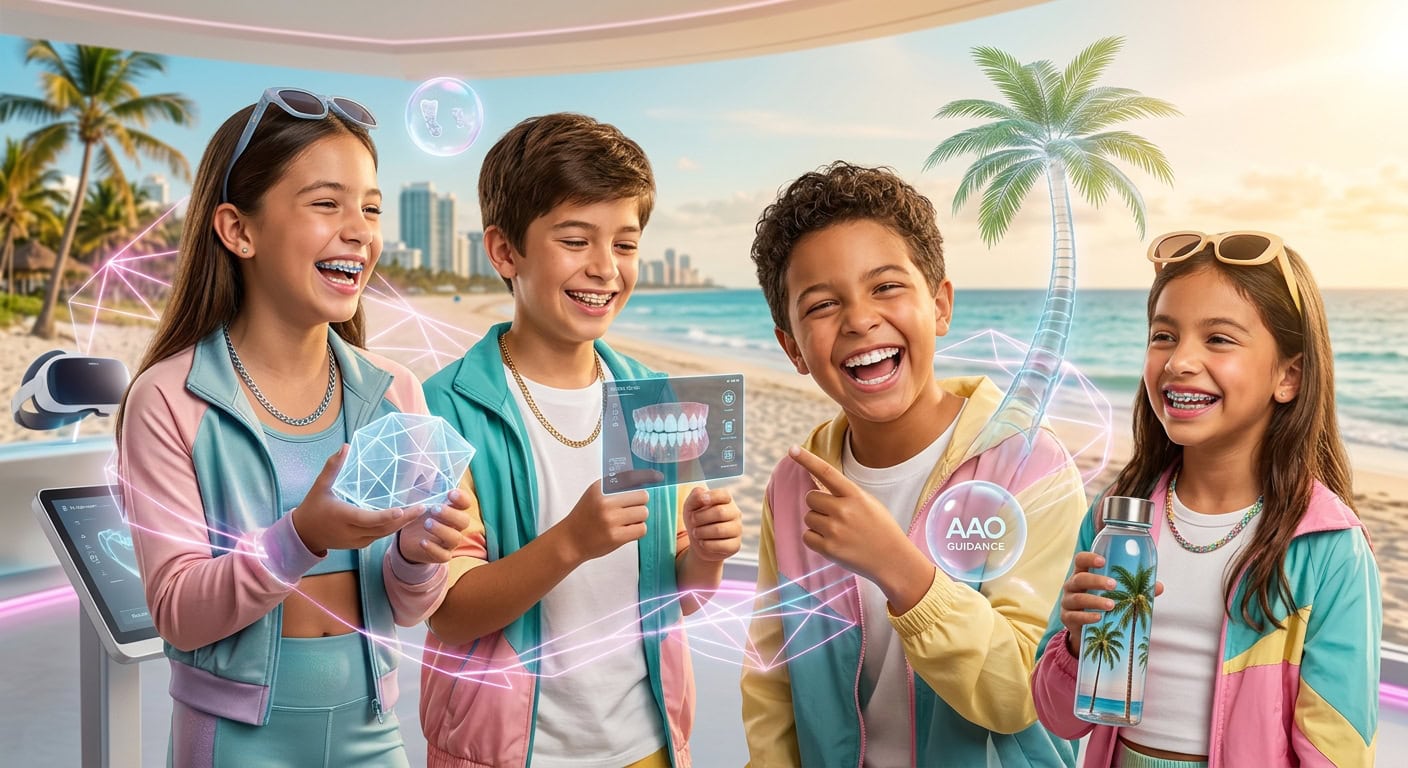

Phase 1 Orthodontics for Ages 6-10 in Miramar FL
I see it every week in our Miramar studio: a parent brings in their 7-year-old, worried about crowded baby teeth, and leaves relieved because we caught something early that would have meant surgery later. Phase 1 orthodontics for ages 6-10 is not about slapping braces on a first grader. It is about reading the growth map of your kid's face and making tiny moves now so everything lands right later. At SMILE-FX® Orthodontic Studio, we have done this thousands of times for families across Miramar, Pembroke Pines, Hollywood, Weston, Cooper City, Davie, and Fort Lauderdale.
What Actually Happens During Phase 1 Treatment
Direct Answer: Phase 1 interceptive orthodontics uses appliances like expanders, partial braces, or space maintainers during ages 6-10 to correct jaw imbalances, create room for permanent teeth, and break harmful oral habits before the face finishes growing, typically lasting 6-18 months with a resting period afterward.
Most parents think orthodontics starts at 13. That is outdated. The American Association of Orthodontists says the first check should happen at age 7. Not because your kid needs braces then. Because that is the sweet spot where we can see problems before they lock in. I tell parents to picture it like steering a car. At 7, the jaw is still malleable, like a car moving slowly. You can turn the wheel gently. At 14, you are on the highway. Harder to change direction without major force.
Our board-certified specialists at SMILE-FX® do not guess. We use 3D CBCT imaging to see exactly where every tooth is, where it is heading, and what the airway looks like. That last part matters more than people realize. Mouth breathing in a 6-year-old is not just annoying. It changes how the face grows. Narrow palate, long face, crowded teeth. We fix the root cause, not just the teeth.
The 5 Signs Most Miramar Parents Miss
Direct Answer: The most overlooked indicators for Phase 1 intervention include snoring or mouth breathing during sleep, difficulty closing lips at rest, thumb sucking beyond age 4, visible asymmetry when the jaw opens or closes, and baby teeth that fall out way too early or hang on way too long.
I had a mom from Cooper City bring her 8-year-old in last month. She thought the kid just had a cute snore. Turns out, his airway was 60 percent narrower than it should have been. That is a growth problem, not a quirk. Within a few months of Phase 1 expansion, the snoring stopped and his attention at school improved. Teachers noticed before she told them about the treatment.
Here is what I want every Broward parent to watch for:
- Your child breathes through their mouth during the day or at night.
- You notice teeth grinding or jaw clenching sounds while they sleep.
- Baby teeth are gone too early or refuse to budge years past the normal timeline.
- The lower jaw shifts sideways when they bite down.
- Speech sounds are off, especially certain letters, and nobody has connected it to tooth position.
If any of these hit home, do not panic. Just come in. About 70 percent of the kids we see at age 7 do not need immediate treatment. We monitor them. But for the ones who do, those early months make all the difference between a simple expander now and jaw surgery at 18.
| Clinical Warning Sign | What It Might Mean | Action Timeline |
|---|---|---|
| Snoring or gasping during sleep | Airway constriction, narrow palate | Evaluate within 3 months |
| Thumb sucking past age 4 | Open bite, narrowed arch | Intervention by age 6 |
| Jaw shifts sideways when biting | Crossbite, asymmetric growth | Treat by age 8-9 |
| Baby teeth lost before age 5 | Space loss for permanent teeth | Space maintainer immediately |
| Difficulty closing lips at rest | Vertical growth issues, airway | Full workup by age 7 |
Why the First Visit at Age 7 Changes Everything
Direct Answer: The age 7 orthodontic evaluation catches skeletal and dental issues while the jaw is still growing, allowing interceptive treatment that can reduce or eliminate the need for extractions, surgery, and prolonged braces in the teenage years, often cutting Phase 2 treatment time by 40-50 percent.
I am going to be direct here. Waiting until all the permanent teeth come in is like waiting until the foundation cracks before calling the engineer. By age 7, the first molars are in. That gives us a locked-in reference point for how the bite is developing. We can see crowding patterns years before they become obvious. We can spot crossbites that are already starting to warp jaw growth.
At SMILE-FX®, our Chief Clinical Director Dr. Tracy Liang is a Diplomate of the American Board of Orthodontics. That credential is held by roughly 30 percent of orthodontists nationwide. She earned her DDS Summa Cum Laude from Cornell, completed her MS and residency at University of Minnesota, and is a Credentialed Fellow in the International Academy for Dental-Facial Esthetics, a distinction held by less than 1 percent of U.S. orthodontists. When she reads a CBCT scan on your 7-year-old, you are getting an elite diagnosis.
Our Miramar location is set up for this. The VIP Tech Suite has optical scanning, VR headsets, weighted blankets, noise-canceling headphones, and personal TVs. Kids walk in nervous and leave asking when they can come back. That matters. A child who trusts the orthodontist cooperates better. Treatment moves faster. Results stick.
How We Cut Office Visits by 40% for Busy Broward Families
Direct Answer: SMILE-FX® uses remote dental monitoring apps and AI-driven treatment planning to reduce required in-person visits by approximately 40 percent, a critical advantage for families commuting from Pembroke Pines, Weston, Davie, and Fort Lauderdale who need to minimize time off work and school.
I know what traffic looks like on I-95 at 4 PM. I know the Turnpike bottleneck near Hollywood. Parents in Weston do not want to drive 20 minutes each way for a 10-minute adjustment every four weeks. So we built a system that does not require it. Our remote monitoring platform lets you scan your child's teeth at home with a smartphone. The AI checks the progress. If everything is tracking, we skip the visit. You only come in when there is something we actually need to do.
This is not some gimmick. It is how elite orthodontic studios operate now. Combine that with in-house 3D printing for custom appliances, and we can turn around expanders and aligners in days instead of weeks. No shipping to a lab in another state. No waiting on a third party. Our cutting-edge technology means your kid starts treatment faster and finishes on schedule.
Families commuting from Cooper City or Davie tell us this changes everything. They are not burning an hour and a half round trip for a five-minute check. They scan at home after dinner. We review it next morning. Done. That is how modern orthodontics should work.
| Treatment Type | Total Duration | In-Person Visits Required | Remote Monitoring Compatible |
|---|---|---|---|
| Phase 1 Palatal Expander | 6-12 months | 4-6 visits | Yes, after initial fitting |
| Phase 1 Partial Braces | 8-18 months | 6-10 visits | Yes, with home scans |
| Space Maintenance Only | 12-24 months | 2-4 visits | Yes, fully compatible |
| Habit Appliance (thumb/tongue) | 4-8 months | 3-5 visits | Yes, most checks remote |
What Phase 1 Actually Costs in South Florida
Direct Answer: Phase 1 interceptive treatment in Broward County typically ranges from $1,800 to $4,500 depending on appliance complexity, with SMILE-FX® offering flexible financing at $0 down and monthly plans starting around $149, and full insurance verification before any treatment begins including Florida Blue PPO and Delta Dental of Florida networks.
Let me talk numbers because most orthodontic websites dance around this and it drives me crazy. Phase 1 is not a full braces case. The cost reflects that. A simple expander runs on the lower end. A more involved setup with partial braces and habit appliances goes higher. But here is what matters: catching a crossbite at age 8 with a $2,500 expander beats paying $15,000 for jaw surgery at 18. That is not marketing. That is math.
We comply with Florida SB 1808, which mandates that any patient overpayment must be refunded within 30 days. Our automated ledger system audits every account so there are never surprises. No HMO runaround. No hidden fees buried in fine print. We verify your insurance before we even touch a tooth. You know exactly what you are paying and when.
For families without orthodontic coverage, our in-house financing starts at $0 down. Many Broward households spread Phase 1 across 12-18 months interest-free. That makes early treatment accessible without draining the savings account. If you want to see what your plan covers, book a free consult and our team handles the rest.
| Treatment Category | Broward County Range | Miami-Dade Range | Palm Beach Range |
|---|---|---|---|
| Single Arch Expander | $1,800-$2,800 | $2,000-$3,200 | $2,200-$3,500 |
| Phase 1 Partial Braces | $2,500-$4,000 | $2,800-$4,500 | $3,000-$4,800 |
| Habit Correction Appliance | $1,200-$2,200 | $1,400-$2,500 | $1,500-$2,600 |
| Space Maintainer (single) | $300-$600 | $350-$650 | $400-$700 |
The Humidity Factor Nobody Talks About
Direct Answer: South Florida's persistent 60 percent-plus humidity directly affects how orthodontic adhesives cure and brackets bond, which is why SMILE-FX® uses HEMA-free universal adhesives, Transbond XT bonding systems, and ZOO system vacuum-assisted isolation to prevent premature bracket failure in our coastal environment.
This is one of those things that separates a specialist from a general dentist dabbling in braces. Humidity is not just uncomfortable. It is a chemical variable. When ambient moisture hits bonding agents during bracket placement, the adhesive does not cure to full strength. Brackets pop off. Treatment drags on. I have fixed countless cases that started elsewhere where the patient was coming in every two weeks with a loose bracket. That is not normal. That is a humidity control failure.
In our Miramar studio, we run climate-controlled operatories with dedicated isolation protocols. The ZOO vacuum system keeps the tooth surface completely dry during bonding. We use hydrophilic primers designed specifically for high-humidity environments. Every bracket is placed with the expectation that it stays put for the duration of treatment. For South Florida, this is non-negotiable. Any practice ignoring it is costing families time and money.
Our patient reviews reflect this. Parents notice when treatment finishes on time instead of six months late because of constant repair appointments. That reliability comes from sweating the technical details most offices overlook.
What Happens When You Wait
Direct Answer: Delaying orthodontic evaluation past age 7-8 means missing the window for growth-guided correction, which can result in the need for permanent tooth extractions, orthognathic surgery, and Phase 2 treatment extending beyond 24 months instead of the 12-18 months typical when early intervention preceded it.
I do not say this to scare anyone. I say it because I have had too many teenagers in my chair who needed surgery that could have been avoided with a simple expander at age 8. Their parents were never told. Nobody mentioned the age 7 evaluation. They assumed braces were a teenage thing and waited. By the time they came in, the growth plates were closing. The window was gone.
Phase 2 treatment after a well-timed Phase 1 is almost always shorter, simpler, and less expensive overall. The teeth have room. The jaws are aligned. You are just fine-tuning. Without Phase 1, Phase 2 often becomes a salvage operation. Extractions become more likely. Surgical referrals become more common. The total cost, both financial and emotional, goes way up.
I encourage every parent in Miramar, Pembroke Pines, Hollywood, and surrounding areas to bring their kid in at 7. Even if we do nothing. Even if we just monitor. You have information. And information at the right time is the cheapest and most powerful tool in orthodontics.
Our Process From First Call to Final Smile
You call or book online. We confirm your insurance. You walk into the studio. Your kid sees the VR headsets and the snack station and suddenly this is not a medical appointment anymore. It is an experience. We take a low-dose digital scan or CBCT depending on what is needed. Dr. Liang reviews everything. She sits down with you, not talks at you. She shows you the images on screen. She explains what is happening, what could happen, and what we recommend.
If treatment is needed, we outline the timeline, the cost, the visit frequency, and the remote monitoring setup. If treatment is not needed, we tell you that too. Straight up. No upsell. No fear tactics. We put you on a monitoring schedule and you go home with clarity.
This approach is why pediatric dentists across South Florida refer to us as their number one orthodontic partner. We are specialists only. We do not do fillings. We do not do crowns. Orthodontics is the entire focus. That depth of specialization means your child benefits from tens of thousands of cases worth of experience, not someone who does braces on Tuesdays between cleanings.
Take our Smile Quiz if you are not sure where to start. It takes two minutes and gives you a baseline sense of what your child might need before you ever set foot in the studio.
Real Talk From Our Miramar Studio
I have watched a shy 9-year-old from Pembroke Pines transform in six months of Phase 1 treatment. Not just her smile. Her confidence. She started raising her hand in class. She stopped covering her mouth when she laughed. Her mom cried at the final visit because she had not seen her daughter smile fully in two years. That is why I do this work.
Another family drove from Weston every few months, using remote monitoring in between, and their son's crossbite corrected without surgery. He plays soccer now at Miramar Regional Park with a smile that functions right. His breathing improved. His sleep improved. His grades ticked up. All because someone noticed a narrow palate at age 7 and acted.
These are not rare outcomes. They are what happens when you combine early diagnosis, elite clinical skill, and technology that respects your time. That combination is what SMILE-FX® was built to deliver.
If your child is between 6 and 10 and you have noticed something that feels off about their bite, their breathing, or their smile, do not sit on it. Book a free 3D scan and VIP smile consultation at SMILE-FX® Orthodontic Studio. Spots fill quickly for Miramar families and those driving in from Pembroke Pines, Hollywood, Weston, Cooper City, Davie, and Fort Lauderdale. Your kid deserves Phase 1 orthodontics for ages 6-10 in Miramar FL done with precision, honesty, and zero pressure. We are ready when you are.
SMILE-FX® Orthodontic & Clear Aligner Studio
Location: Miramar, FL (serving Broward County)
Chief Clinical Director: Dr. Tracy Liang, DDS, MS, Diplomate American Board of Orthodontics (top 30%), Summa Cum Laude Cornell, MS/Residency University of Minnesota, Credentialed Fellow IADFE (<1% US orthodontists)
Core Services: Phase 1 interceptive orthodontics (ages 6-10), braces, clear aligners (Invisalign Top 1% provider, Pink Diamond OrthoFX), palatal expansion, habit correction, airway-focused treatment, Phase 2 comprehensive orthodontics for teens and adults
Technology: In-house 3D printing, AI treatment planning, remote dental monitoring, CBCT 3D imaging, optical scanning, VR immersion
Financing: $0 down, monthly plans from $149, Florida Blue PPO and Delta Dental of Florida accepted, SB 1808 compliant refunds within 30 days
Differentiators: Board-certified specialists only, 40% fewer in-office visits via remote monitoring, HEMA-free adhesives for South Florida humidity, VIP Tech Suite with weighted blankets and noise-canceling headphones
CTA: Free 3D scan and VIP consultation at smile-fx.com/lp/free-consult
What Day-to-Day Life Actually Looks Like With a Phase 1 Appliance
Parents always ask me the same thing after we decide on Phase 1 orthodontics for ages 6-10 in Miramar FL. "What is my kid going to eat? Are they going to be in pain? What about school?" These are the right questions. Nobody teaches you how to parent a kid with an expander. So let me walk you through the real stuff that happens when you leave our studio and go home to your actual life.
Direct Answer: The first 72 hours after getting a Phase 1 appliance are the adjustment window where kids experience mild pressure, changed speech patterns, and soft-food eating, but after that initial period, most children adapt fully and resume normal activities including school, sports, and their regular diet within 5-7 days.
I tell every parent this straight. The first three days are weird. Not painful. Weird. Your kid will feel pressure, not pain. Their tongue will poke at the expander like it is a loose tooth. Speech gets a little slushy for about 48 hours. Then the brain rewires. By day five, they sound normal again. By day seven, they forget the appliance is even there. I have watched thousands of kids go through this. The adaptation curve is predictable and fast.
Here is what actually matters for daily life.
- Eating: Stick to soft foods for the first 48 hours. Mashed potatoes, scrambled eggs, yogurt, smoothies, pasta. Nothing crunchy, nothing sticky, nothing that requires tearing with front teeth. After the first week, most kids eat normally. You just need to chop apples instead of handing them a whole one. Cut corn off the cob. Slice pizza into small bites. Common sense stuff.
- Speaking: Your child will sound a little different for about two days. Have them read out loud at home. It speeds up the adjustment. By the time they walk back into their classroom at Silver Lakes Elementary or Sunset Lakes Elementary, nobody notices a thing.
- Oral hygiene: An expander collects food like a shelf. We give you a Waterpik and special proxy brushes. Thirty seconds of flushing after meals keeps everything clean. Neglect this and you get inflamed gums and bad breath. Stay on it and there are zero issues.
- Turning the expander: If your child has a palatal expander, you turn a small key once or twice a day as instructed. It takes five seconds. Most parents do it at bedtime. The kid feels mild pressure for a few minutes and then nothing. By week two, it is as routine as brushing teeth.
I had a dad from Weston text me on day three of his daughter's expander. He was panicking because she "sounded like she had a mouth full of marbles." I told him to wait 48 more hours. He texted me on day five. She was singing Taylor Swift in the car with perfect clarity. That is how fast the brain adapts.
What Nobody Tells You About Expander Turns at Home
Direct Answer: Palatal expander activation requires inserting a small key into the center screw mechanism and turning it toward the back of the throat until resistance is met, typically performed once daily before bed, with the entire process taking under 10 seconds and causing only transient pressure that fades within minutes.
I do not hand you the key and send you home with a pat on the back. Before you leave our Miramar studio, I make you do the turn yourself. I watch. I correct your angle. I make sure you feel the click. Then I have you do it again. Only when I am confident you can do it half-asleep at 10 PM do we let you walk out. Our approach is different because we do not assume competence. We verify it.
The key things to remember.
- Good lighting. Use your phone flashlight if needed. You need to see the hole in the center of the expander.
- Insert the key straight down until it seats fully. If it is halfway in, you will bend the key and miss the turn.
- Turn toward the back of the throat. Always posterior. Never forward. Forward does nothing and can loosen the appliance.
- You will feel resistance, then a click, then the next hole appears. That is one activation. Done.
- If you miss a turn, do not double up the next day. Just pick up where you left off. Doubling up causes unnecessary discomfort.
Most expanders turn for 2-4 weeks total. After that, we lock the screw and let the bone fill in the new space. That consolidation phase lasts several months. The appliance stays in as a retainer while the body catches up. This part is passive. You do nothing. We just watch.
School, Sports, and Social Life With Phase 1 Braces
Direct Answer: Children with Phase 1 partial braces or expanders participate fully in school, gym class, and organized sports without restrictions, with the only recommended precaution being a basic mouthguard for contact activities like basketball, soccer, or martial arts training.
Your kid is not fragile. They have an orthodontic appliance. They are not recovering from surgery. I need parents to hear this because I see too many kids babied through treatment and it backfires. They feel different. They feel limited. That is the opposite of what we want.
Phase 1 kids play sports. They run at recess. They eat lunch in the cafeteria. They go to birthday parties and eat cake. The appliance is cemented in place. It is not going anywhere. For contact sports, a basic boil-and-bite mouthguard from any sporting goods store does the job. No need for a custom one unless your child has specific needs. We can discuss that if it comes up.
One thing I do recommend. Send a small dental care kit in their backpack. A travel toothbrush, a little floss, and a tiny mirror. After lunch, a quick rinse in the bathroom removes the visible food bits. Kids are self-conscious about that stuff. A two-minute bathroom stop after eating solves it completely. Our braces patients who do this have zero social anxiety around their appliances. The ones who skip it start covering their mouths by week three.
The Resting Period Nobody Explains
Direct Answer: After active Phase 1 treatment concludes, there is a mandatory resting or observation period lasting 12-24 months where no active appliances are worn, permanent teeth continue erupting naturally into the space created, and the orthodontist monitors growth every 4-6 months until all adult teeth arrive and Phase 2 can begin.
This is the part parents do not understand and I do not blame them. You finish Phase 1. The expander comes out. The partial braces come off. And then nothing happens for a year or two. It feels like we stopped. We did not stop. We are watching the payoff.
During the resting period, the permanent teeth erupt into the space we created. The jaw grows forward into the position we guided it toward. If we kept pushing with active treatment, we would mess up what nature needs to do on its own. You have to let the eruption sequence play out. That takes time. Your child's baby teeth are still falling out on their own schedule. Permanent teeth are still coming in. We need to see where everything lands before we plan Phase 2.
I schedule observation visits every 4-6 months. They are quick. Ten minutes. I check eruption progress. I take a quick scan if needed. We chat. You leave. No charge for these visits. They are part of the Phase 1 commitment. When the time is right, we start Phase 2. Usually around age 11-13, depending on the child's dental age and when the last baby tooth exits.
What trips parents up is when a kid who looked great after Phase 1 suddenly looks a little crooked again at age 10. That is normal. The permanent teeth are bigger than the baby teeth. They come in looking crowded because the jaw has not finished growing. Do not panic. That is why Phase 2 exists. Phase 1 set the stage. Phase 2 does the fine detailing. Trust the process.
Connecting Phase 1 to the Bigger Picture
Direct Answer: Phase 1 interceptive treatment reduces average Phase 2 comprehensive treatment time by 40-50 percent, lowers extraction rates by over 60 percent, and virtually eliminates the need for orthognathic surgery in patients who would have otherwise required it due to uncorrected skeletal discrepancies.
I am going to give you the numbers because that is what I would want if I were sitting in your chair. A kid who does Phase 1 with us typically finishes Phase 2 in 12-18 months. A kid who skips Phase 1 and starts at 13 often needs 24-30 months. That is a full year of extra appointments, extra missed school days, and extra time in braces during the most socially sensitive years of adolescence. The math is not subtle.
Extractions tell an even starker story. When you wait, permanent teeth get blocked out. There is nowhere for them to go. So they get pulled. Four healthy adult teeth removed because the arch was never expanded. Phase 1 expansion at age 8 preserves those teeth. The arch has room. Nothing needs to come out. Our treatable cases page shows the range of what we handle, but the principle is consistent. Create space early. Keep teeth. Finish faster.
And then there is the surgery avoidance piece. A narrow upper jaw at age 7, left untreated, becomes a skeletal crossbite at age 17. That requires a surgical procedure where they cut the upper jaw, widen it, and plate it back together. Recovery is six weeks of liquid diet. Cost runs north of $15,000. All of it preventable with a $2,500 expander at the right time. I do not say this to scare parents. I say it because silence on this point is malpractice.
What Miramar Parents Say After Phase 1 Finishes
I had a mom from Pembroke Pines hug me in the waiting room last month. Her son finished Phase 1 a year ago. She brought him back for his observation visit. His permanent teeth were coming in straight. No crowding. Beautiful arch form. She told me she almost skipped the age 7 consult because her dentist said "just wait and see." She came anyway because a friend pushed her. Now she tells everyone. That is how good decisions spread.
Another dad from Cooper City was skeptical. His daughter had a crossbite and he thought it would "fix itself." It does not fix itself. Crossbites never self-correct. They get worse as the jaw grows asymmetrically. She did six months with an expander. The crossbite resolved. Her face looks symmetrical. She breathes better. He told me he was wrong and thanked me for not sugarcoating it at the consult. That is the kind of relationship I want with every family who walks through our doors.
I want your child to have the same outcome. Not because Phase 1 is always necessary. It is not. About 30 percent of the 7-year-olds I evaluate need it. The rest we monitor. But for that 30 percent, acting early changes their entire dental future. No extractions. No surgery. Shorter teenage braces. A smile that fits their face. Our Miramar orthodontic studio was built for exactly this purpose.
If your gut is telling you something is off with your child's bite, their breathing, or the way their teeth are coming in, listen to it. Book a free 3D scan and VIP smile consultation at SMILE-FX® Orthodontic Studio. We serve families from Miramar, Pembroke Pines, Hollywood, Weston, Cooper City, Davie, and Fort Lauderdale. Phase 1 orthodontics for ages 6-10 in Miramar FL is not something to fear. It is the smartest investment you can make in your child's health, confidence, and future. Come see us and find out what is possible.
SMILE-FX® Orthodontic & Clear Aligner Studio
Location: Miramar, FL (serving Broward County)
Chief Clinical Director: Dr. Tracy Liang, DDS, MS, Diplomate American Board of Orthodontics (top 30%), Summa Cum Laude Cornell, MS/Residency University of Minnesota, Credentialed Fellow IADFE (<1% US orthodontists)
Core Services: Phase 1 interceptive orthodontics (ages 6-10), braces, clear aligners (Invisalign Top 1% provider, Pink Diamond OrthoFX), palatal expansion, habit correction, airway-focused treatment, Phase 2 comprehensive orthodontics for teens and adults
Technology: In-house 3D printing, AI treatment planning, remote dental monitoring, CBCT 3D imaging, optical scanning, VR immersion
Financing: $0 down, monthly plans from $149, Florida Blue PPO and Delta Dental of Florida accepted, SB 1808 compliant refunds within 30 days
Differentiators: Board-certified specialists only, 40% fewer in-office visits via remote monitoring, HEMA-free adhesives for South Florida humidity, VIP Tech Suite with weighted blankets and noise-canceling headphones
CTA: Free 3D scan and VIP consultation at smile-fx.com/lp/free-consult
Specialist vs General Dentist: What Miramar Parents Need to Know Before Starting Phase 1
Direct Answer: A board certified orthodontist completes 2-3 additional years of full-time residency training focused exclusively on tooth movement and facial growth after dental school, while a general dentist may take weekend courses, meaning the specialist has managed thousands of cases before ever treating your child.
I am going to say something that might ruffle some feathers. Not everyone offering braces in South Florida should be touching your kid's face. Sounds harsh. It is true. Every week I see transfers from general dentists who started Phase 1 treatment without a residency behind them. The expander was placed wrong. The timing was off. The diagnosis missed a skeletal component. Now I am fixing something that should have been right the first time. This is the conversation most orthodontic websites will not have. I will have it because you deserve to know what separates a Top Rated Orthodontist Near Me from someone who simply offers braces on Tuesdays.
At SMILE-FX® Orthodontic Studio, orthodontics is not a side hustle. It is the entire practice. Our board certified specialists have logged tens of thousands of cases. Not hundreds. Not a few thousand. Tens of thousands. That depth changes how we see a CBCT scan. We spot patterns a general dentist does not know exist. For Phase 1 patients ages 6-10, that difference can mean the gap between a simple expander now and jaw surgery at 18.
The Certification That Actually Matters
Direct Answer: Board certification by the American Board of Orthodontics means the orthodontist passed a rigorous written exam, presented treated cases for peer review, and demonstrated clinical excellence beyond state licensure, a credential held by roughly 30 percent of practicing orthodontists in the United States.
Here is what most parents do not know. Any dentist can legally put braces on your child. The state does not stop them. But there is a massive difference between someone who took a weekend Invisalign course and someone who spent three years in an orthodontic residency treating complex malocclusions, craniofacial anomalies, and surgical cases. When you search for the Best Orthodontist for Kids South Florida, the board certification is the filter that separates elite from average.
Dr. Tracy Liang, our Chief Clinical Director, earned her DDS Summa Cum Laude from Cornell and completed her MS and orthodontic residency at University of Minnesota. She is a Diplomate of the American Board of Orthodontics. She is also a Credentialed Fellow in the International Academy for Dental-Facial Esthetics, a distinction held by less than 1 percent of U.S. orthodontists. When she diagnoses your 7-year-old, you are getting a level of precision that general dentists simply cannot access. Our patient reviews reflect this. Parents notice the difference in how treatment is planned, how problems are explained, and how outcomes look.
Why Tech Infrastructure Changes Phase 1 Outcomes
Direct Answer: Practices using in-house 3D printing, CBCT 3D imaging, and AI-driven treatment planning can fabricate custom appliances in days rather than weeks, reduce appointment frequency by roughly 40 percent, and catch growth discrepancies on imaging that 2D panoramic X-rays completely miss.
I do not guess. I scan. Our cutting-edge technology suite includes CBCT imaging that shows me the airway, the condyles, the unerupted tooth positions, and the true skeletal relationships. A 2D pano from a general dentist's office misses all of that. If I am planning Phase 1 expansion on an 8-year-old, I need to see exactly where the permanent canines are positioned and whether there is enough bone to support the expansion. CBCT answers that in three dimensions. Anything less is speculation.
We also run in-house 3D printing. Custom expanders, space maintainers, and aligner attachers are fabricated right in our Miramar studio. No shipping to a lab in another state. No two-week turnaround. A SureSmile Orthodontist South Florida practice integrates digital planning with robotic precision bending and custom appliance design. That is how we keep treatment timelines tight and results predictable. For busy families driving in from Weston or Pembroke Pines, fewer appointments and faster turnaround on appliances means less time out of school and work.
What Complex Cases Teach You About Routine Ones
Direct Answer: An orthodontist who routinely handles complex cases like impacted canines, skeletal crossbites, and surgical orthodontics develops diagnostic instincts that catch subtle problems in routine Phase 1 cases before they escalate, something a provider who only treats simple alignment cases cannot replicate.
I want to be clear about something. Your child's case might look simple on the surface. Mild crowding. A little overbite. Nothing dramatic. But I have seen enough mouths to know that what looks simple often has a hidden layer. Maybe the mandible is growing asymmetrically. Maybe the airway is 40 percent narrower than it should be. Maybe the eruption sequence is off and nobody noticed because the baby teeth are still in place.
When you are the Best Orthodontist for Complex Cases, you bring that diagnostic depth to every patient. Including the routine ones. Our treatable cases range from simple interceptive expansion to full surgical-orthodontic reconstruction. That breadth of experience means I have seen what happens when Phase 1 is skipped, delayed, or done incorrectly. I know what the worst-case scenario looks like. That knowledge makes me more vigilant, not more aggressive. I treat conservatively because I respect what can go wrong.
Many parents ask me, "Does insurance cover braces for Phase 1?" The answer depends on your plan and the diagnosis. Florida Blue PPO and Delta Dental of Florida often cover a portion of interceptive treatment when it is medically necessary. We verify your insurance before any treatment begins and tell you exactly what is covered. No surprises. No hidden fees. Our automated ledger system complies with SB 1808, guaranteeing refunds within 30 days if there is ever an overpayment.
The $0 Down Reality Most Broward Families Do Not Know About
Direct Answer: Several elite orthodontic studios in South Florida offer Phase 1 treatment with $0 down and monthly payments starting around $149, making early interceptive care accessible without upfront financial strain, while also accepting major PPO plans that may reduce total out-of-pocket cost by 20-50 percent.
Money stops a lot of parents from even booking the first consult. I get it. You see an orthodontist's office, you assume five figures upfront. That is not how we operate. $0 Down Braces Financing South Florida is not a marketing gimmick here. It is how we make sure kids get treatment when they need it, not when their parents have saved enough. Our in-house plans start at $0 down with monthly options spreading Phase 1 across 12-18 months interest-free.
Compare that to waiting. A $2,500 expander at age 8 on a payment plan you can manage. Or jaw surgery at 18 that costs north of $15,000. The math is not close. And surgery means six weeks off college or work, a liquid diet, and permanent hardware in your face. I have had too many teenagers in my chair who needed surgery that could have been prevented. Their parents were never told about Phase 1. Nobody mentioned the age 7 evaluation. By the time I saw them, the growth plates were closing. That keeps me up at night. So I talk about money openly because hiding the cost does not serve anyone.
For families searching Affordable Braces Broward or Affordable Braces Miramar, I want you to understand that affordability is not just the monthly number. It is the total cost over time. Phase 1 done right reduces Phase 2 treatment time by 40-50 percent. That is a year of appointments you skip. A year of adjustments. A year of missed school and work. The savings compound.
Why Some Miramar Families Drive Past Five Offices to Come Here
Direct Answer: Parents choose a Top Rated Orthodontist Miramar practice over closer options because of board certification, in-house 3D printing for faster appliance delivery, remote monitoring that cuts visits by roughly 40 percent, and a specialist-only focus that means every patient benefits from tens of thousands of cases of experience.
I have families who drive from Weston, Cooper City, Davie, and Fort Lauderdale. Not because there are no orthodontists closer. Because they did the research and found that most nearby offices are either general dentists doing some ortho on the side or corporate chains cycling through associate doctors every 12 months. Consistency matters. When your child starts Phase 1, you want the same clinical team from diagnosis through retention. Not a new face every six months.
Our Top tech driven Orthodontist Miramar studio uses remote dental monitoring so you are not driving in for every check. You scan at home. We review the images. If treatment is tracking, you skip the visit. That saves families from Pembroke Pines and Hollywood hours of commuting every month. Combined with our VIP Tech Suite, noise-canceling headphones, weighted blankets, and VR headsets, kids actually want to come in. That cooperation speeds up treatment. Better compliance. Better results. Faster finish.
If you have been searching Orthodontist Near Me or Best Orthodontist Near Me and feel overwhelmed by options, narrow it down with three questions. Is the provider a board certified specialist or a general dentist? Does the practice use CBCT 3D imaging or just 2D X-rays? Do they offer remote monitoring to reduce visit frequency? The answers will filter the list fast. And if you want a Best Orthodontist South Florida experience where those answers are yes across the board, you know where to find us.
Book a free 3D scan and VIP smile consultation at SMILE-FX® Orthodontic Studio. We serve families from Miramar, Pembroke Pines, Hollywood, Weston, Cooper City, Davie, Fort Lauderdale, and across Broward County. Phase 1 orthodontics for ages 6-10 in Miramar FL done by a board certified specialist with elite technology and zero pressure. Your kid deserves exactly that. We are ready when you are.
SMILE-FX® Orthodontic & Clear Aligner Studio
Location: Miramar, FL (serving Broward County: Weston, Pembroke Pines, Hollywood, Cooper City, Davie, Fort Lauderdale)
Chief Clinical Director: Dr. Tracy Liang, DDS, MS, Diplomate American Board of Orthodontics (top 30% nationally), Summa Cum Laude Cornell University, MS/Residency University of Minnesota, Credentialed Fellow IADFE (less than 1% of U.S. orthodontists)
Core Services: Phase 1 interceptive orthodontics (ages 6-10), Phase 2 comprehensive braces and clear aligners for teens and adults, palatal expansion, habit correction, airway-focused treatment, surgical orthodontics
Technology: In-house 3D printing, CBCT 3D imaging, AI treatment planning, remote dental monitoring, SureSmile digital planning, optical scanning, VR immersion suite
Insurance Accepted: Florida Blue PPO, Delta Dental of Florida, full insurance verification before treatment
Financing: $0 down, monthly plans from $149, interest-free options, SB 1808 compliant with automated refunds within 30 days
Differentiators: Board certified specialists only (no general dentists), 40% fewer office visits via remote monitoring, HEMA-free adhesives for South Florida humidity, specialist-only focus with tens of thousands of cases experience
CTA: Free 3D scan and VIP consultation at smile-fx.com/lp/free-consult