
Phase 1 Orthodontics in Miramar: Why Age 7 Matters for Your Child
Your seven-year-old doesn't need perfect teeth yet, but this year matters more than you think.
At this age, your child's jaw is still growing, baby teeth are making room for adult ones, and a trained orthodontist can spot patterns that will shape their smile for life.
We're not talking about braces for a second-grader.
We're talking about early evaluation and, when needed, gentle guidance that prevents bigger problems down the road.
Here's what most parents in Miramar and Broward County don't realize: the American Association of Orthodontists recommends every child have an orthodontic evaluation by age 7.
Not because something's always wrong.
But because this is the window when we can see what's coming and act strategically, before permanent teeth arrive and situations become more complex to fix.
What Happens at Age 7 That Orthodontists Notice
Around age 7, your child's first permanent molars start erupting.
At the same time, the baby incisors (front teeth) begin shedding.
This transition is like a preview of the coming attractions.
An experienced pediatric orthodontist can read these clues:
- Crowding patterns: Is there enough space for adult teeth, or are baby teeth already overlapping?
- Bite development: Are the upper and lower jaws growing proportionally, or is one pulling ahead of the other?
- Mouth-breathing habits: Is your child breathing through their mouth instead of their nose? This affects jaw growth and tooth alignment.
- Tongue positioning: Where does the tongue rest? Forward tongue posture can shift teeth development.
- Habits: Thumb sucking or finger sucking past age 5-6 can alter bite and jaw shape.
None of this means your child "needs braces" at seven.
It means we can gather intelligence.
And intelligence leads to smarter decisions later.
Phase 1 Orthodontics: Growth Guidance, Not Correction
Phase 1 (also called interceptive orthodontics) is preventive medicine for your child's smile.
If we spot a developing issue, like a narrow upper arch, a crossbite, or severe crowding brewing, we can gently guide growth while your child's bones are still soft and responsive.
Think of it as steering the ship before it hits the rocks, not trying to turn it around after.
Common Phase 1 scenarios we see in Miramar and Broward include:
- Posterior crossbite: Upper back teeth bite inside the lower teeth. Phase 1 can expand the upper arch before it hardens.
- Severe crowding: Not enough space for adult teeth. Early guidance can create room and reduce the need for extraction later.
- Anterior open bite: Mouth breathing or tongue thrust creates a gap between front teeth. We address the habit and guide correction.
- Class II or Class III bite patterns: Jaw growth imbalances. Early intervention can improve outcomes significantly.
Phase 1 typically lasts 12 to 24 months.
After that, we monitor your child's growth and development.
Then, when all adult teeth have erupted, usually around age 11 to 13, Phase 2 fine-tunes the final result.
This two-phase approach often means shorter treatment overall, fewer complications, and better long-term stability.
What Your Child Actually Experiences During Phase 1 Treatment
Here's where trust matters.
Parents worry: Will my child be uncomfortable? Will they hate wearing this thing? Will it affect school or sports?
Phase 1 appliances are designed for growing children, not adults.
Most are removable or low-profile.
Common options include:
- Palatal expanders: Gently widen the upper jaw using slow, natural growth. Mildly noticeable but becomes background noise quickly.
- Functional appliances: Guide jaw growth by encouraging forward positioning. Your child wears it at night or part-time.
- Habit-breakers: Stop thumb sucking or tongue thrust. Simple, non-invasive.
- Limited braces: When warranted, we use smaller brackets and gentler forces on just the teeth causing issues.
The key difference at SMILE-FX: we use cutting-edge technology and pediatric-focused comfort protocols.
Your child's experience includes quiet, calm appointments with our board-certified specialists, not general dentists.
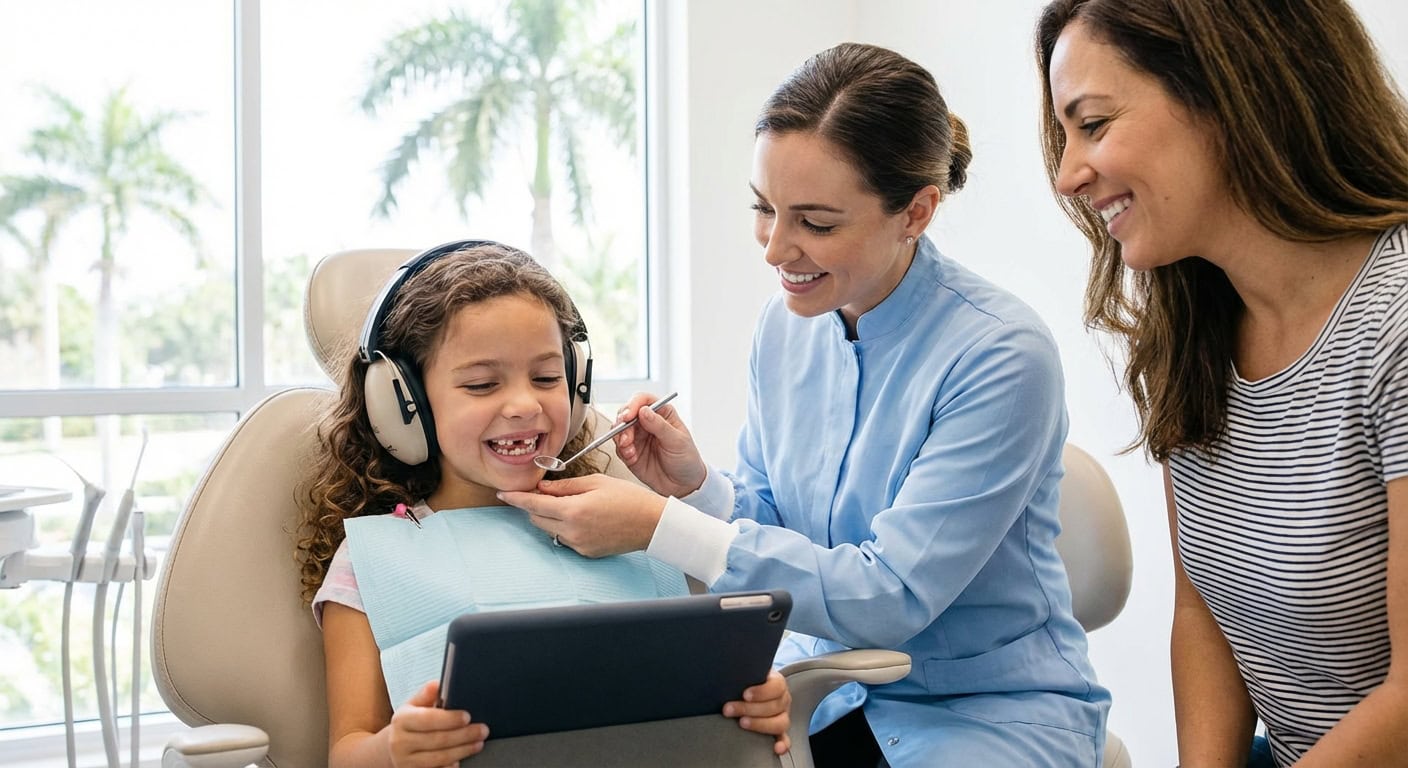
We have noise-canceling headphones, weighted blankets, on-demand TV shows, games, and snacks.
The goal isn't just moving teeth, it's building a child who trusts dental care.
When Age 7 Evaluation Shows: "Your Child Doesn't Need Treatment Yet"
This might sound backwards, but one of our most important jobs is telling parents their child doesn't need Phase 1 treatment.
That's not a missed opportunity, it's professional honesty.
And it builds trust.
We might recommend monitoring instead of treatment if:
- Crowding is mild and likely to self-correct as adult teeth come in.
- Bite patterns are within normal variation for this developmental stage.
- Habits like thumb sucking are already resolving naturally.
- Jaw growth is proportional and on track.
In these cases, we schedule regular check-ups every 6 to 12 months to watch development.
We educate you on what to observe at home.
And we explain exactly when and why we'd recommend intervention if growth changes direction.
Parents appreciate this candor.
It signals expertise, not sales pressure.
Why Families from Miramar, Pembroke Pines, Weston and Broward Choose SMILE-FX
South Florida parents understand: if you want the best care for your kids, sometimes you drive for it.
Families across Broward, from Hollywood to Davie to Fort Lauderdale, choose SMILE-FX because we specialize in pediatric and teen orthodontics with evidence-based protocols and genuine comfort.
Here's what sets us apart:
- Board-certified specialists only: Every orthodontist at SMILE-FX is board-certified. Not general dentists adding braces to their menu. This matters for complex Phase 1 cases, interceptive decisions, and long-term outcomes.
- Pediatric-designed experience: We're not a high-volume adult mill. Our office, protocols, and team are built for kids. That's not a side service, it's our specialty.
- Cutting-edge diagnostics: We use advanced imaging and digital planning so we see growth patterns clearly. Better diagnosis equals better decisions.
- Evidence-based treatment: We follow AAO guidelines and current orthodontic science. No hype. No unnecessary treatment. Smart decisions for your child's age and development stage.
- Trusted by pediatric dentists in South Florida: Local pediatric dentists refer their patients to us because they know we'll deliver. That's not marketing, that's professional respect earned through results.
Our Miramar location is centrally positioned for easy access from Pembroke Pines, Weston, Cooper City, Davie, and surrounding areas.
Most families spend 15 to 25 minutes driving.
For specialized pediatric orthodontics, that's a worthwhile investment in your child's future.
What Phase 1 Actually Costs and Payment Options
Phase 1 treatment ranges from $2,000 to $5,000 depending on complexity and length.
At your free consultation, we'll give you exact pricing for your child's situation.
We offer flexible payment plans and insurance coordination to make it manageable.
Most parents ask: will my child need braces twice, Phase 1 and Phase 2?
Possibly, but not always.
Some kids finish with Phase 1 and never need Phase 2.
Others benefit from comprehensive braces or clear aligners in Phase 2.
Every child is different.
We plan for your specific situation, not a template.
How Phase 1 Fits Into Your Child's School and Sports Life
Most Phase 1 appliances are removable or low-profile.
Your child can remove them for sports with our guidance and wear them during sleep or homework time.
We work with your family's schedule and your child's comfort level.
This flexibility means no stress about sports tournaments, school pictures, or social events.
Parents often ask: what happens if we don't do Phase 1 and wait until all adult teeth are in?
That's a valid choice.
However, you may miss the window for growth guidance, which can mean longer treatment later, possible extractions, or surgical orthodontics in severe cases.
Phase 1 is preventive, it's often easier and more efficient than waiting.
Your Action Plan: What to Do Before Age 8
If your child hasn't had an orthodontic evaluation yet, now is the right time.
Here's what to expect:
- Schedule a free consultation: No cost, no pressure. We'll review your child's development, explain what we observe, and answer your questions.
- Comprehensive evaluation: We'll take digital images and discuss findings. We explain exactly what we see and why we do or don't recommend treatment.
- A plan, not a surprise: You'll leave with clarity: either we start Phase 1 now, monitor and check back in 6 months, or wait and re-evaluate at age 9. No guesswork.
- Your questions answered: Costs, timeline, what your child will experience, how it affects school or sports, we cover it all.
Bring your child.
Let them meet our team in a calm, welcoming environment.
Let them see the office isn't scary.
This early experience shapes how they feel about dental care for life.
The Real Story: Why Phase 1 Orthodontics in Miramar Matters Beyond Straight Teeth
Orthodontics isn't vanity, it's health and development.
A child with proper bite alignment, adequate space for teeth, and correct jaw growth has:
- Better chewing efficiency and digestion.
- Clearer speech.
- Easier oral hygiene and fewer cavities.
- Better breathing and sleep quality.
- Improved confidence as they grow.
- Often, shorter and simpler treatment overall.
Phase 1 evaluation at age 7 is about catching patterns early and guiding growth intelligently.
It's not about perfection at seven.
It's about smart parenting, gathering information, making informed decisions, and giving your child the best foundation for their permanent smile.
Parents in Miramar, Pembroke Pines, Weston, Davie, Cooper City, Hollywood, and across South Florida trust SMILE-FX because we combine board-certified expertise, pediatric specialization, cutting-edge technology, and genuine care for your child's experience.
Ready to Schedule Your Child's Free Evaluation for Phase 1 Orthodontics
Book your no-cost orthodontic consultation with SMILE-FX today.
We'll evaluate your child's development, answer every question, and give you a clear plan, whether that's Phase 1 treatment, monitoring, or waiting with guidance.
No pressure.
Just expert care and honest answers.
Visit us in Miramar or schedule a virtual consultation.
Your child's smile journey starts here with the best orthodontic practice for braces, clear aligners, and Invisalign for all ages, teens, kids, and adults.
Phase 2 Orthodontics After Age 11: Completing Your Child's Smile Transformation in Miramar
Your child is now 11 or 12, all their adult teeth are in, and Phase 1 did exactly what it was supposed to do.
The foundation is set.
The jaw growth has been guided.
The crowding or bite issues that could have become major problems were addressed early.
Now comes Phase 2, where we take that solid foundation and build the smile you've both been waiting for.
Phase 2 orthodontics is about precision and finishing touches.
This is where comprehensive braces, clear aligners, or Invisalign work their magic to align every tooth perfectly, create the right bite relationship, and give your kid a smile they'll want to show off.
If Phase 1 was prevention, Phase 2 is perfection.
What Changed Since Phase 1 and Why Phase 2 Works Better Now
By age 11 or 12, your child's skeleton has matured significantly.
The soft, moldable bones of early childhood have hardened into adult bone structure.
This means we can't rely on growth to do the heavy lifting anymore.
We need stronger forces and more aggressive movement to get teeth exactly where they need to be.
Here's what's different now:
- Most or all adult teeth are erupted and visible.
- The permanent tooth structure is complete, so we see the full picture.
- Bone density is higher, allowing us to move teeth more decisively.
- Your child can better understand and follow wear instructions for removable appliances.
- Cooperation improves because they're older and can see the goal clearly.
Phase 1 set the stage.
Phase 2 closes the curtain on a transformed smile.
The Real Differences Between Braces, Clear Aligners, and Invisalign
When you walk into SMILE-FX for Phase 2 planning, your first question is usually straightforward: braces or clear aligners?
Let me be honest about what actually matters here.
Braces are the workhorse.
They're fixed to the teeth, they apply steady pressure every single day, and nothing your kid does can remove them by accident.
They're especially great for:
- Complex bite corrections.
- Severe rotations or tipping.
- Cases where compliance isn't guaranteed.
- Faster treatment timelines.
Metal braces are reliable, proven, and affordable.
We also offer ceramic braces if appearance matters more to your teen.
Clear aligners and Invisalign are the invisible option.
Your child wears custom-made plastic trays that gradually shift teeth over time.
They're removable for eating, drinking, and cleaning, which means your kid's oral hygiene stays excellent.
The catch: they only work if your child actually wears them.
We typically recommend 20 to 22 hours per day.
If your teen is responsible and won't sneak them out constantly, they love them because no one at school knows they're in orthodontic treatment.
We use advanced 3D imaging to map out the exact movements, so you see the results before treatment even starts.
For Phase 2 treatment in Miramar and Broward, here's the breakdown:
- Braces typically run 18 to 30 months depending on complexity.
- Clear aligners usually take a similar timeline but feel less intrusive day to day.
- Invisalign is essentially the premium brand of clear aligners with the most refined technology.
Your orthodontist will recommend which approach makes sense for your kid's specific situation, not what we want to sell.
Why the Age Gap Between Phase 1 and Phase 2 Matters
You might be wondering why we don't just do everything at age 7.
Great question, and the answer is science.
Between ages 7 and 11, massive growth happens.
The jaw continues to develop, teeth erupt on their own timeline, and sometimes nature fixes problems we were worried about.
That's not luck, that's biology working in our favor.
We use those years to observe, monitor, and let growth do some of the work.
Then, when growth plates have mostly closed and all adult teeth are in, we have a complete picture and can execute Phase 2 with precision.
Some families ask if they can skip Phase 1 entirely and wait until age 11 to start braces.
Technically yes, but you're leaving tools on the table.
Phase 1 often shortens Phase 2 treatment by several months.
It reduces the chance of needing tooth extractions.
It can prevent surgical orthodontics in severe bite cases.
Early intervention is like investing now to save later.
What Your Child Actually Experiences During Phase 2
If your kid did Phase 1, this won't shock them.
If this is their first orthodontic experience, here's the reality check:
The first week after braces go on or aligners start, teeth are sore.
Not agony, but a tender, achy feeling like they've been working out.
Over-the-counter pain relievers help.
Soft foods help.
After a week, most kids adapt and barely notice it.
For braces specifically:
- Monthly appointments (usually 20 to 30 minutes).
- We tighten wires and adjust brackets gradually.
- Some soreness for 24 to 48 hours after each adjustment, then it settles.
- Eating restrictions (no sticky, hard, or super crunchy foods).
- Regular brushing and flossing become non-negotiable.
For clear aligners:
- Your child changes to a new aligner every 1 to 2 weeks at home.
- Fewer appointments because the entire plan is made upfront.
- Removable, so eating and drinking normal foods stays possible.
- Higher responsibility: your kid has to remember to wear them and keep them clean.
At SMILE-FX, we use cutting-edge technology and digital treatment planning so your child sees their smile transformation before treatment even starts.
That visualization is powerful.
It keeps them motivated when their mouth is sore or they're tired of the routine.
The Timeline: How Long Does Phase 2 Really Take
Most Phase 2 treatments run 18 to 30 months.
Some finish faster, some take longer.
Here's what affects the timeline:
- Complexity of the original bite problem: Simple crowding moves faster than severe skeletal bite issues.
- How much Phase 1 accomplished: Kids who did Phase 1 usually need less Phase 2 time.
- Growth rate: Fast growers sometimes finish ahead of schedule.
- Compliance: For braces, this is less of a factor. For aligners, if your kid forgets to wear them, everything slows down.
- Bone density and tooth roots: Some people's biology responds faster to tooth movement.
Your orthodontist will give you a specific estimate during your consultation based on your kid's unique situation.
That's not a guess, it's based on thousands of cases and digital treatment mapping.
The Cost Reality of Phase 2 and Insurance Coverage
Phase 2 treatment typically costs between $3,500 and $7,500 depending on whether you choose braces or aligners and what kind of braces (metal vs. ceramic).
Many dental insurance plans cover 50% of orthodontic treatment, up to a lifetime maximum (usually around $1,500 to $2,000).
That means your family picks up the rest.
We work with you to maximize insurance benefits and offer flexible payment plans so cost doesn't become a barrier to getting your kid the best care.
Some families combine Phase 1 and Phase 2 costs and spread payments over years.
Others use FSA or HSA accounts if they have them available.
We're transparent about pricing from day one, no surprises at the end.
Common Questions About Phase 2 Success and Results
Will the results last after treatment ends?
Yes, if your child wears their retainer.
This is critical.
After braces come off or aligner treatment finishes, teeth want to shift back to where they started (that's called relapse).
A retainer holds them in place while the bone and ligaments around the teeth stabilize in their new positions.
We typically recommend wearing a retainer every night for the first year, then several nights a week long-term.
Some families choose a fixed bonded retainer on the back of the front teeth, which stays in place permanently.
This is worth the investment to protect years of treatment.
What if my child quits and doesn't want to finish treatment?
Rare, but it happens.
Usually around month 6 to 12 when the initial excitement fades and they're tired of the routine.
We talk kids through this by showing progress photos, reminding them how close they are, and adjusting treatment to be more comfortable if possible.
Stopping midway leaves teeth partially corrected, which isn't ideal.
Most families push through, and kids are grateful when they see the final result.
Can my child play sports with braces or aligners?
Absolutely.
With braces, we recommend a mouthguard during contact sports to protect the mouth and the braces.
With aligners, your kid can remove them during games and practices, which many athletes prefer.
We'll give specific guidance during your consultation based on your child's sport.
What about wisdom teeth? Do they affect treatment?
Wisdom teeth usually start coming in around age 16 to 18, well after Phase 2 treatment is done.
We monitor them and advise on whether extraction makes sense later.
They don't typically interfere with your child's corrected bite, but some orthodontists recommend extracting them preemptively to reduce crowding risk years down the line.
Why SMILE-FX Stands Out for Phase 2 Treatment in Miramar
By the time your kid reaches Phase 2, you've already invested years in their smile.
You want the finish line to be perfect.
Here's what we do differently:
Board-certified orthodontists specializing in teens and kids.
Not general dentists adding braces to their menu, but specialists trained exclusively in orthodontics.
This matters because Phase 2 requires fine-tuned decision-making about force systems, extraction decisions, and bite correction strategies.
Advanced digital diagnostics and treatment planning.
We use 3D imaging, intraoral scans, and computer modeling so your kid's entire treatment is mapped before we touch their teeth.
They see the predicted outcome.
We have a clear plan.
No guessing.
Custom treatment for each patient.
We don't have a template.
Your child's bite, growth pattern, and preferences shape their specific treatment plan.
A practice built for teens and younger kids.
Our office is designed for growing people, not adults.
Comfortable chairs, noise-canceling headphones, entertainment, and a team that speaks your kid's language.
Proven results and referrals from other dentists.
We're trusted by pediatric dentists across South Florida who refer their patients to us.
That's not marketing, that's professional respect.
Our Miramar location is easy to reach from Pembroke Pines, Weston, Cooper City, and all surrounding areas in Broward County.
The Real Cost of Not Doing Phase 2
Some families finish Phase 1 and consider stopping.
Their thinking: Phase 1 prevented the worst of it, so why spend more?
Fair question, but here's the trade-off:
Teeth that are adequately spaced but crooked look crooked.
A bite that's functional but misaligned can cause jaw pain and uneven wear on teeth over time.
And your kid's confidence matters.
A teenager with a smile they're not proud of holds back.
They cover their mouth in photos.
They don't smile as much.
It affects how they carry themselves.
Phase 2 isn't a luxury add-on, it's the completion of the work Phase 1 started.
Getting Started With Phase 2: The Consultation
If your child completed Phase 1, we've been monitoring them.
We know exactly when Phase 2 should begin.
If this is their first time working with us, we'll do a full evaluation.
You'll learn:
- Exactly what we're correcting and why.
- Whether braces, clear aligners, or Invisalign is right for them.
- Timeline expectations.
- Cost and payment options.
- What happens after treatment ends (retainers).
We answer every question you have.
No pressure to decide on the spot, but most families do because the plan is clear and the benefits are obvious.
Orthodontics for kids and teens in Miramar, Broward County, and across South Florida starts with that first honest conversation.
We work with all kinds of cases, from simple crowding to complex skeletal bites that might have needed surgery decades ago.
After Phase 2: Retention and Long-Term Care
The moment braces come off or aligners are finished, retention begins.
This is non-negotiable.
Your child wears a retainer to hold their new smile in place while bone and ligaments stabilize around the teeth.
We typically recommend:
- Full-time wear (except eating) for the first 3 to 6 months.
- Night-time only after that for at least a year.
- Several nights per week ongoing for stability.
Some families add a bonded fixed retainer on the inside of the front teeth for permanent support.
This is separate from the removable retainer and adds extra security.
The habit of wearing a retainer becomes as routine as brushing teeth once established.
Your kid doesn't miss it.
Bringing It All Together: Why Phase 1 and Phase 2 Create the Best Outcomes
The two-phase approach works.
We see it in thousands of smiles.
Phase 1 intercepted problems when bones were still growing and responsive.
Phase 2 now finishes the job with precision.
Your child ends up with:
- Teeth that are straight and properly aligned.
- A bite that functions well and looks balanced.
- Reduced risk of tooth wear, jaw pain, and future dental problems.
- A smile they're genuinely proud of.
- Confidence that radiates in photos, conversations, and how they carry themselves.
This isn't just about aesthetics, though that matters.
It's about oral health, function, and the psychological boost of liking your own smile.
SMILE-FX Orthodontic & Clear Aligner Studio is the premier choice for comprehensive orthodontic care for all ages, from Phase 1 interceptive treatment through complete Phase 2 transformation.
We specialize in braces, clear aligners, and Invisalign for kids, teens, and adults in Miramar and throughout Broward County.
Our board-certified orthodontists use cutting-edge technology and pediatric-focused protocols to deliver results that last.
Your child's smile transformation doesn't happen by accident.
It happens through expert planning, consistent care, and a practice that genuinely cares about their experience.
Book your free 3D scan and VIP smile consultation here.
We'll evaluate your child's development, explain Phase 2 options, show you projected outcomes, and give you a clear path forward.
No pressure, no sales pitch, just expert orthodontic care for braces, clear aligners, and Invisalign treatment for teens, kids, and adults in Miramar, Pembroke Pines, Weston, and all of Broward County.
Your child's best smile is waiting.
Keeping Your Child's Smile Healthy Between Orthodontic Appointments in Miramar
Your kid is in braces or aligners now, and you're wondering what happens between those monthly visits.
The truth is, what your child does at home matters way more than what we do in the chair.
We can move teeth, but you're the one making sure they stay clean, the wires don't snap, and the whole process doesn't derail because someone got lazy with brushing.
This is the stuff nobody really talks about, but every parent of a kid in orthodontic treatment needs to know.
The Daily Routine That Actually Protects Your Investment
Let's be real, orthodontic treatment costs money and time.
You've already made the call to invest in your kid's smile through Phase 1 and Phase 2.
Now you want to make sure nothing goes sideways in between appointments.
The secret isn't complicated.
It's just consistency.
With braces, your child needs to brush after every meal and snack.
Not a quick rinse, but an actual two-minute brushing session where they get around the brackets and under the wires.
An electric toothbrush works better than a manual one because it does more of the work.
Flossing gets tricky with braces in the way.
We recommend using a water flosser or threader floss that your kid can get between teeth without fighting the hardware.
Skip this step and you're asking for cavities, which means emergency dental visits and delayed treatment.
With clear aligners or Invisalign, it's actually simpler.
Your child removes the trays, brushes normally, and puts them back in.
But here's where compliance matters: if they're not wearing the aligners the recommended 20 to 22 hours per day, treatment slows down and timelines slip.
We see this constantly.
A kid who wears their aligners faithfully finishes on schedule.
One who leaves them in the backpack finishes six months late.
What Foods Are Actually Off Limits and Why It Matters
Braces have enemies.
Sticky foods like caramel, taffy, or gum can bend wires and pop brackets off.
Hard foods like nuts, hard candy, or corn on the cob can break brackets too.
Crunchy foods like carrots, popcorn, and ice chips are problems because the force needed to bite through them transfers straight to the bracket.
We give families a full list at their first appointment, and honestly, most teenagers adjust faster than parents think they will.
They find alternative snacks, eat softer versions of their favorite foods, and move on.
The ones who cheat and snap a bracket?
Now they're scheduling emergency appointments and pushing back their finish date.
With clear aligners, food restrictions aren't an issue because they come out to eat.
That's one of the reasons some families prefer them.
When Something Goes Wrong and How to Handle It
Brackets break.
Wires pop out.
Things happen.
If your kid has a bracket emergency, call us right away, even if it's between regular appointments.
We can usually fit them in the same day or next day, depending on the issue.
A popped bracket that goes untreated for weeks throws off your whole treatment timeline, so don't wait and hope it fixes itself.
Some emergencies are minor and can wait until the next scheduled visit.
A wire sticking out that's poking the cheek?
That's annoying but not urgent.
A broken bracket affecting multiple teeth?
That needs attention soon.
We give every patient instructions on what to do if something breaks, how to reach us, and what counts as an emergency versus something that can wait.
Insurance, Payment Plans, and Affording the Full Journey
Parents always ask the same thing: does insurance cover braces?
The answer is: sometimes, kind of.
Most dental insurance plans cover somewhere between 40 and 60 percent of orthodontic treatment, with a lifetime maximum usually capping out around $1,500 to $2,000.
That means if your kid's treatment costs $5,000, insurance picks up maybe $1,500, and your family covers the rest.
We work with your insurance to maximize what they'll pay, file all the paperwork for you, and then offer flexible payment plans to make the remaining balance manageable.
Many families pay monthly over 24 months or longer.
Some use FSA or HSA accounts if available.
The point is, cost shouldn't be the reason your kid doesn't get the smile they deserve.
We offer $0 down financing options and work with families across South Florida on Affordable Braces and Invisalign pricing.
At your consultation for a FREE 3D scan and VIP smile assessment, we'll show you exactly what your family's out-of-pocket cost looks like and what payment plans fit your budget.
Keeping Appointments and Staying on Timeline
This sounds obvious, but you'd be shocked how many families miss appointments and then wonder why treatment takes longer than expected.
Orthodontic treatment is a timeline.
Missing appointments by months throws off the whole schedule.
We book patients out in advance because we need to see them on a regular schedule to adjust wires, change aligners, and monitor progress.
Life gets busy, I get it.
But even a single missed appointment can add weeks to your kid's treatment.
Build appointments into your calendar the way you would school or sports.
Set phone reminders the week before.
Block out 30 minutes for a braces adjustment.
These small habits keep everything moving forward.
Dealing With Discomfort and Mouth Soreness
The first week after braces go on, your kid's mouth will be sore.
The first week with new aligners, same story.
That's normal.
Over-the-counter pain relief like ibuprofen helps.
Soft foods for a few days helps.
Rinsing with warm salt water reduces inflammation.
By day 10, most kids stop mentioning it.
Their mouth adapts, the soreness fades, and they get back to normal eating and talking.
If soreness lasts longer than two weeks or gets worse instead of better, call us.
That's not normal and we need to adjust something.
Bracket sores or wire pokes can be fixed by us during an appointment.
In the meantime, dental wax on a bracket or wire reduces irritation to the inside of the cheek.
Speech and Sports: Common Worries That Fade Fast
Parents worry their kid will have a lisp with braces.
Some teenagers do, briefly.
Most adapt within a week or two and sound completely normal.
We've never seen permanent speech changes from orthodontic treatment.
Sports is easier than most families expect.
With braces, we recommend a mouthguard during contact sports.
It protects both the teeth and the braces, and honestly, any athlete should wear one anyway.
With aligners, your kid can take them out during games and practices, which many young athletes prefer.
Put them back in after the game.
Training and conditioning don't need the aligners in, just games and practices.
Clear Aligners vs Braces: Managing Them Day to Day
We work with all kinds of patients, and the choice between braces, clear aligners, or Invisalign comes down to lifestyle and compliance.
With braces, your kid can't lose them or forget to wear them.
They're bonded to the teeth for the whole treatment.
The trade-off is food restrictions, more careful brushing, and visibility.
With aligners, responsibility is on your kid.
They have to remember to wear them.
They have to keep them clean.
They have to not accidentally leave them at a friend's house.
For a responsible teenager, this is way better.
For a kid who loses their phone three times a week, braces might be the smarter choice.
Finding the Best Orthodontist for Your Family's Needs
Choosing who treats your kid matters.
You want a board certified orthodontist who specializes in kids and teens, not a general dentist adding braces to the side.
You want someone who uses cutting edge technology and treats your family like people, not appointments.
SMILE-FX Orthodontic and Clear Aligner Studio is the Top Rated Orthodontist in Miramar and across Broward County because we do both.
We're board certified specialists who focus exclusively on orthodontics for kids, teens, and adults.
We use advanced 3D imaging and treatment planning so you see exactly what your kid's smile will look like before treatment even starts.
We offer Invisalign, clear aligners, and braces for all kinds of cases, from simple crowding to complex bite problems.
Our Miramar location is easy to reach from Pembroke Pines, Weston, Cooper City, and surrounding areas.
Most families spend 15 to 25 minutes driving, which is worth it for specialized care you can trust.
The Long Game: What Happens After Treatment Ends
The day braces come off or your kid finishes their aligner series, that's not the finish line.
It's the start of retention.
Your child wears a retainer to hold their new smile while the bone and ligaments around the teeth stabilize.
Teeth want to shift back to where they started, and a retainer stops that.
We typically recommend full-time wear for the first few months, then several nights per week long-term.
Some families add a bonded fixed retainer on the back of the front teeth for permanent support.
Retainer compliance matters just as much as treatment compliance.
Skip it and you'll watch your kid's smile gradually shift back to how it was.
Your Next Step: Book a Consultation for the Best Orthodontist Near You
Whether your kid needs Phase 1 interceptive treatment, Phase 2 comprehensive orthodontics, or you're starting from scratch, the first step is a proper evaluation.
Book your FREE 3D scan and VIP smile consultation here.
We'll show you exactly what treatment looks like, what it costs, how long it takes, and answer every question your family has.
No pressure, no sales pitch, just honest expert care from the Best Orthodontist for Kids South Florida and the Top Rated Orthodontist Near Me you can trust.